Of all the categories of corporate learning, technical training is the one that fails most consistently. A team is hired into roles that require specific technical skills. The skills are either not yet at the level the role needs, or the technology stack has shifted and the team needs to catch up. The company buys a training programme to close the gap. Six months later, the gap is still there. The team completed the course. The skills did not transfer.
This pattern is common enough across organisations that it should be more discussed than it is. Generic technical courses from large vendor catalogues do not produce engineers, analysts, or designers who can apply the skills in their actual work. The reason is not that the learners are not capable. It is that the format of the training is built for completion, not capability, and technical skills are particularly resistant to being taught through formats designed primarily for completion.
Why technical training fails more often than other types
Most corporate learning content can survive being delivered passively. A compliance module on company policies can be watched, absorbed at the conceptual level, and applied later because the application is not particularly skill-dependent. The learner needs to know the policy. They do not need to develop a new motor skill to apply it.
Technical training is different. The gap between knowing how to do something and being able to do it is enormous, and it can only be closed through deliberate practice. A learner who watches a course on a programming language and never writes code in it has not actually learned the language. They have learned about the language, which is a different and significantly less useful thing. The same applies to data analysis tools, design software, cloud platforms, financial modelling, or any domain where the skill is fundamentally about doing rather than knowing.
What generic vendor courses tend to get wrong
A few patterns appear consistently in technical training that does not transfer to capability.
Outdated examples. Technology moves quickly and the examples in a course can be two or three versions behind the tools the learner is actually using. The principles may still be valid, but the gap between the example and the learner's reality creates friction every time they try to apply what they have learned.
No actual practice. The course explains concepts, shows demonstrations, and tests recall with multiple choice questions. The learner never writes a line of code, builds a model, runs a query, or produces an artefact in the tool they are supposedly learning. Without practice the skill does not form.
Scenarios that do not match the company's real stack. A learner working on a specific company's data pipeline does not benefit from generic examples that assume a different infrastructure. The translation from course example to actual work is a significant cognitive load that often does not happen in any meaningful way.
Instructors who explain rather than show. The course is recorded by someone articulate and knowledgeable. They walk through concepts clearly. They do not pair-program with a struggling learner. They do not debug live code. The learner never sees what real problem-solving looks like in the tool, only polished explanations of how it works.
A learner who has watched ten hours of technical content and never produced anything in the tool has not learned the tool. They have learned what watching content about the tool feels like.
What good technical training actually looks like
Technical training that produces capability has a few features in common. None of them are exotic. All of them are harder to scale than passive video content, which is why they are not the default.
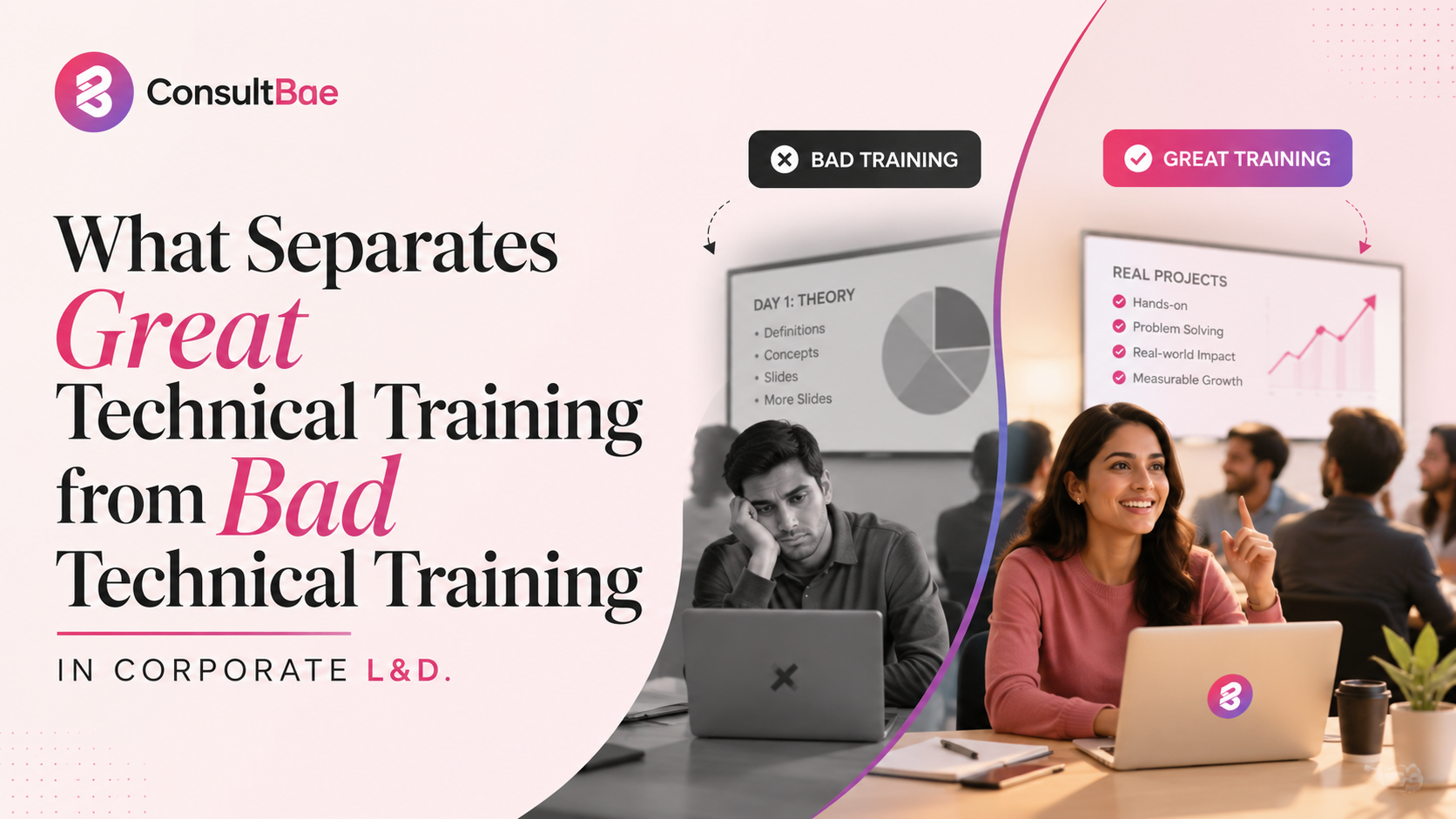
Hands-on labs are central, not peripheral. The learner is writing, building, or producing throughout the programme. The labs are graded or reviewed in ways that provide real feedback, not just acceptance based on whether the output runs.
Real codebases or comparable artefacts are used where possible. Working with an actual code repository, even a sanitised version, is closer to the work the learner will do than working with abstract textbook examples. The friction of navigating a real codebase is itself part of the skill being developed.
Project-based assessment is used instead of multiple choice. The learner builds something. The thing they built is the evidence of whether they learned. This requires more from the assessment design and more from the people grading it, but it is the only assessment format that actually measures what the programme was meant to develop.
Instructors can pair with learners on real problems. Not necessarily for every learner, but the option exists. When a learner is stuck on something that does not appear in any course material, there is someone they can work through it with. This is where most learning actually happens in technical work, and most corporate training is built to avoid it.
Why this is hard to scale and why most L&D teams default to easier formats
Building technical training that works at the level described above is operationally heavy. Hands-on labs require infrastructure and content development. Project-based assessment requires people who can grade real artefacts. Pair-programming or comparable mentorship requires available instructors with both technical and pedagogical capability. None of this is impossible. All of it is more expensive per learner than a video course on a generic platform.
Most learning and development teams have budget structures and headcount that make the high-touch model difficult to scale across a workforce. The default becomes generic video courses because they fit the available resources, even when everyone involved knows the format is not producing the outcomes the organisation needs.
Hands-on labs throughout the programme, not just at the end. Examples and exercises that map to the technology stack the learner actually uses. Project-based assessment that produces evidence of capability rather than recall. Instructors available for real problem-solving, not just recorded explanations. Reinforcement after the initial course that connects to real work. Measurement focused on capability transfer, not on completion rates.
How ConsultBae approaches technical training
Our technical training tracks are built around what actually works in this category. We work with subject matter experts who can pair with learners, not just record polished explanations. We design hands-on labs into the structure of every track. We use project-based assessment where the artefact the learner produces is the evidence of learning. And we tailor examples to the client's actual technology environment wherever the engagement allows.
This approach is more operationally intensive than generic video courses. It is also significantly more likely to produce engineers, analysts, or designers who can apply the skills in their work. The alternative is paying for completion certificates that do not translate to capability, which is what most organisations are doing now and what most organisations are not satisfied with.
The technical skill gap is real and costly. The training built to close it should be designed for capability, not completion. The two formats look superficially similar and produce fundamentally different outcomes.
Shivani Agarwal leads the E-Learning vertical at ConsultBae, overseeing end-to-end course production across technology and non-technology domains.
Building technical training that needs to actually work?
ConsultBae designs technical training around capability, not completion. Let us talk about what your team needs to be able to do.
Talk to us