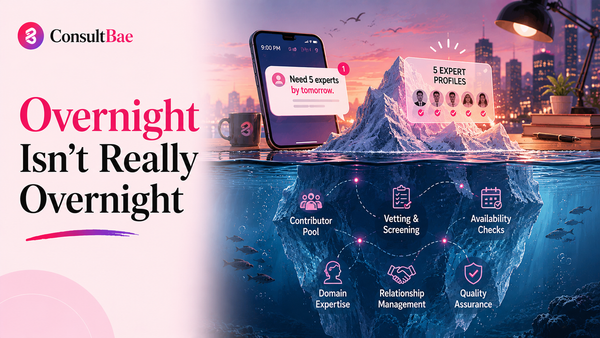

Whenever a large e-learning project misses a deadline, the first instinct is to blame the process. Something in the workflow must have failed. In my experience it almost never has. We act as a sourcing partner on one part of a much larger machine, and when delivery breaks on our side, the reason is nearly always the same. It is the people, and more precisely, whether the person we onboarded is still there when the work is actually assigned.
That distinction matters, because it changes what you do to prevent it. A broken process gets fixed with a better checklist. A people problem gets solved much earlier, before the project even starts.
People break before the process does
For a course to move from an idea to something live, a lot has to happen. It has to be structured, an instructional designer has to work on it, internal teams have to take in feedback and run it, and only then does it move to video production. We plug into one step of that, sourcing the subject matter experts who validate the content. So when I look at what fails, it is rarely the sequence of steps. It is that an expert we lined up is suddenly not responding, or is no longer available to work.
That is not a small caveat. These are not full-time employees you can hold to a schedule. They are experts with day jobs who agreed to contribute, and the moment their availability shifts, your delivery shifts with it.
The gap that quietly kills delivery
Here is the mechanism behind most of it. On large projects, we onboard people in bulk before the project starts, but the work gets assigned in smaller batches over time. That creates a lag between the day someone signs on and the day their course actually lands on their desk. Sometimes that gap is two months.
A lot changes in two months. The expert has taken another freelancing project, or joined somewhere full-time and no longer has the bandwidth, or, just as often, they have simply stopped taking you seriously because so much time passed with no work. I think of it as the recency factor. When it is missing, people drift, and when the work finally arrives they either do not respond or realise it is not something they want to do after all. The process ran exactly as designed. The person at the end of it was gone.
Why we over-hire on purpose
The obvious question is why we onboard everyone up front instead of hiring in small batches as we go. It looks wasteful, and the dropout does cost us. But it is a deliberate trade, and it comes down to which risk you would rather carry.
Imagine a build of two hundred courses. If I onboard experts for all two hundred before kickoff and then lose availability on twenty or thirty of them, that is an impact I can absorb and manage. If instead I onboard for only fifty, start the project, and fail to find people for the next fifty just in time, the entire delivery collapses. So we plan the whole thing before we begin, and we line up at least two to three experts per course rather than one. Sometimes luck is genuinely bad and all three fall through for a single course, and we still get caught. But kick-starting a project without every resource already in place is a far bigger risk than over-hiring. That is a trade I will make every time.
Kick-starting a project without every resource already in place is the biggest risk of all.
Trust is the real onboarding
The hardest part of managing a hundred freelancers is not the work itself. It is the very beginning, when they do not yet know who you are. There is so much fraud online that reaching out to a stranger with an offer is met with suspicion, and reasonably so. Building that first bit of trust is the real onboarding, and it takes time.
Once it is there, everything gets easier. When people see that your invoicing is fair, your payments arrive on time, and they do not have to chase you, they stop treating you like a client and start treating you like a support partner, someone who will voice their concerns and cover for them. That is when a project becomes smooth. Some of the experts from our very first project have now worked with us across five or six more, and one of them picks up any AI or ML course I send without even asking about payment, because he already knows it will be fair. That kind of trust is worth more than any process document.
The coordination nobody sees
The part that keeps a project alive is unglamorous. It is being reachable. Even though project management is not formally our job, if an expert has a question about a submission or a payment and no one answers, they simply stop working until it is resolved. The delivery window between the expert and the client can be as tight as forty-eight hours, so if I miss replying to someone for even twenty-four, it hits the deadline directly.
And because we hire across the globe, someone has to be available in both the India and the US time zones, because a query left overnight is a day of delivery lost. None of this shows up in a workflow diagram. It is just the quiet, constant work of making sure the people you sourced are still with you by the time the work arrives. Get that right, and the process takes care of itself.
Provision two to three experts per course before kickoff, not one, and not just in time.
Keep the relationship warm through the lag between onboarding and assignment, so people do not drift.
Staff coordination across every time zone your experts sit in, not only your own.
Answer queries inside twenty-four hours. On a forty-eight-hour delivery window, silence is a missed deadline.
About the author
Shivani Agarwal leads the e-learning vertical at ConsultBae, where she sources and manages the subject matter experts behind large course builds. She spends most of her time on the part of delivery that no workflow captures, keeping people available and reachable from onboarding to the final submission.
The workflow is the easy part. Keeping the people is the job.
If you are building courses at scale, tell us the experts you need and the timelines you are working to, and we will provision and manage them so your delivery does not depend on luck.
Talk to our e-learning team