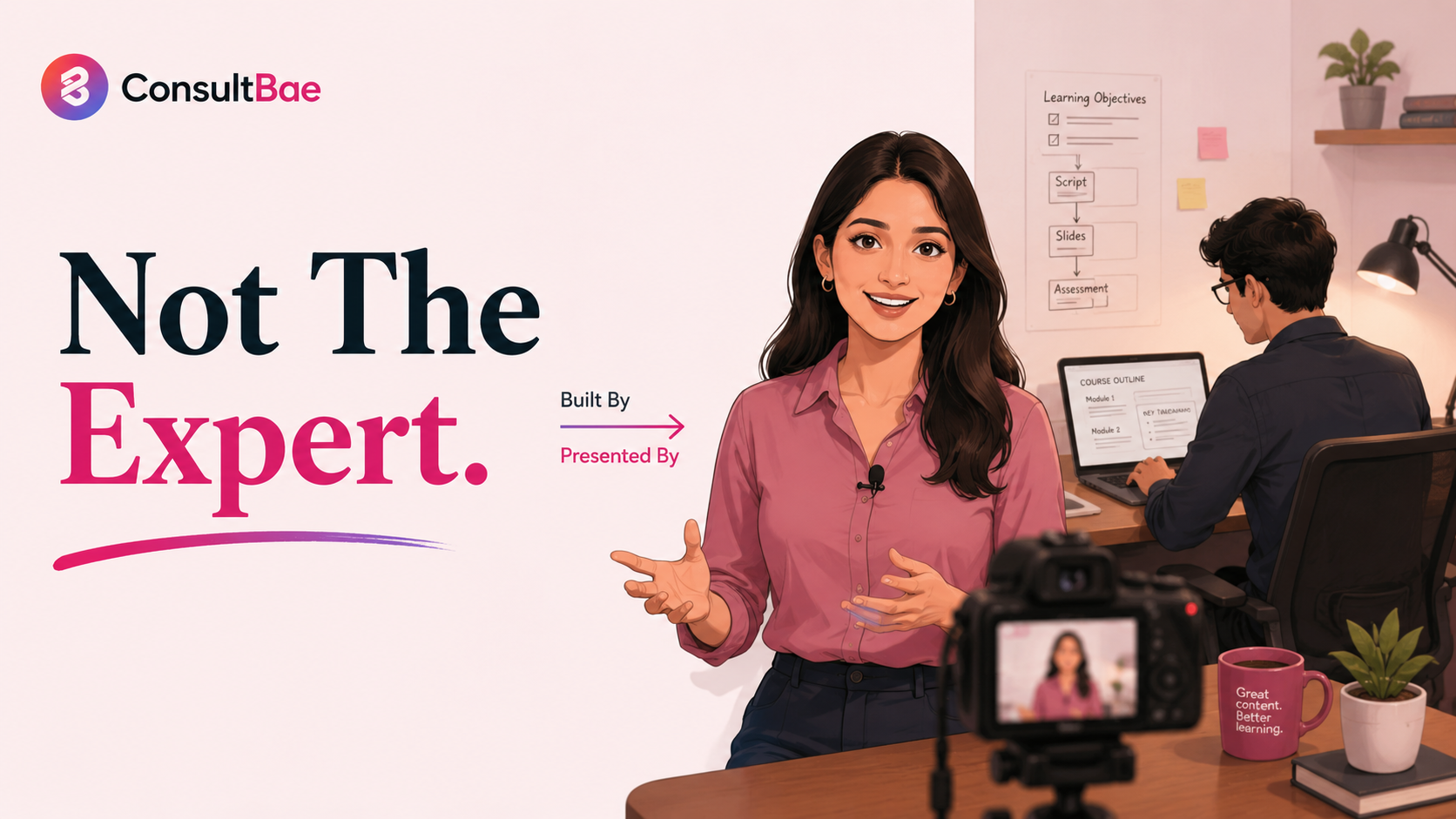
There is a reasonable assumption that the person explaining a certification course to you on screen is the person who built it. They speak with confidence about the topic. Their name and photograph appear on the platform page. The course is structured around their expertise. It is a natural inference, and it is wrong in more cases than most learners realise.
Across major certification platforms, roughly 30 to 40 percent of visible course instructors are genuine subject matter experts who built the content and are delivering it themselves. The remaining 60 to 70 percent are professional actors, user-generated content creators, or voiceover artists who are delivering content that was designed by someone else. This is not a criticism of those courses. The production split exists because the skills required to build a credible course on a technical subject are genuinely different from the skills required to deliver it compellingly on camera, and finding a single person who excels at both is considerably harder than sourcing each skill separately.
Understanding this split matters for anyone making production decisions. Not because one approach is better than the other in general terms, but because the right choice depends on specific factors about the course, the audience, and the type of credibility the content needs to carry.
What the 30 to 40 Percent Split Actually Means
The split is a product of a practical reality in course production: domain expertise and on-camera performance are different capabilities that rarely reach excellence in the same person simultaneously. A cardiologist who has spent twenty years developing clinical judgment about a specific procedure knows things about that procedure that no actor or content creator can replicate. But they may speak in a way that is technically dense, move through concepts too quickly, or present with a flatness of affect that makes it genuinely hard to stay engaged across a thirty-minute module.
Conversely, a professional presenter who has built their career on communicating technical content accessibly and engagingly on screen may have no domain knowledge at all. Their value is entirely in the delivery, and their delivery is precisely what makes a learner feel that they are in the presence of someone who can explain things clearly. The content they are delivering came from someone else entirely. The credibility of the explanation comes from the professional's ability to embody understanding they were given rather than understanding they developed.
Neither of these is dishonest as a production choice. It is standard practice, recognised across the industry, and the quality of the final course depends on how well the production team manages the handoff between the person who knows and the person who communicates. What determines whether the split works is the quality of the alignment between the subject matter expert's input and the professional talent's delivery.
When the Subject Matter Expert Should Be on Camera
The clearest case for putting the subject matter expert on camera is when the credibility of the content is inseparable from the credibility of the person delivering it. In domains where the learner needs to trust that the person explaining the material has actually done the work at a professional level, the visible presence of a practitioner carries weight that professional talent cannot replicate. A surgeon explaining a clinical decision-making framework, an engineer demonstrating a specific technical workflow in a live environment, a financial analyst walking through a real modelling approach: in each of these cases, the practitioner's natural fluency with the material, the specific vocabulary they use, the way they handle complexity without oversimplifying, are part of what makes the course credible.
Tool demonstration videos are a particularly strong case for expert delivery. When a subject matter expert demonstrates a software tool by performing a real task they actually use in their professional work, the authenticity is visible in the naturalness of their navigation: they know where the features are because they use them regularly, not because they memorised a script. This is something professional talent cannot produce without extensive preparation, and even with preparation, the rehearsed quality of a demonstration built from a script differs from the fluent quality of someone showing how they actually work.
The limitation of expert delivery is the camera presence problem. A subject matter expert who is excellent in their professional domain and comfortable in a one-on-one teaching context may become visibly uncomfortable in front of a camera in a way that does not fully resolve with coaching. The discomfort shows in ways that affect the learner's experience: a stiffness in delivery, an inability to maintain natural eye contact with the lens, a tendency to read from notes in a way that breaks the sense of direct communication. When these factors are present, the case for expert delivery weakens regardless of how deep the domain knowledge is.
When Professional Talent Produces a Better Learning Experience
Professional talent, whether an actor, a presenter, or a user-generated content creator with a strong established screen presence, produces a better learning experience when the primary requirement is engagement and accessibility across a broad audience. For certification courses that need to work for learners across different professional backgrounds, different levels of prior knowledge, and different levels of patience for dense technical content, a skilled communicator who can pace the explanation thoughtfully and maintain the learner's attention across a full module is often the more effective choice than a subject matter expert whose delivery is excellent in the right context but uneven on screen.
Professional talent also works well for courses that need to project a global standard of delivery quality, which often means a neutral accent, a consistent energy level across multiple recording sessions, and the ability to handle revision requests without the scheduling complexity of working around a practitioner's primary professional commitments. These are practical production advantages that compound when the course catalogue is large and the production timeline is tight.
The limitation of professional talent delivery is the loss of the authentic practitioner signal. A learner in a specialised field may notice that the course instructor does not speak quite like a practitioner would, uses terms slightly differently from how they appear in professional contexts, or handles edge cases in ways that feel more scripted than experienced. This signal is harder to detect in general-audience courses and more noticeable in expert-audience ones, which is why the delivery choice needs to be calibrated against who is actually taking the course.
"About 30 to 40 percent of the instructors you see on screen are actual subject matter experts delivering the courses they built. The rest are professional actors and talent. Both can produce excellent courses. The choice depends on what the course actually needs to be credible to the people taking it."
The User-Generated Content Creator as a Distinct Third Option
Between the subject matter expert and the professional actor sits a third delivery profile that has grown significantly as a sourcing option in recent years: the user-generated content creator. This is a person who has built an audience through their own online content, who is comfortable on camera, who communicates technical or professional content in a natural and accessible way, and who in many cases has genuine domain knowledge or professional experience in the subject area they cover.
The user-generated content creator occupies a specific and useful middle ground. They are not a polished professional actor with no domain knowledge. They are not a domain expert with no camera presence. They are a practitioner-communicator whose existing audience has already confirmed that their way of explaining things works for the type of learner the course is trying to reach. For courses targeting audiences who already follow this type of content, the creator's established presence adds a layer of audience trust that neither professional actors nor unfamiliar subject matter experts can replicate.
The sourcing challenge with user-generated content creators is specificity: the domain needs to match the course content, the communication style needs to match the platform's quality standards, and the creator's schedule and commercial expectations need to be compatible with a course production process that typically requires multiple recording sessions, revision rounds, and timeline commitments that independent content creators are not always structured to meet. These are solvable problems, but they require a different sourcing approach from both professional talent recruitment and subject matter expert sourcing.
How to Make the Delivery Decision Before Production Begins
The delivery decision, whether the course is presented by the subject matter expert, by professional talent, by a user-generated content creator, or by some combination, is most productively made before production begins rather than after the content is built. Making it late forces the production team to adapt content that was created with one delivery profile in mind to a different one, which rarely produces the best result for either the content or the delivery.
The primary question to answer is who is taking the course and what they need from the instructor's visible presence. An expert audience taking an advanced certification in a technical field is more likely to notice and value the practitioner authenticity that subject matter expert delivery provides. A broad professional audience taking a foundational course on a widely used tool is more likely to benefit from the accessibility and engagement quality that professional talent provides. The audience profile determines the credibility requirement, and the credibility requirement determines the delivery profile.
The secondary question is what the content requires specifically. Does this course include tool demonstrations that need to look like authentic professional use? Subject matter expert delivery or user-generated content creator. Does it need to project consistent global quality across a large course catalogue with multiple recording sessions? Professional talent. Does it need the combination of domain credibility and established audience trust that an expert-communicator can provide? User-generated content creator with relevant domain experience.
Subject matter expert: Best for courses where practitioner authenticity is the primary credibility signal. Tool demonstrations, advanced technical content, and courses for expert audiences who would notice the difference between a practitioner and someone performing expertise. Requires camera presence coaching and should be reserved for experts who can perform adequately on screen without it becoming a production problem.
Professional actor or presenter: Best for broad-audience courses where engagement and accessibility are the primary delivery requirements. Large-scale course catalogues, courses targeting learners across varying levels of prior knowledge, and situations where production consistency across many sessions matters more than practitioner authenticity. Requires strong subject matter expert input upstream to ensure the content being delivered is accurate and appropriately framed.
User-generated content creator: Best for courses targeting audiences who already consume this type of content and where the creator's established presence adds audience trust that neither actors nor unfamiliar experts can replicate. Requires careful sourcing for domain alignment and production-compatible working arrangements, but produces a credibility and engagement combination that the other profiles individually cannot achieve.
The production decision that gets made before the first camera rolls determines a great deal about the quality of what the learner experiences at the end. A course built with the right delivery profile for its specific audience and content type will outperform a technically superior course built with the wrong one, because the learner's engagement with the material depends on the delivery in ways that the content quality alone cannot compensate for.
Need the Right Delivery Profile for Your Course?
ConsultBae sources subject matter experts, professional actors, voiceover artists, and user-generated content creators for e-learning platforms across 40 plus domains. We match the delivery profile to the course requirement, not to whatever is easiest to find.
Talk to Our E-Learning Team