- What localisation means beyond translation
- The dubbing artist's role and what makes them different from a voiceover artist
- Domain vocabulary and why a fluent translator is not always the right choice
- Quality review in the target language and who does it
- What the demand for localised courses looks like right now
A certification course that performs well for English-speaking learners does not automatically perform well when the same content is delivered in Hindi, Marathi, or Telugu. This sounds obvious when stated directly. In practice, the production decisions made during original-language course creation frequently embed assumptions about language, pacing, cultural reference, and domain vocabulary that create real problems when the course is adapted for a different linguistic market.
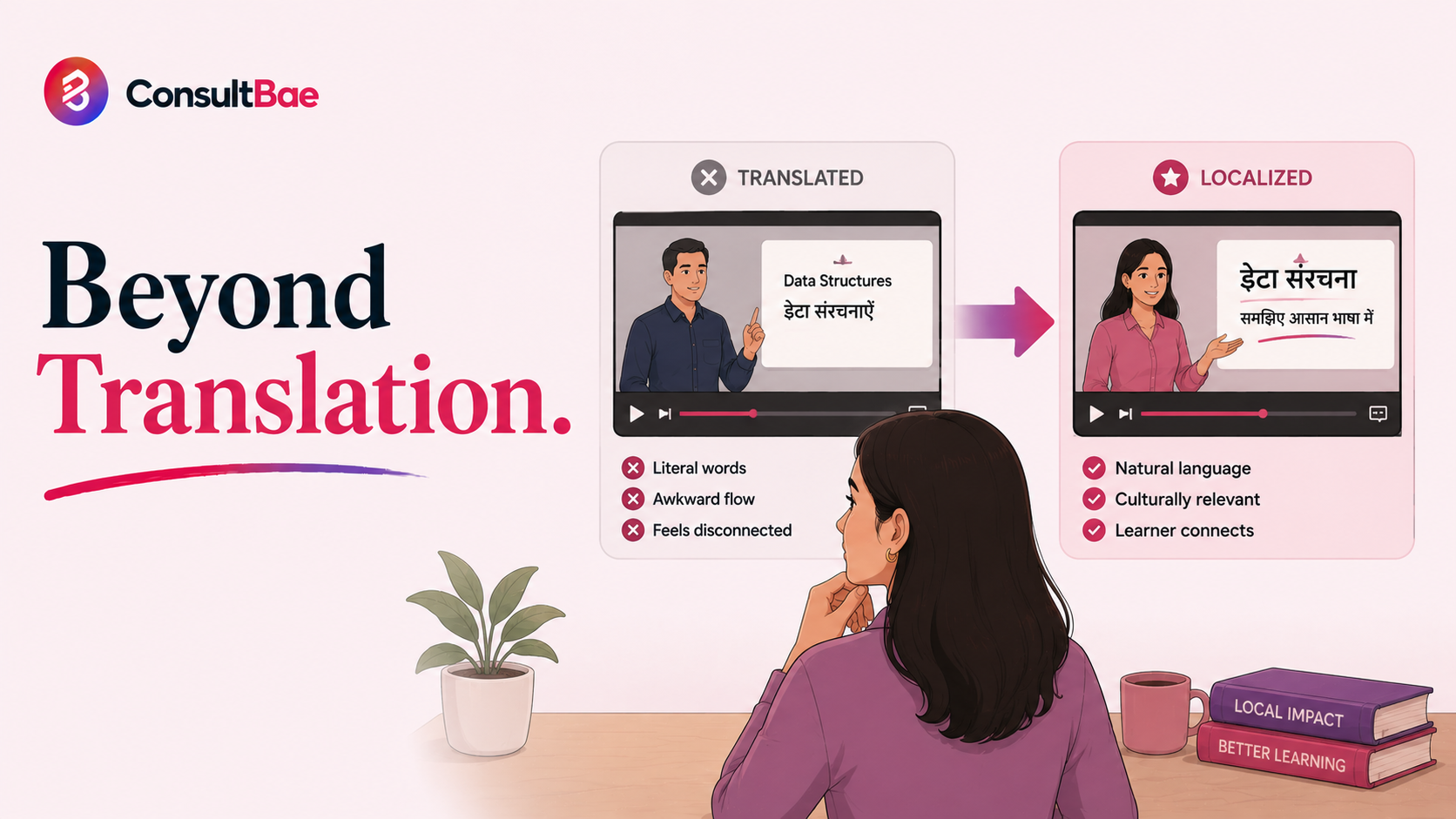
Translation handles the words. Localisation handles everything else: the pace of delivery, the cultural appropriateness of examples, the domain vocabulary as it is actually used by practitioners in the target language, and the quality of the audio recording in a way that meets professional standards for that market. Getting the words right is necessary. It is not sufficient, and confusing the two is what produces localised courses that are technically complete but practically less effective than the original for the learners they were built to serve.
As platforms expand their course catalogues into regional and vernacular languages, the demand for localisation as a distinct production capability, rather than translation as an add-on step, is growing. Understanding what that production capability actually requires is the starting point for any platform that wants to serve multilingual audiences without degrading the quality of the learning experience in the process.
What Localisation Means Beyond Translation
Translation is the conversion of written text from one language to another. Localisation is the adaptation of a piece of content so that it functions naturally and credibly for an audience in a specific linguistic and cultural context. The distinction becomes most visible in spoken content, which is what most certification courses involve.
When a course module is delivered by an on-camera instructor or through narration over a screen demonstration, the original production was paced, toned, and cadenced for a specific language. The instructor's natural speaking rhythm in English is different from the rhythm that feels natural in Hindi. A sentence that takes eight words in English may require twelve in Marathi to convey the same meaning with the same clarity. A cultural example that is immediately accessible to an English-speaking learner may require substitution or explanation for a learner whose professional context is different.
None of these adjustments happen through translation alone. They require a producer who understands both the original content and the target audience well enough to make judgment calls about what needs to be preserved exactly and what needs to be adapted to function correctly in the new context. This is a different skill from linguistic fluency, and it requires a different type of contributor.
The Dubbing Artist's Role and What Makes Them Different From a Voiceover Artist
A voiceover artist provides audio narration for content that does not have a visible speaker: screen demonstrations, animated explainers, text overlays read aloud. Their value is voice quality, clarity of diction, and the ability to maintain consistent tone across a recording session. They are not required to match the timing of existing audio or the movement of an on-screen speaker's mouth.
A dubbing artist works under an additional constraint: the audio they record must match the timing and rhythm of the original speaker's delivery closely enough that the lip movement visible on screen does not feel disconnected from the audio the learner is hearing. This constraint is technically demanding in a way that voiceover work is not. It requires the dubbing artist to deliver the translated content in a way that fits the original pacing, which sometimes means compressing or expanding the delivery to match timing windows that the target language does not naturally produce.
In practice, most e-learning localisation sits between full dubbing and simple voiceover: the original video may show the speaker but the expectation for synchronisation is lower than in film dubbing, while still requiring the audio to feel natural and appropriately paced rather than cramped or padded to fit. Finding artists who can work in this middle register, who can deliver natural, professional audio in the target language while being guided by the structure of the original, is a sourcing challenge that is distinct from standard voiceover recruitment.
"The same course that works beautifully in English can feel rushed, stilted, or disconnected when localised if the production choices upstream were only optimised for the original language. Localisation is not the last step. It has to be considered from the first one."
Domain Vocabulary and Why a Fluent Translator Is Not Always the Right Choice
Certification courses in technology, finance, healthcare, and other professional domains use vocabulary that has specific meanings in professional practice. These meanings are often not captured by the standard translation of the English term, because the way practitioners in a given field describe their work in Hindi, Marathi, or Gujarati may use different words entirely, or may use a mix of English technical terms and vernacular language that reflects how professionals in that context actually communicate.
A fluent translator who is not a practitioner in the relevant domain will produce a technically correct translation that may sound foreign to practitioners in the target market. The translated course will be linguistically accurate and professionally unconvincing, which is a specific kind of quality failure that is harder to detect in review than an obvious translation error but more damaging to the learner's trust in the course content.
The solution is not simply to hire a practitioner to translate: practitioners are often not professional translators and the quality of their translation may be inconsistent even when the domain vocabulary is right. The solution is to use a professional translator as the primary producer and a domain practitioner as the reviewer, specifically for the vocabulary and phrasing that determines whether the course sounds like it was written by someone who actually does the work or by someone who read about the work and translated the description of it.
Quality Review in the Target Language and Who Does It
The quality review step in original-language course production involves checking the content against the source material, the platform's standards, and the subject matter expert's validation notes. In localised production, there is an additional review layer: a check by a fluent speaker of the target language who can evaluate whether the localised version is coherent, natural, and professionally credible to the audience it is intended for.
This reviewer is not evaluating translation accuracy in the academic sense. They are evaluating the experience a learner in the target market will have when they take the course: whether the pacing feels natural, whether the vocabulary is appropriate for the professional context, whether the dubbing or narration is delivered in a way that builds the learner's confidence in the content rather than distracting from it with production choices that feel mismatched.
Finding this reviewer requires sourcing someone who combines linguistic fluency in the target language, professional familiarity with the course's domain, and the ability to evaluate production quality with enough specificity to give feedback that can be acted on. This is a different profile from any of the production roles in the original-language workflow, and it needs to be sourced and contracted separately rather than being absorbed into existing roles that do not have the relevant capability.
What the Demand for Localised Courses Looks Like Right Now
The demand for vernacular and regional language course content is being driven by two converging forces. The first is the expansion of internet access and digital learning into markets where English fluency is not universal and where learners are more effectively served by content in their first language. The second is the growth of workforce development and compliance training within organisations that operate across linguistic regions and need their employees to receive consistent training regardless of which language those employees are most comfortable working in.
For major certification platforms, this creates a production challenge that does not scale well with their existing infrastructure. The original-language course production process is well-developed. The localisation process, which requires different contributor profiles, different quality review mechanisms, and a different relationship between translation and production, is less mature. Platforms that are expanding into vernacular markets are discovering that the workflows they have built for English-language production do not transfer cleanly to the localisation use case.
Domain-aware translator: A professional translator with sufficient familiarity with the course's subject area to handle domain vocabulary accurately without requiring practitioner review of every line. Handles the primary written translation of all course text and narration scripts.
Dubbing or voiceover artist in the target language: A professional with the vocal quality and delivery capability to record the narration in the target language. For courses with on-screen speakers, needs to work within the pacing constraints of the original recording rather than at their natural delivery pace.
Domain practitioner reviewer: A subject matter expert who is a native or fluent speaker of the target language and can verify that the domain vocabulary and professional framing of the localised course reflects how practitioners in that language actually work and communicate.
Localisation quality reviewer: A fluent speaker of the target language who evaluates the finished localised course as a learner would experience it, checking for naturalness of pace, coherence of delivery, and overall production quality before the course is submitted for platform review.
The courses that perform well in localised markets are the ones where localisation was treated as a production process in its own right, with its own contributor profiles and quality standards, rather than as a translation step appended to the end of the original production workflow. The platforms that build or access this capability now are positioning themselves for the next wave of growth in markets where English-language course content alone will not be sufficient to serve the learner base they are trying to reach.
Expanding Your Course Catalogue Into Regional Languages?
ConsultBae sources domain-aware translators, dubbing artists, vernacular subject matter experts, and localisation reviewers for e-learning platforms building multilingual course libraries. We treat localisation as production, not as an afterthought.
Talk to Our E-Learning Team