A company onboards a recruitment partner on a Monday. By Friday, profiles are already moving through the pipeline. A month later, the hiring manager is frustrated. Nothing has converted yet. The partnership feels slow. The partner is doing exactly what was agreed, but the client is measuring it against a timeline that was never part of the brief.
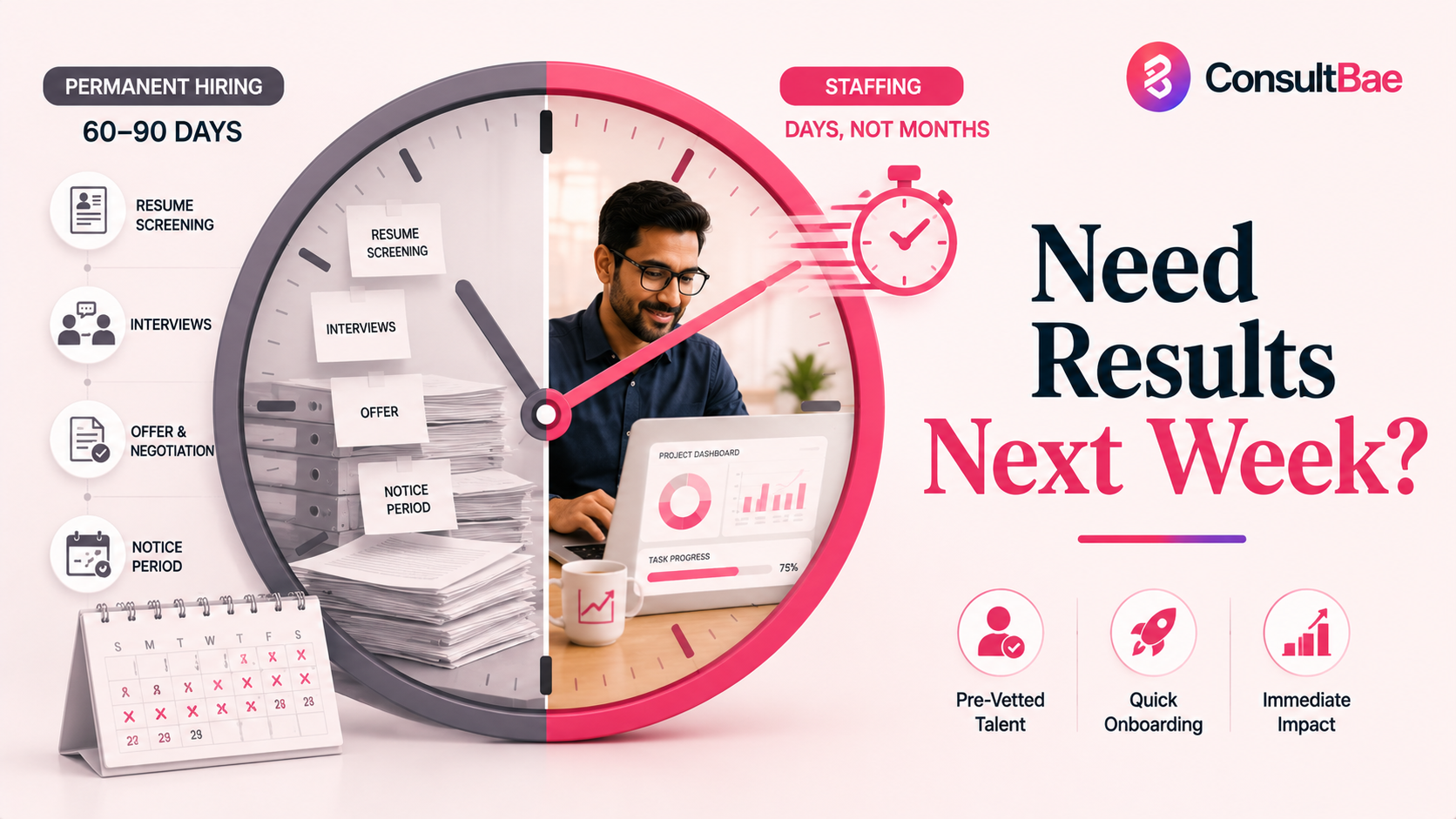
This is one of the most common friction points in recruitment relationships, and it almost never gets discussed honestly before the engagement begins. Permanent hiring has a cycle. That cycle has a built-in delay between activity and visible outcome that is structural, not a sign of underperformance. Staffing operates on a completely different timeline, with faster feedback, shorter loops, and more immediate visibility into whether things are working. Confusing the two, or applying one model's expectations to the other, is where most client frustration comes from.
Understanding the difference is not just useful for managing expectations. It determines which model you should be using in the first place.
What the Recruitment Cycle Actually Looks Like From the Inside
Permanent hiring for a mid-senior role does not produce results in week one. It produces activity in week one: sourcing runs, profiles are qualified, outreach goes out, early responses come in. The work is real and it is happening, but it is invisible to the client at this stage because no candidate has yet cleared the first internal review.
Week two and three are typically where the first meaningful profiles reach the hiring manager. These are not the only candidates in the pipeline: sourcing continues running in parallel. But the candidates visible to the client at this stage are the ones who cleared the initial screening, which is one filter among several still ahead of them. Interviews, second-round conversations, offer negotiation, notice periods: by the time a candidate joins the company and produces any output that the client can point to as proof the hire was right, six to ten weeks have usually passed from the day the brief was signed.
This is not a flaw in the process. It is the nature of placing a person who will be on your payroll for years. The diligence takes time because the stakes justify the time. But it does mean that any client evaluating the recruitment partnership in week three is evaluating activity, not outcomes, and drawing conclusions about outcome-level performance from activity-level data.
Why Results Lag 30 to 60 Days Behind the Placement
Even after a candidate accepts an offer, the visible result of the hire is still weeks away. Most mid-senior professionals in India are on notice periods of 30 to 90 days. The offer acceptance, which feels like the finish line to everyone involved in the search, is actually the beginning of a waiting period before the hire shows up at a desk and starts producing work.
Add to this the onboarding ramp: the first 30 days in a new role are rarely productive in any measurable sense. The person is learning the environment, building context, establishing relationships. By day 60, they are beginning to contribute. By day 90, the hire either looks clearly right or clearly difficult, and the client has something concrete to evaluate.
This means the recruitment partner who closed a role in week two will not receive meaningful feedback on that placement for another two to three months. The client who signed the brief in January may not have a clear view of whether the hire was successful until April. In that window, the relationship between partner and client runs almost entirely on trust and communication, not on visible results.
"Recruitment ideally comes with a cycle. I onboarded a large company last week. The result will come eventually after a month or two months. That is just how permanent hiring works."
How Staffing Changes the Feedback Loop
Staff augmentation does not have this lag built in. When a company brings in a contractual resource through a staffing partner, that person is typically on-site or productive within days of the agreement being finalised. There is no notice period to wait through. There is no extended onboarding because the resource is expected to hit the ground running on a specific, defined scope of work. The feedback loop is immediate: within the first week, the client knows whether the person is competent, available, and communicating correctly.
This immediacy changes the nature of the relationship between client and partner. In staffing, the partner is evaluated quickly, continuously, and concretely. If the resource is not working out, the client raises it fast and the partner responds fast. The performance conversation is ongoing, not deferred to a post-placement review three months later.
This faster feedback loop is one of the reasons staffing relationships tend to build trust more quickly than permanent hiring relationships. The client sees what the partner is capable of within weeks, not months. Placements that work well create visible proof early. And the volume of transactions over a six-month staffing engagement produces a much richer picture of the partner's reliability than a single permanent hire reviewed at the 90-day mark.
The Mistake of Applying One Model's Expectations to the Other
The most damaging version of this confusion happens when a client with a permanent hiring need starts evaluating the partner on a staffing timeline. They expect to see results in two weeks. When week three arrives without a confirmed joiner, they interpret this as the partner underperforming. Conversations become tense. The partner accelerates in ways that may not serve the quality of the placement. Candidates who haven't fully cleared assessment start being presented to manage the optics of visible activity. The quality of the hire suffers, and everyone loses.
The reverse mismatch is less common but equally real. A client who needs a resource available within the week to join an ongoing project signs a permanent hiring agreement because that is what their procurement process allows for. The partner is now trying to run a staffing engagement through a framework designed for permanent placement, with a timeline that cannot accommodate the 30-day notice period the hiring manager is about to discover is non-negotiable.
Neither of these failures is inevitable. Both are preventable if the right conversation happens before the brief is signed, not after the frustration has already set in.
How to Know Which Engagement You Actually Need
The question of whether you need permanent hiring or staffing is not always obvious from the job description. It depends on the actual need underneath the description: how urgently the output is required, how long the scope is expected to run, whether the role is likely to evolve in ways that make a fixed permanent hire riskier than a flexible contractual resource, and what your budget allows for in terms of the trade-off between immediate availability and long-term payroll commitment.
A company that needs someone to join a project already in motion, for a scope that runs six months and may or may not extend, needs staffing. A company that needs someone to build a function from the ground up, shape the team culture, and stay for three to five years needs permanent hiring. These are different problems and they require different engagement models, different partner relationships, and different patience for the feedback loop.
When is the output actually needed? If the answer is within 30 days, permanent hiring cannot accommodate that without extraordinary circumstances. Staffing can.
How long is the scope? Engagements under 12 months are usually better suited to contract staffing. Roles expected to run indefinitely and grow into leadership belong in permanent hiring.
What are you evaluating the partner on, and when? If you need visible results in four weeks, set that expectation explicitly with your permanent hiring partner, or reconsider whether staffing is the right model for this need.
What happens if the hire leaves in year one? Permanent hiring carries replacement risk. Staffing builds flexibility. Knowing which risk you can absorb determines which model you should choose.
The recruitment cycle is not broken when it takes 60 days to show results. It is working as designed. The staffing cycle is not slow when it asks for more ongoing coordination. It is working as designed. The only thing that creates friction is misalignment between what was chosen and what was expected. Getting that alignment right is the conversation that happens before the first profile is sourced, and it is the most valuable thing a recruitment partner can offer.
Not Sure Which Model Your Hiring Need Requires?
ConsultBae runs both permanent mid-senior hiring and staff augmentation, with a three-team structure built to close roles in under two weeks. We start by understanding what you actually need, not just what role you want to fill.
Talk to Our Hiring Team