Ask a learning and development team to describe their course production process and they will typically describe it in terms of the content: the subject matter expert who validates it, the instructional designer who structures it, the actor who delivers it. The content is what the learner experiences, so it is natural for content to dominate the conversation about production.
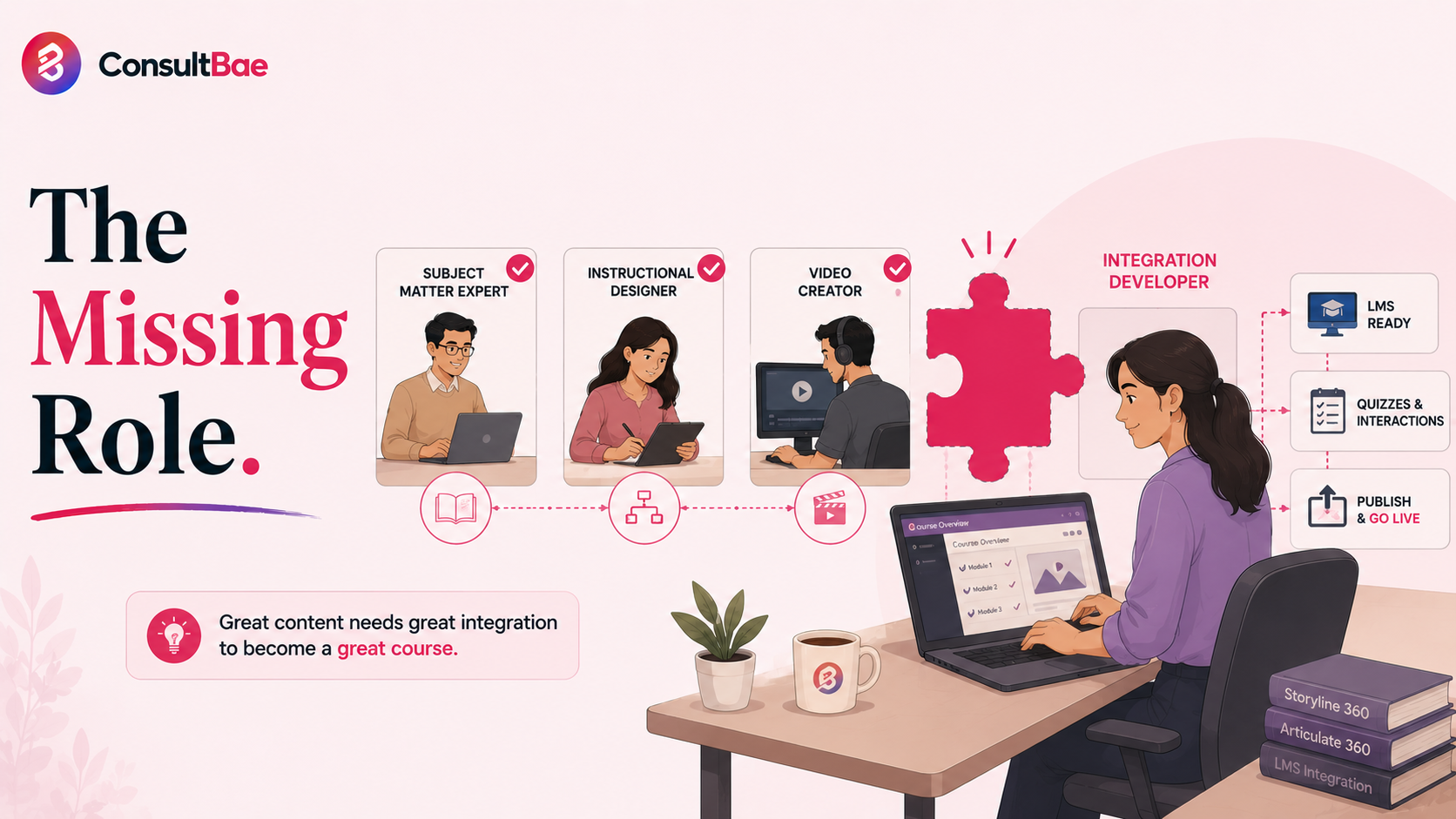
What tends to be absent from that description is the technical layer: the person who takes all of the finished content, the recorded videos, the validated text, the assessment questions, the interactive elements, and assembles it into a functional, navigable course that can actually be published to the learning platform where learners will access it. This role, the Storyline or Articulate developer who handles course integration and platform publishing, is where more e-learning timelines collapse than most production teams would like to admit.
Not because the role is glamorous. It is not. Because it is the last dependency before a course goes live, and when it has not been planned for adequately, everything that came before it is finished and waiting while the team scrambles to find someone who can do the work.
What a Course Integration Developer Actually Does
Storyline and Articulate are the authoring tools most widely used for producing interactive e-learning courses for enterprise and certification platforms. They allow course creators to combine text, video, audio, quizzes, branching scenarios, and interactive elements into a single navigable experience that runs inside a learning management system or a platform like the large certification sites where courses are sold or distributed.
The integration developer's job is to take all of the approved course components and build this experience. This involves importing and sequencing video recordings, synchronising voiceover audio with visual content, configuring quiz logic and scoring, setting up branching paths where the learner's response determines what content they see next, applying the platform's visual template and branding standards, and exporting the finished course in the file format the platform requires for upload.
None of this is work that an instructional designer, a subject matter expert, or a video editor does. It requires specific technical familiarity with the authoring tool, understanding of how different learning management systems expect content to be formatted, and the patience to work through the kind of detailed integration problems that arise when video encoding settings don't match platform requirements or when quiz logic needs debugging because a branching path is resolving incorrectly. It is technical, iterative, and time-consuming, and it is the step between "all the content is ready" and "the course is live."
Why This Role Is Distinct from Instructional Design
Instructional design is the practice of structuring learning content so that it achieves specific learning objectives. An instructional designer decides what goes in each module, how concepts are sequenced to build on each other, where knowledge checks should appear, and what the assessment at the end should measure. This is a pedagogical role. It requires understanding of how people learn, how to break down complex knowledge into teachable units, and how to design the learning path so that by the end the learner can do something they could not do at the beginning.
Course integration is not this. An integration developer does not make decisions about what the course contains or how the learning objectives are structured. Those decisions come in from the instructional designer and the subject matter expert as finished specifications. The integration developer's job is to implement those specifications faithfully in the authoring tool and produce a publishable output. The skill set is technical, not pedagogical, and the two roles require different profiles, different hiring criteria, and different sourcing approaches.
The confusion between the two roles, and the assumption that an instructional designer can handle the integration work or vice versa, is one of the most reliable sources of late-stage production delays. It is reasonable to expect that someone who works in e-learning will have familiarity with Storyline or Articulate. It is not reasonable to expect that familiarity with a tool at the level required to use it for basic design work translates into the technical depth needed to build a complex branching course, debug publishing errors, and meet the specific output specifications of a major certification platform. These are different levels of the same tool, and they require different people.
"We also provide Storyline developers, Articulate developers, who actually do the integration of the courses into those platforms which go live on the client platform. This is a separate role, a separate skill, and a separate hiring problem from everything else in the production chain."
What Makes a Good Integration Developer Hard to Find
The supply of people who can competently build courses in Storyline or Articulate at the level required for professional certification content is smaller than most clients expect when they first start looking. This is partly because the tools are specialised: familiarity with general video editing software or presentation tools does not transfer. It is partly because the level of technical depth required for complex interactive course builds is significantly higher than the level required for simple linear courses, and the market does not always clearly distinguish between the two.
The experienced integration developer, the one who can handle a 30-module course with branching logic, accessibility compliance, multi-language text layers, and a specific output format for a demanding platform, is typically fully engaged. They are freelancing across multiple clients or working in-house for a learning organisation that pays enough to retain them. They are not idle and available the week before a project needs to go live.
This is the timing problem that produces most late-stage integration emergencies. The course content is ready. The client needs the course live in two weeks. The integration developer who has been assumed to be available is not available. The search for a replacement begins, and the candidates available on short notice are typically the ones who are less experienced, which produces either a delay while a more suitable candidate is found or a quality compromise that affects the final product.
When in the Production Timeline This Role Needs to Be Engaged
The integration developer needs to be identified and confirmed at the same time as the subject matter experts and instructional designers, not after all the content is finished. This is counterintuitive because the integration work cannot begin until the content exists, but the sourcing and confirmation of the developer needs to happen early for two reasons.
The first is availability. A good integration developer working in the freelance market has a lead time. Confirming them four to six weeks before their work begins is reasonable. Confirming them the week they are supposed to start is not, and the probability of finding someone with the right technical level on short notice in a busy market is low.
The second is specification. The integration developer needs to know early what platform the course is being built for, what authoring tool version is required, what the platform's specific output specifications are, and whether there are accessibility, branding, or interactive complexity requirements that will affect the build. Getting these specifications from the platform and communicating them to the integration developer before production begins prevents the scenario where all the content is built in a format the integration tool cannot import cleanly, or where the published output fails the platform's technical review.
What Happens When This Role Is Forgotten Until the End
The scenario plays out in a recognisable pattern. The content production goes well. Subject matter experts are engaged and delivering. The instructional designer has structured the modules carefully. The recordings are complete and edited. The platform is expecting the course in ten days.
Then someone asks: who is building this in Storyline? And the answer turns out to be no one confirmed, a vague assumption that the instructional designer would handle it, or a name that turns out to be unavailable. The next ten days are spent finding an integration developer rather than building the course.
1. Instructional designer: Structures the learning objectives, sequences content, designs the course flow. Engaged first, before any content is created.
2. Subject matter expert: Validates content accuracy, provides real-world context, records tool demonstrations where required. Engaged in parallel with or immediately after the instructional design phase.
3. On-camera talent or voiceover artist: Records the delivery of course content for the learner. Engaged once the script and content structure are finalised.
4. Course integration developer: Builds the finished course in the authoring tool and prepares it for platform publication. Must be confirmed early even though work begins late in the production cycle. This is the role most often left to the end by accident.
5. Platform reviewer: The client's internal team who receives the finished course and confirms it meets quality and technical standards before publication. Their requirements need to be communicated to the integration developer before building begins, not after.
Planning for the integration developer at the start of the production process rather than the end is one of the simpler operational improvements available to any team running e-learning production at volume. The content work is where most of the intellectual and creative energy goes. The integration work is where the production timeline most commonly stalls. Recognising these as separate problems that require separate solutions, sourced at separate times with separate criteria, is the change that stops the late-stage scramble from becoming a recurring feature of the production calendar.
Need Storyline or Articulate Developers for a Production Cycle?
ConsultBae sources and manages course integration developers alongside the full production role stack for e-learning platforms, so the technical layer is confirmed before the content is finished, not after.
Talk to Our E-Learning Team