
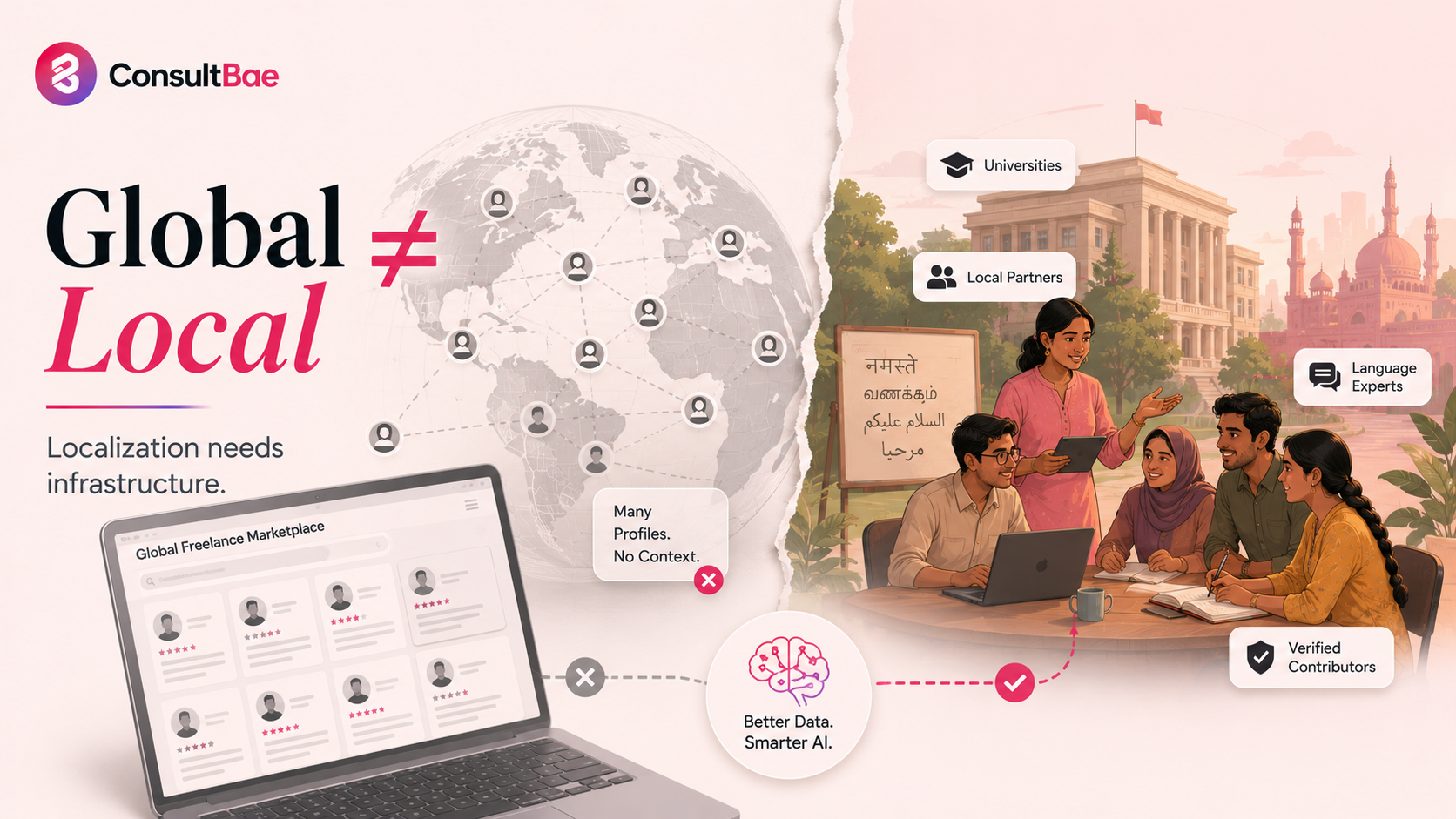
When enterprise engineering teams prepare to adapt a large language model for a new international market, their standard operational reflex is to route data collection tasks through massive digital freelancer networks. On paper, these open digital marketplaces promise instant access to thousands of native speakers across any geographic region. The software distributes labeling scripts or voice recording tasks to unverified users who happen to match basic location profiles on their mobile devices. The process appears efficient, cost-effective, and infinitely scalable until the validation stage reveals high levels of background noise, inconsistent dialects, and skewed cultural interpretations.
The structural error lies in confusing presence with localization. A user sitting in a regional hub using a specific IP address does not automatically mean they possess the exact cultural nuance, educational alignment, or dialect purity required to create clean machine learning training assets. Open crowdsourced marketplaces lack authentic background verification, meaning that a massive portion of the incoming data stream contains systemic bias and low quality control. For modern enterprise models attempting to handle complex contextual reasoning, relying on anonymous digital clicks introduces catastrophic training vulnerabilities that can cost millions to trace and remedy post-training.
Beyond the Generic Digital Freelancer Network
True localization is a complex human infrastructure puzzle rather than a simple software distribution mechanism. When a machine learning model interacts with users across varying regional territories, it must interpret more than literal vocabulary. It has to navigate distinct regional variations, local slang, and specific structural changes in non-Latin scripts. Open freelance boards cannot manage these subtle variations because they operate on a transactional model that rewards volume over linguistic accuracy. Contributors often speed through prompt scripts without matching instructions, producing data assets that look clean on a spreadsheet but fail in live model evaluations.
Furthermore, open digital marketplaces suffer from an invisible friction regarding infrastructure access. In many international regions, the precise demographics required to train regional AI models are completely absent from global freelance portals. Attempting to source niche linguistic attributes or specific data modalities through a public app storefront results in a highly skewed data sample, usually over-representing tech-savvy urban centers while entirely missing crucial regional populations. Bypassing this friction requires shifting away from anonymous web distribution, moving toward managed, verified human pipelines that treat global data sourcing with the same scrutiny as executive corporate recruitment.
"You cannot build a localized speech or text model by treating global contributors like anonymous clicks on a screen. Localization is an operational infrastructure, not a software feature."
Activating Trusted Regional Infrastructure
To overcome the limitations of open marketplaces, enterprise data procurement must build localized, verified networks on the ground. This structural alignment is achieved by bypassing general freelancer apps and setting up direct partnerships with trusted institutions inside target geographies. Engaging directly with university linguistics departments, regional community initiatives, and localized non-governmental organizations allows an enterprise to build an authenticated data workforce across more than one hundred countries. This framework replaces unverified digital crowds with targeted cohorts whose background, language habits, and regional characteristics are thoroughly documented before any data collection begins.
For example, when an enterprise requires high-volume language data across complex regional dialects, working directly with university professors allows the project to tap into groups of checked, native-speaking students who understand academic precision. These contributors do not view data tasks as a rapid-fire clicking game; they treat them as a structured research project, adhering closely to strict annotation guidelines. This methodical approach allows data managers to build a highly responsive global footprint, securing verified data streams that remain completely inaccessible to generic online freelance networks.
• Source direct institutional partnerships instead of relying on open public job boards.
• Verify dialect backgrounds and regional demographics prior to onboarding data contributors.
• Establish localized operational nodes to handle nuanced cultural context checks.
Maintaining Centralized Ground Truth Across Borders
Assembling a vetted international workforce solves the sourcing bottleneck, but it creates a secondary challenge: ensuring that data validation standards remain perfectly identical across distinct geographic territories. If an operation deploys separate annotation guidelines across different global hubs without centralized tracking, the incoming data sets will inevitably conflict. Managing cross-border data logistics requires pairing deep regional access with centralized tracking tools and advanced data-routing management systems from day one.
This operational model processes every single asset through a dual-layer verification loop. The first layer operates directly inside the target country, where local linguistic experts review submissions for cultural authenticity, contextual accuracy, and dialect preservation. The second validation layer runs through our centralized data vertical in Gurgaon, utilizing advanced tracking technology to audit technical quality metrics, data consistency, and guideline compliance. This integrated strategy bridges the gap between global scale and micro-level quality control, giving deep-tech enterprises the clean, high-fidelity datasets required to power elite multi-modal models without the high costs of open marketplace noise.
Deploy Verified Global Data Solutions
Stop risking your model training performance on unverified marketplace crowd data. Partner with ConsultBae to deploy highly targeted, institutionally verified data operations across 100+ countries.
Connect with Us