
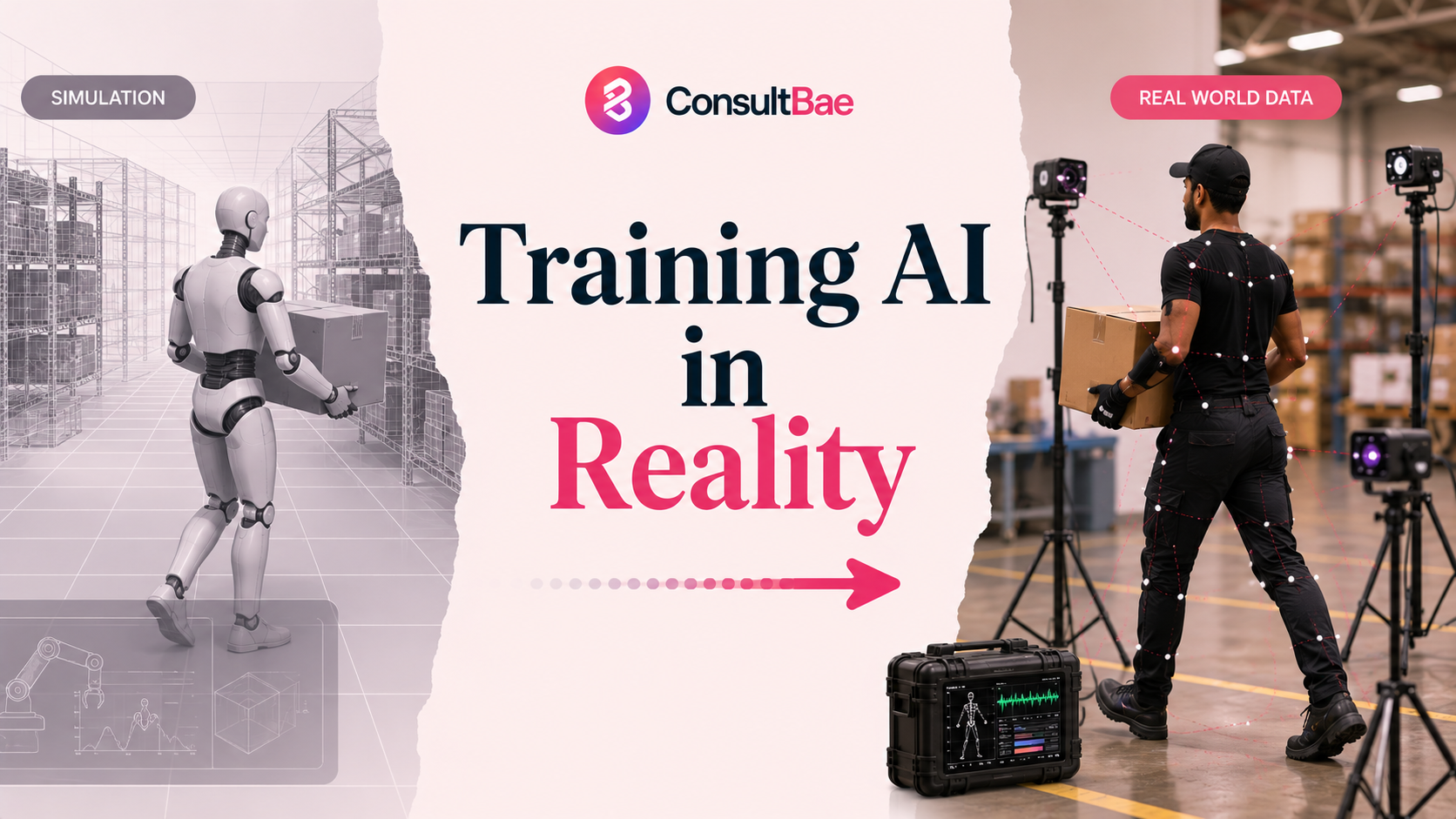
Training a robotic arm to navigate a perfectly controlled digital simulation might only require a weekend of compute time. However, training that same robotic hardware to safely handle a fluctuating factory floor without collision failures is an entirely different engineering challenge. The digital world is clean and predictable, while the physical world is filled with complex, unseen geometry, irregular lighting, and unpredictable human movement.
As enterprise development shifts aggressively toward Physical AI, engineering teams are discovering that synthetic renders are insufficient for real-world deployment. To bridge the gap between software capability and hardware execution, spatial data collection pipelines must capture and validate real-world operational activities. This transition demands a highly structured approach to human task tracking, translating organic human movement into precise, machine-readable kinematic logic.
Why Perfect Simulators Fail the Edge-Case Test
Digital simulators are incredibly effective at teaching a physical model the foundational rules of its environment. They establish basic physics, general object recognition, and optimal pathfinding. The breakdown occurs when these systems encounter minor physical irregularities that cannot be easily synthesized, such as the glare of warehouse lighting on a metal surface, an unexpected obstacle in a transit path, or the nuanced way a human operator handles a delicate tool.
When autonomous systems leave their code sandboxes and face these physical edge cases, their lack of real-world training data causes hesitation or outright failure. Synthetic data lacks the entropy of actual physics. To build true resilience, the model must process thousands of hours of grounded, real-world tracking data that captures the unpredictable variations of a live operational environment.
"A simulated environment teaches a robot how things should work. Real-world human telemetry teaches it how things actually work."
Mapping Human Telemetry to Machine Kinematics
Acquiring this grounded spatial data requires orchestrating real human operators to perform specific physical tasks while being meticulously recorded. This is not simply a matter of setting up a video camera; it involves capturing the complex telemetry of human joints, tool manipulation, and spatial awareness across multiple axes. Every reach, lift, and pivot must be isolated and tagged so that a robotic counterpart can safely mimic the intent behind the motion.
The operational mechanics of structuring these real-world collection runs are complex. Teams must build custom, multi-modal collection hubs that safely guide human contributors through specific physical scenarios. This ensures the resulting datasets contain the exact kinematic variables necessary to teach machines how to interact seamlessly alongside human workers without disrupting daily logistics.
• Scenario Design: Mapping specific industrial or commercial tasks into trackable steps.
• Multi-Angle Capture: Synchronizing video, depth sensors, and telemetry tools.
• Kinematic Annotation: Structuring the raw physical data into precise machine logic vectors.
Validating Multi-Camera Spatial Datasets
Once the physical data is captured, it moves into an intensive validation phase. Because spatial tracking relies on multiple simultaneous camera angles to build a three-dimensional understanding of an event, the annotation process requires extreme precision. Human-in-the-loop tracking teams must carefully audit the footage to ensure depth perception, bounding boxes, and skeletal mapping remain perfectly aligned across every frame.
This cross-border hardware verification prevents catastrophic routing errors during live deployment. By integrating localized physical collection teams with centralized, high-precision validation protocols, organizations can successfully train the next generation of Physical AI to navigate the chaotic realities of the modern industrial world.
Ground Your Physical AI Models
Don't let synthetic data gaps stall your robotics deployment. Partner with ConsultBae to capture and validate precise human telemetry across secure, localized collection hubs.
Connect with Us