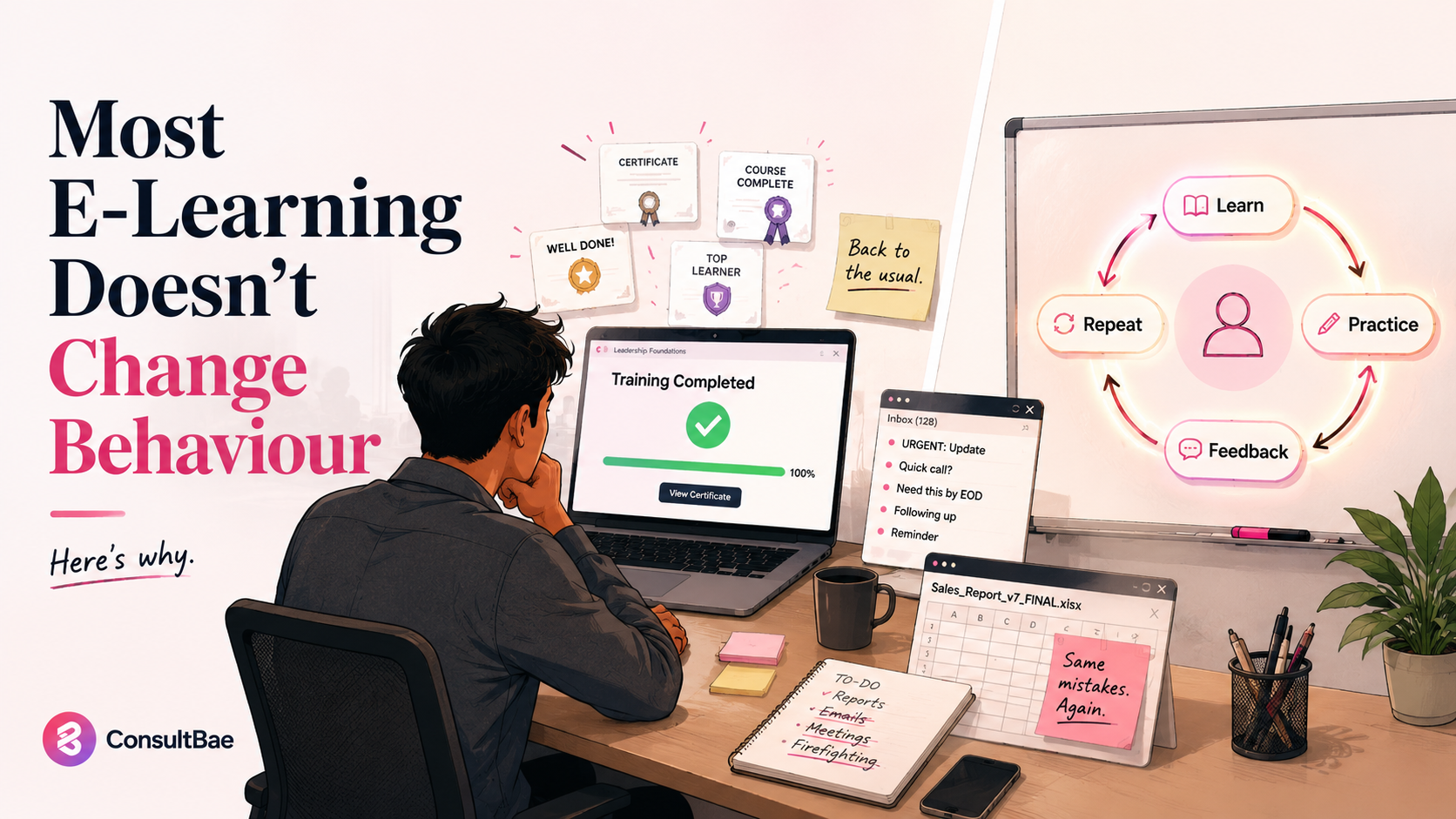
A common pattern in corporate learning programmes: the course is built, the employees complete it, the certificates are issued, and three months later nothing about how the work gets done has actually changed. The course delivered information. The information did not translate into behaviour. The programme is considered complete because the completion metrics say so, but the underlying problem the course was meant to solve is still there.
This is not unusual. It is the default outcome for most corporate e-learning, and it is not because the courses are poorly made or the employees are not engaged. It is because completion and learning and behaviour change are three different things, and a course built to drive completion will not automatically produce the other two.
Completion is not learning, and learning is not behaviour change
A completed course tells you the employee finished the content. It does not tell you they retained it. A retained piece of content tells you they could pass an assessment on it. It does not tell you they would actually apply it when they encounter the relevant situation at work. Each step in this chain is a separate transition, and each one has its own failure rate.
Most corporate e-learning is designed with completion as the primary success metric. The course flows are built to keep learners engaged enough to finish. The assessments are written to be passable. The certificates are issued automatically. None of this is wrong on its own. It becomes a problem when completion is treated as a proxy for behaviour change, because the proxy is not predictive of the outcome the organisation actually wanted from the programme.
Why most corporate e-learning stops at the first step
Building content for completion is easier than building content for behaviour change. Completion can be designed for using known patterns: engaging video, manageable length, clear progression, an assessment the learner is reasonably likely to pass. Behaviour change requires a deeper design choice: what does this person actually do at work, what specifically needs to change, and what conditions need to be in place for the change to stick.
The second set of questions is harder to answer and harder to measure. As a result, most programmes do not engage with them. The course gets built around the topic, the learners complete it, and the question of whether it changed anything in their actual work gets quietly set aside.
A completed course is evidence that someone watched the videos. It is not evidence that anything changed in how they work. The two are routinely confused because completion is what gets measured.
The three things behaviour change actually requires
For an e-learning programme to actually change how employees work, three conditions need to hold together. Any one of them missing significantly reduces the chance of the programme producing real change.
Relevance to actual work. The content has to map onto situations the learner will recognise from their day to day. Generic principles delivered in the abstract get filed under interesting and then forgotten. Specific scenarios that mirror real working contexts give the learner something to attach the new behaviour to. Most poorly-performing corporate courses fail here first. They teach concepts that are technically accurate and operationally disconnected from how the work actually happens.
Repeated reinforcement after the initial course. Behaviour change does not happen from a single exposure. The learner encounters the new approach once in the course, returns to their normal work, and within days the new pattern fades because the old patterns are reinforced by every routine of the working day. Reinforcement is what bridges the gap: short refreshers, prompts at the relevant moments, peer conversations that surface the new approach in real situations. Without this, the course is a one-off event with predictable decay.
An environment that supports the change. If the working environment continues to reward the old behaviour, the new one will not take hold no matter how well the course was designed. This is often the most uncomfortable condition because it involves managers and culture rather than learning content. A course that teaches a new decision-making framework will not change decisions if managers continue to override based on old frameworks. The environment has to actively support the new behaviour, or it will fade.
Why one-off video courses cannot deliver this on their own
A standalone video course can do parts of this, but not all of it. It can deliver relevant content if it is designed well. It cannot deliver repeated reinforcement, because by definition it is a single event. And it cannot shape the working environment, because that is outside its scope. A programme that relies on the course alone is asking the course to do work the course is not equipped to do.
What works better is a programme that uses the course as the anchor, with additional elements built around it. Practical exercises that the learner applies to their real work in the days after completion. Manager involvement that creates conversation about the new approach in team contexts. Refresher content that surfaces at relevant moments rather than as scheduled training. Peer cohorts that allow learners to compare how they are applying the new approach and where they are struggling.
Content built around recognisable work scenarios, not abstract principles. A planned arc of reinforcement after the initial course, with prompts and refreshers across the weeks that follow. Manager involvement that creates real conversation about the new behaviour in the team context. Practical exercises that connect the learning to real work the learner is doing. Measurement that goes beyond completion to look at whether behaviour has actually shifted, even informally.
How ConsultBae approaches this
The e-learning vertical at ConsultBae works on programmes, not just courses. When a client comes to us with a learning need, we ask what behaviour is supposed to change, what the working environment looks like that the learner is returning to, and what reinforcement is realistic given the operational constraints. The course is one piece of what we deliver. The reinforcement design, the manager-involvement plan, and the measurement framework are the others.
A course that drives completion is the easier deliverable. A programme that drives behaviour change is the more useful one. We build both, but we are clearer than most about the difference and what each one actually requires.
Shivani Agarwal leads the E-Learning vertical at ConsultBae, overseeing end-to-end course production across technology and non-technology domains.
Building a learning programme that needs to actually work?
ConsultBae designs e-learning programmes around behaviour change, not just completion. Let us talk about what your team needs.
Talk to us