The course took six months to build. The subject matter expert wrote the content, designed the structure, recorded themselves presenting it, and created the assessment questions. They knew the subject better than anyone in the organisation. The course is accurate, thorough, and almost entirely ineffective as a learning experience.
The content is pitched at a level the target learner cannot follow. The structure reflects how the expert thinks about the subject rather than how someone new to it needs to encounter it. The on-camera delivery is technically correct and deeply uncomfortable to watch. The assessment questions test recall of what was said rather than whether the learner understood it. The screencast portions are captured at the wrong resolution with the wrong pacing and no indication of where the learner should be looking.
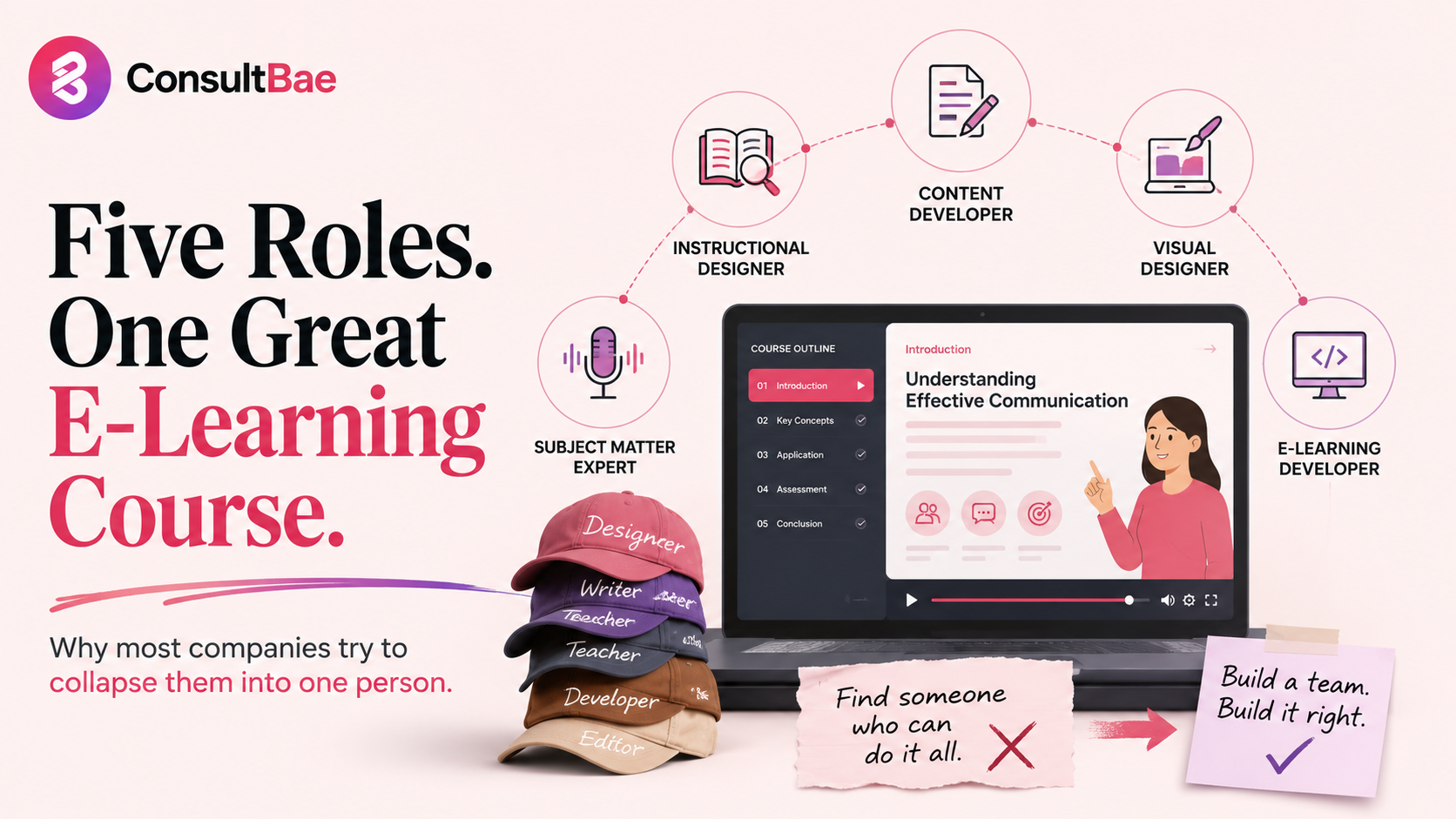
None of this is a failure of effort or expertise. It is a failure of role design. The expert was asked to do five jobs simultaneously, each of which requires a different skill set, and the course reflects the limits of what one person can carry.
Why companies collapse the roles
The default assumption when a company decides to build an e-learning course is that the hard part is finding someone who knows the subject well enough to teach it. Once that person is identified, the assumption goes, the course will follow. What this misses is that knowing a subject and being able to design a learning experience around it are independent skills, and both are independent of the ability to present on camera, write assessments that test understanding, and produce screencasts that a learner can follow without getting lost.
The collapse happens for practical reasons: the subject matter expert is available, the budget for external production support is not allocated, and the deadline is soon. The result is a course where every role was covered by the same person and none was done at the level a dedicated specialist would have brought to it.
Role 1: The subject matter expert
The subject matter expert is the reason the course exists. Their knowledge of the domain is the raw material everything else is built from. Their role is to provide that knowledge accurately, review the content that is built around it, and confirm that nothing has been lost or distorted in the translation from expertise to learning experience.
What the subject matter expert is not responsible for is deciding how that knowledge should be structured for a learner, how it should be presented on camera, or how it should be assessed. Those decisions require different expertise, and asking the subject matter expert to make them produces outcomes that reflect their domain knowledge rather than their understanding of how people learn.
The subject matter expert's role is deep and essential. It is also bounded. Respecting those boundaries produces better work from the expert and a better course for the learner.
Role 2: The instructional designer
The instructional designer is the person who takes the subject matter expert's knowledge and builds a learning journey from it. Their job is not to understand the subject as deeply as the expert. It is to understand how people learn and to structure content so that a specific learner, with a specific starting point, can move reliably toward a specific outcome.
This means writing learning objectives that describe what the learner will be able to do rather than what the course will cover. It means sequencing content so each module builds on what came before rather than following the logical structure of the subject as a discipline. It means identifying the assumed context the expert takes for granted and making it explicit for the learner who does not have it yet.
Instructional design is a trained discipline. It is not something that follows naturally from subject matter expertise, and it is not something that can be approximated by someone with good communication skills and a clear mind. The specific technical knowledge of how to design for learning outcomes is what separates a course that produces behaviour change from a course that produces certificate completions.
The subject matter expert knows what needs to be learned. The instructional designer knows how learning actually happens. Both are necessary. Neither substitutes for the other.
Role 3: The assessment writer
Assessment writing is routinely treated as the last step in course production: the expert reviews the material, adds some questions at the end, and the course is done. The questions test whether the learner can recall what was said. The learner passes. Whether they understood it or can apply it is not what the assessment measures.
A well-written assessment is built around the learning objectives, not the content. It tests whether the learner can do the thing the course was designed to teach them to do, under conditions similar to the real-world situations where they will need to do it. Writing this kind of assessment requires understanding both the learning objectives and the cognitive level at which the learner needs to be able to operate: not just recall, but comprehension, application, and in some cases analysis.
Assessment writing is a distinct role from instructional design and from subject matter expertise. The assessment writer needs to know enough about the subject to write plausible distractors in a multiple choice question. They need to know enough about learning design to pitch questions at the right cognitive level. And they need enough distance from the content to see it the way a learner sees it rather than the way someone who already knows it does.
Role 4: The on-camera presenter
Subject matter experts are often deeply uncomfortable on camera. This is not a personal failing. Presenting to a camera is a specific skill that requires practice, and most people who have spent their careers developing domain expertise have not had occasion to develop it. The result, when experts are asked to present their own courses, is technically accurate content delivered in a way that creates friction between the learner and the material.
Pacing that is too fast or too slow for the learning context. Eye contact that is with the script rather than the camera. Delivery that is natural in conversation but does not translate to the compressed, deliberate communication that recorded learning requires. These are not problems a second take fixes. They are the result of asking someone to do a job they were not trained for.
A professional presenter or actor who has been thoroughly briefed on the material can deliver the same content with the clarity, pacing, and presence that a learner needs. The expertise remains the subject matter expert's. The delivery is handled by someone whose expertise is delivery.
Role 5: The screencast specialist
A screencast is not a recording of someone using a piece of software. It is a guided visual explanation that takes a learner through a process step by step, at the right pace, with the right emphasis on each action, and with enough context at each stage that the learner understands not just what is being done but why.
Most screencasts produced without a dedicated specialist share the same problems: the cursor moves faster than the learner can follow, the resolution is wrong for the platform the course will be delivered on, the audio does not sync cleanly with the on-screen action, and the recording does not pause or call out the moments where the learner is most likely to make a mistake.
A screencast specialist plans the recording before opening the software. They script the narration against the action sequence. They know what frame rate and resolution the delivery platform requires. They know how to structure a process demonstration so the learner can follow and replicate it rather than watch and forget it.
Subject matter expert: Domain knowledge, content accuracy, edge case identification, review and sign-off at each stage.
Instructional designer: Learning objectives, content structure, learner journey, briefing document, module sequencing.
Assessment writer: Question design, cognitive level calibration, distractor plausibility, alignment to learning objectives.
On-camera presenter: Delivery, pacing, clarity of communication, camera presence, retakes until the standard is met.
Screencast specialist: Process recording, narration scripting, resolution and format, pacing against the learner's ability to follow.
What happens when one person carries all five
When one person carries all five roles, the course reflects their strongest skill and shows the gaps in the rest. A subject matter expert carrying all five produces content that is accurate and inaccessible. A good communicator carrying all five produces something watchable that teaches the wrong things. A project manager carrying all five produces something that is on schedule and not particularly effective.
More commonly, the person carrying all five runs out of time and energy before the last roles are done well. The content is finished. The assessment is a afterthought. The delivery is a single take. The screencast has no narration. The course ships because the deadline arrived, not because it was ready.
How ConsultBae approaches this
ConsultBae works as an end-to-end capability partner for organisations building e-learning courses. That means we provide all five roles, separately staffed by people whose expertise matches what each role requires. Subject matter experts across more than 40 domains and 50-plus countries. Instructional designers who build the learning structure around the expert's knowledge. Assessment writers who build evaluation that tests understanding rather than recall. Professional actors and on-camera presenters for delivery. Screencast specialists for process and software recordings.
The subject matter expert remains central. Their knowledge is the reason the course exists and their review is built into every stage of production. What changes is that every other role is handled by someone trained specifically for it, so the expert can do the job they are actually suited for without being asked to carry the four jobs they are not.
A good e-learning course is not produced by one person doing everything adequately. It is produced by five distinct roles, each done well, working from a shared brief toward a shared outcome. That is what ConsultBae builds.
Shivani Agarwal leads the E-Learning vertical at ConsultBae, overseeing end-to-end course production across technology and non-technology domains.
Building an e-learning course?
ConsultBae provides all five production roles as a single end-to-end capability partner. Let us talk about what your course needs.
Talk to us