- Why the capacity partner is always working to someone else's calendar
- What happens when the brief is five candidates by tomorrow
- How a pre-built contributor pool changes the answer
- What the client relationship needs to include for a fair window
- What trust looks like when the timeline is always compressed
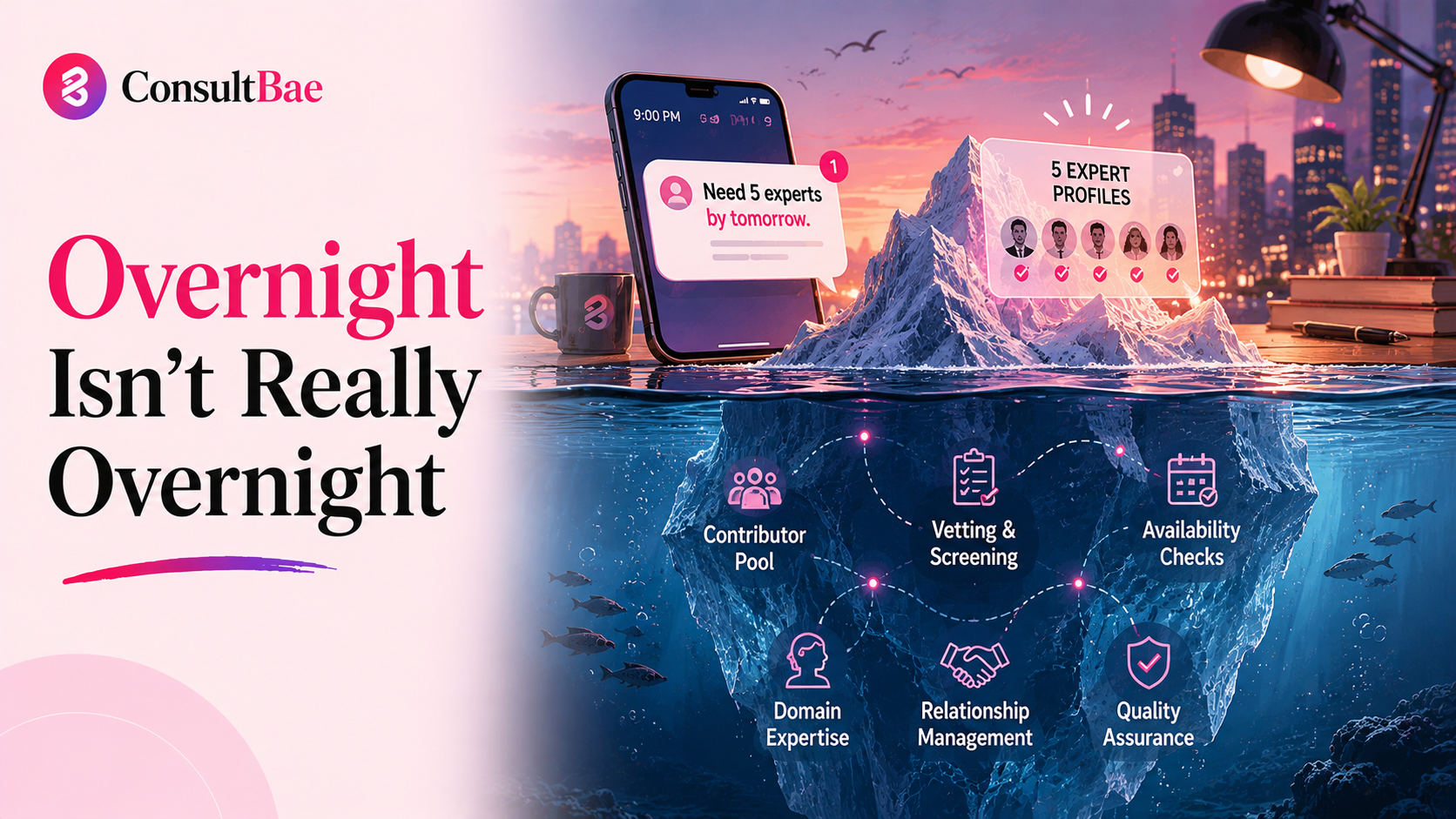
The call came in at 9 in the evening. A client had a proposal due to submit to their own client the following morning. To make that proposal credible, they needed to be able to name specific subject matter experts who were already identified, vetted, and available for the courses they were pitching. They needed the profiles by morning. We had them by morning.
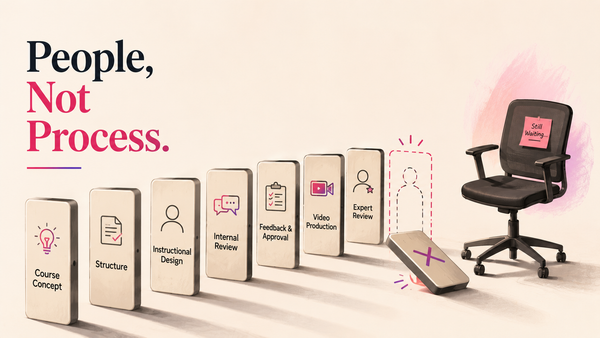
This is not an exceptional situation in the e-learning capacity partnership world. It is the normal operating condition. The capacity partner is structurally the last link in a sales and production chain that they did not design, do not control, and receive extremely late notice from. The client is a production company or intermediary who only knows they have the work once their own proposal is accepted, which means the timeline pressure that arrives at the capacity partner's door was created by a sales cycle that was never visible to them.
Building an operation that can consistently absorb this kind of compressed demand without failing the brief requires a specific kind of infrastructure. Not the infrastructure of fast reaction, but the infrastructure of preparation: a contributor pool that is always maintained, always vetted, and always ready to be activated against a new brief before that brief has formally arrived.
Why the Capacity Partner Is Always Working to Someone Else's Calendar
In the e-learning production chain, the capacity partner typically sits at the third or fourth remove from the final deadline. The end platform sets a production schedule. The production company or intermediary commits to delivering courses against that schedule. The capacity partner is engaged to source the contributors who will do the work. Each link in that chain has a window, and the window at the capacity partner's end is what remains after every earlier link has consumed its share of the available time.
This structural position produces a timing problem that cannot be solved by working faster at the sourcing stage alone. The sourcing window is compressed not because the production company is disorganised but because the nature of proposals and project awards means that the production company genuinely does not know they have the work until they win the bid. They cannot tell the capacity partner earlier because they do not know themselves earlier. The compressed timeline is not a communication failure. It is a structural feature of how project work flows through production chains.
Recognising this changes the operational response. The correct response to a structural constraint is not to react more quickly when the constraint materialises. It is to build an infrastructure that is already positioned for the constraint before it arrives, so that the response when it arrives is deployment rather than activation.
What Happens When the Brief Is Five Candidates by Tomorrow
A brief that requires five vetted, available, appropriately credentialled subject matter experts by the following morning cannot be fulfilled through a standard sourcing process. Standard sourcing: search for candidates, make initial contact, screen profiles, check availability, request introductory videos, review communication quality, confirm agreement terms. This process takes days at minimum, and it produces good results specifically because it takes that long.
When the timeline is compressed to hours, the question is not how to run the standard process faster. The question is what was built ahead of this moment that makes the answer already available. A pre-built, continuously maintained contributor pool with vetted profiles across the relevant domains and active availability confirmations means that the response to a next-morning brief is not a search: it is a selection. The work of finding, screening, and vetting happened in advance, and the compressed brief is fulfilled by deploying that prior investment rather than by improvising under pressure.
This is the operational model that makes it possible to work sitting in India and source candidates based in the United States for a client in India, for a platform in the United States, by the following morning. Not because the sourcing was fast, but because the sourcing was already done.
"The client trusts us enough now that they submit their proposal tomorrow and call us today. They tell us they need two or five candidates for a specific task, based in the US, with specific credentials, by tomorrow. We have them. That is what a year of building the pool looks like in practice."
How a Pre-Built Contributor Pool Changes the Answer
A pre-built contributor pool is not a database of names. It is a maintained set of relationships with vetted individuals who have been screened for communication quality, confirmed for domain expertise, and engaged enough that they are responsive when contacted. The distinction matters because a database of names produces a sourcing task when a brief arrives. A maintained contributor pool produces a deployment decision.
Maintaining the pool requires ongoing investment in activities that do not immediately produce revenue: regular check-ins with contributors who are between projects, updating availability confirmations as professional circumstances change, adding new contributors as domains expand or as the existing pool's coverage in specific areas becomes stale, and retiring contributors whose circumstances or availability no longer match the types of briefs the pool is designed to serve.
This investment is invisible to the client on a day-to-day basis, which is one reason it tends to be underestimated when a new capacity partner relationship is being evaluated. The client who calls the day before the proposal is due and receives five qualified profiles by the following morning sees a fast response. What they are actually seeing is a year of pool maintenance deployed in one phone call. The speed of the deployment is the visible output of the invisible ongoing investment.
What the Client Relationship Needs to Include for a Fair Window
Even with a well-maintained contributor pool, there are limits to how much timeline compression can be absorbed before quality is affected. A brief that requires a highly specialised subject matter expert in a narrow domain, based in a specific geography, with specific availability in a specific time zone, cannot always be fulfilled from existing pool inventory regardless of how well-maintained it is. Some requirements need more sourcing lead time than overnight delivery allows.
The client relationship that works best for a capacity partner operating in this structural position is one where the client communicates intent before certainty. They may not know they have the work until the proposal is accepted. But they often know they are bidding for work before the bid is submitted. A capacity partner who receives even informal advance notice of the profile types a proposal will require can begin preliminary pool checks and availability confirmations before the formal brief arrives, which extends the effective lead time without requiring the client to make commitments before they have won the work.
Building this kind of communication into the relationship requires the capacity partner to ask for it explicitly and to demonstrate through consistent performance that the advance notice is used productively rather than just acknowledged. The client who sees that early informal communication produces a better response when the formal brief arrives will provide that communication routinely. The client who sees no difference between advance notice and last-minute notice will stop providing the advance notice because it appears to produce no benefit.
What Trust Looks Like When the Timeline Is Always Compressed
In a relationship where the timeline is structurally compressed by factors outside either party's control, trust is built through a specific kind of consistency: the capacity partner delivers reliably regardless of when the brief arrives. Not occasionally, not when conditions are favourable, but routinely, across enough engagements that the client no longer treats the compressed timeline as a risk. They know the profiles will be there because the profiles have been there every time before.
This consistency is what shifts the relationship from a transactional exchange to a genuine partnership. The client who trusts the capacity partner's ability to deliver under compressed timelines does not manage them like a vendor. They treat the capacity partner as an extension of their own production function: someone who is factored into the production plan from the earliest stages, not brought in as a last resort when the timeline has already become critical.
A continuously maintained, not just periodically refreshed, contributor pool. The pool needs to be live, with recent availability confirmations and active contributor engagement, not a list of people who were vetted six months ago and have not been contacted since. The difference between a live pool and a stale one becomes visible exactly when the timeline is most compressed.
Domain coverage broad enough to handle the majority of brief types without starting a search from scratch. A pool that covers the domains a client regularly commissions requires much less reactive sourcing than one that has gaps filled by searches. Building coverage deliberately, based on the client's historical brief patterns, reduces the proportion of compressed-timeline briefs that cannot be fulfilled from existing inventory.
A client communication culture that rewards advance notice. When informal early communication reliably produces better outcomes than last-minute contact, clients begin providing it as a matter of course. This is built through demonstrating the benefit, not through asking for the advance notice alone.
Working as the last link in a production chain is not a disadvantage if the infrastructure is built for it. The compressed timeline is the condition of the job. Building the pool, maintaining the relationships, and establishing the communication culture that extends the effective lead time: these are the operational investments that turn a structural constraint into a demonstrated capability, and demonstrated capability is what produces the level of client trust that makes the relationship worth having.
Need a Capacity Partner Who Can Absorb Your Production Timeline?
ConsultBae maintains a live, vetted contributor pool across 40 plus domains so that compressed timelines are met from existing inventory, not from reactive searches. We are built for the way e-learning production actually works.
Talk to Our E-Learning Team