Companies invest in leadership training because they need better managers. Better at giving feedback, better at managing performance, better at building teams that work well together, better at making decisions under uncertainty. The training they buy almost never produces them. The managers who completed the programme are still managers who struggle with the same things they struggled with before, and the investment is quietly written off as one of those things that did not quite work the way it was supposed to.
This pattern is consistent across organisations and across leadership training programmes. The failure mode is recognisable, the causes are diagnosable, and the alternatives that actually produce behaviour change are known. They are just operationally heavier than the format most companies default to, and the gap between the easy version and the effective version is wider for leadership training than for almost any other category of corporate learning.
Why leadership training is even harder than technical training
Technical training fails when the format does not give learners enough practice with the actual tools. The fix, while operationally demanding, is clear: more hands-on labs, more real exercises, more instructor pairing. Leadership training fails for a more complex set of reasons that cannot be solved by adding more practice in the same way.
Leadership skill is not primarily a knowledge problem. The frameworks for giving feedback, managing performance, and resolving conflict are not secrets. Most managers have heard them in some form. What they struggle with is applying these frameworks in real situations, where the situations are messy, the people are specific, the stakes are real, and the manager's own patterns of behaviour are working against the change the framework is supposed to produce.
A course that teaches the framework does not address any of this. The manager learns the framework, returns to their team, and reverts to the patterns they had before because the course did nothing to interrupt those patterns. Knowing the framework and applying it under real pressure are different capabilities, and the second one cannot be developed through content delivery alone.
What most leadership courses get wrong
A few patterns repeat in leadership training that does not produce change.
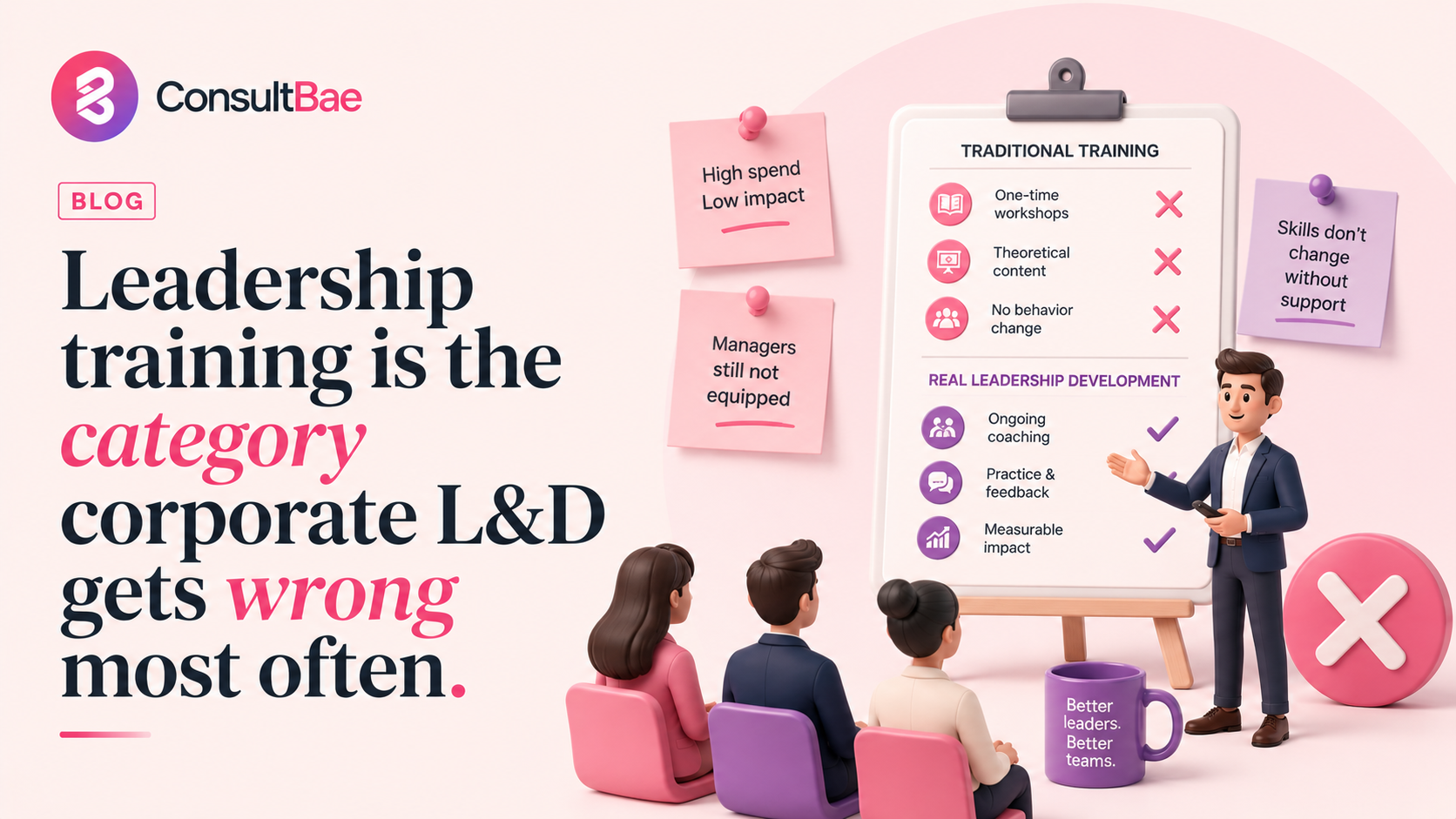
Abstract frameworks instead of specific situations. Courses cover concepts at a level of generality that lets them apply to anyone. The result is that they apply to no one specifically. A manager dealing with a real performance issue with a real direct report does not benefit much from a general framework about giving difficult feedback. They benefit from working through their specific situation with someone who can help them think about it.
No practice with real management challenges. The course presents scenarios for the learner to think about, but the learner is not actually managing through anything during the course. They are learning concepts and being asked to imagine applying them. Imagining is not practising, and the skill that develops through imagining is the skill of imagining, not the skill of managing.
No manager involvement in reinforcement. The learner completes the course and returns to a working environment where their own manager is not aware of what the programme covered, is not modelling the behaviours it tried to teach, and is not creating the conditions for the learner to practise them. Without environmental reinforcement, the course content fades within weeks.
No measurement of behaviour change. The programme measures completion. It does not measure whether the participants are actually managing differently three months later. As a result, the organisation has no signal about whether the programme worked, and the assumption that it did persists through subsequent rounds of the same approach.
The gap between knowing a leadership framework and applying it under real pressure is enormous. Leadership courses that only address the knowledge side leave the application side untouched, which is where the actual struggle lives.
What good leadership development actually involves
Programmes that consistently produce better managers share a few features that one-off courses cannot replicate.
Cohorts that go through the programme together over an extended period, building relationships and accountability that support behaviour change. Real situations from the participants' actual work, brought into the programme and worked through with peer input and facilitator guidance. Coaching that continues between sessions, helping participants navigate specific situations as they arise rather than only discussing situations in the abstract. Peer learning that creates a sense of shared experience and a network of people the participant can reach out to when they are stuck. Time, because behaviour change happens over months, not weeks.
All of this is heavier than a video course. It is also the format that produces actual change. The reason most organisations default to the lighter version is not because they do not understand this. It is because the lighter version is what fits the budget and the operational structure of the L&D function.
Why one-off courses cannot deliver this
A one-off course is a single event. Behaviour change is a sustained process. A single event cannot deliver what a sustained process is built to deliver, regardless of how good the content is or how engaging the instructor is. The format itself is the limit.
A course can plant a concept. It cannot replace the months of practice, coaching, peer feedback, and reinforcement that turn a concept into a habit. Organisations that buy one-off courses for leadership development are buying the concept-planting step and then expecting the habit-formation step to happen on its own. It does not.
Cohort structure that runs over months rather than days. Real situations from participants' work, not abstract scenarios. Coaching that continues between sessions and supports application. Peer learning networks that outlast the formal programme. Manager involvement that reinforces the behaviours the programme teaches. Measurement that focuses on behaviour change rather than completion. Time, deliberately allocated, because the skill takes time to develop.
How ConsultBae thinks about leadership development
Our leadership tracks are structured around the conditions behaviour change actually requires. We design cohort programmes rather than one-off courses where the format allows. We bring in subject matter experts who can work with participants on real situations, not just present concepts. We build in coaching layers that support participants between sessions. And we design for time, because compressing leadership development into a week and expecting lasting change is asking the format to deliver something it is not equipped to deliver.
This is more operationally demanding than producing a video course. It is also the only version of leadership training that consistently produces better managers. The alternative is buying certificates that do not translate to changed behaviour, which is what most leadership training budgets are currently spent on and what most organisations are not satisfied with.
Better managers are not built by content. They are built by sustained practice in environments that support the change. Leadership programmes that understand this difference produce different outcomes from the ones that do not.
Shivani Agarwal leads the E-Learning vertical at ConsultBae, overseeing end-to-end course production across technology and non-technology domains.
Building leadership capability in your organisation?
ConsultBae designs leadership development around the conditions behaviour change actually requires. Let us talk about your team.
Talk to us