The recording session is three days away. The subject matter expert has been told the topic, sent a slide template, and asked to prepare. They are experienced, confident, and genuinely knowledgeable. Everyone assumes the session will go well. Then the recording happens, and what comes back is technically accurate, deeply detailed, and almost entirely unusable for the learner it was built for.
The content is pitched at the wrong level. The structure follows the expert's mental map of the subject rather than the learner's journey through it. The examples assume context the learner does not have. The scope has drifted into adjacent territory that is interesting but irrelevant to the learning objective. The whole thing needs to be rebuilt, and the subject matter expert, who gave their time and preparation in good faith, now has to do it again with a brief they should have had from the beginning.
This is not an unusual situation. It is the default outcome when a briefing document does not exist.
What a briefing document actually is
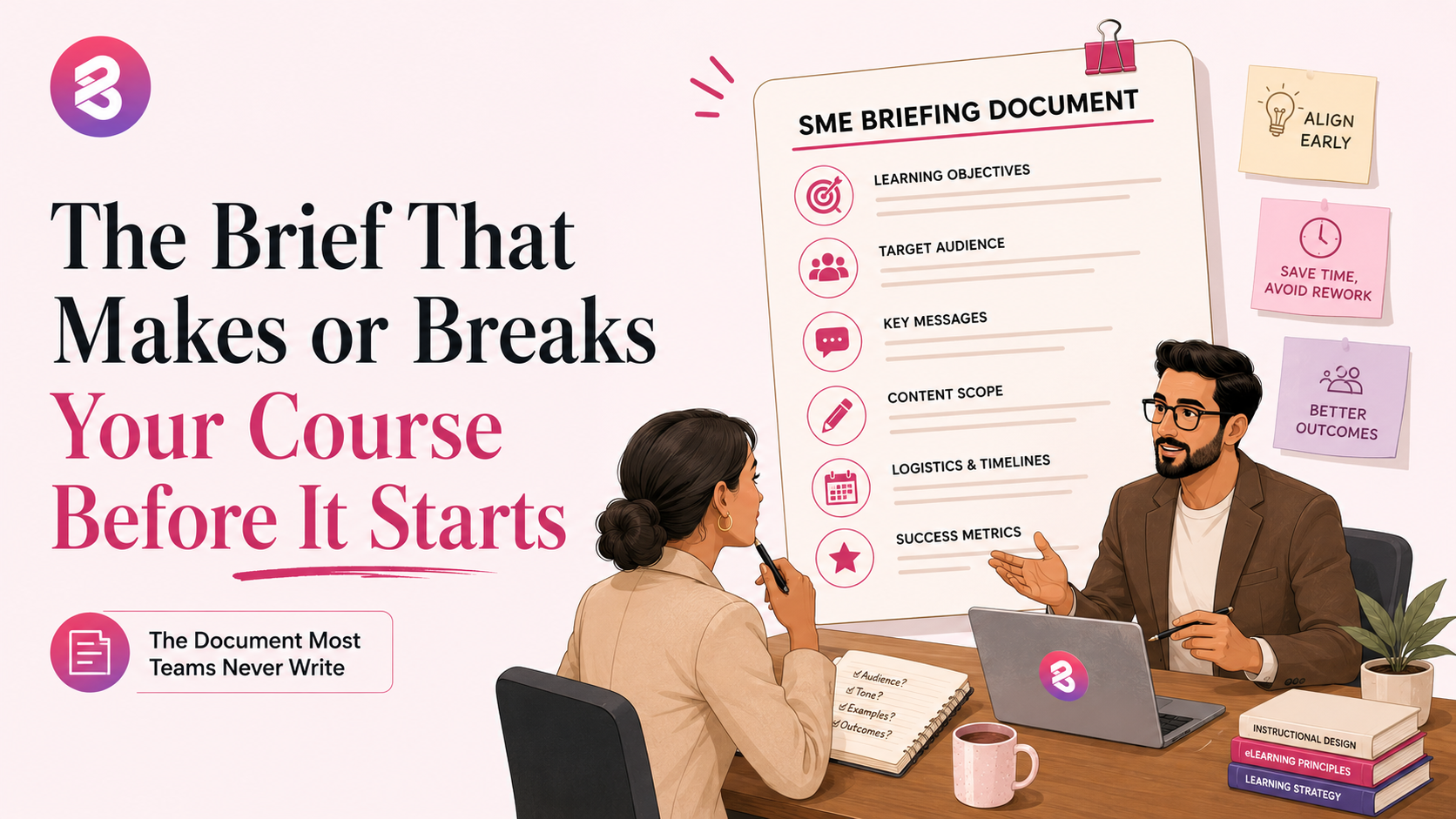
A briefing document for a subject matter expert is not a script. It is not a topic outline or a list of slides. It is a single document that answers the question the expert needs answered before they prepare anything: what exactly does this learner need to be able to do after this course, and what do I need to provide for that to happen.
Its job is to translate the course's learning design into a set of specific, actionable constraints for the expert. It tells them where their expertise is needed and where it is not. It tells them what the learner already knows and what they do not. It tells them what good looks like in terms of explanation and what to avoid. It tells them what is in scope and, just as importantly, what is explicitly out of scope.
Done well, a briefing document takes the expert's deep knowledge and channels it precisely toward what the learner actually needs. Done poorly or not at all, it leaves the expert to make those judgment calls themselves, and however good their expertise, instructional judgment is not what they were hired for.
The briefing document is the moment where the learner's needs and the expert's knowledge are aligned. Skip it and that alignment is left to chance.
What happens without it
An unbriefed subject matter expert will default to what they know: how they would explain this subject to a peer. That default produces predictable problems in a course context.
Scope creep driven by expertise. Experts know more than any single course can contain. Without a clear brief defining scope, they will include what they find important rather than what the learner needs. The course becomes dense and comprehensive in ways that obscure the core learning rather than supporting it.
Level mismatch. Without a clear learner profile, the expert pitches the content to the audience they are most comfortable imagining: someone with background similar to their own. A course built for a first-year analyst ends up written for a mid-level practitioner. The learner it was built for cannot follow it.
Structural drift. Experts organise knowledge the way their field organises it, not the way a learner builds it. The result is content that is logically coherent from a disciplinary perspective and pedagogically backwards for someone new to the subject.
Assessment that tests the wrong things. Without guidance on what success looks like, experts write assessment questions that test recall of what they said rather than the application of what the learner was supposed to learn. The assessment passes people who memorised the content and fails to surface people who understood nothing.
Re-recording. All of the above means the first recording pass produces material that needs significant rework. The expert has to come back. The timeline stretches. The budget absorbs a cost that a briefing document would have prevented.
What the document must contain
A briefing document that actually works contains eight things, in this order.
A learner profile. Not a job title. A specific description of who this person is, what they already know, what they do not know, and what they are trying to do with this knowledge once they have it. The expert needs to be able to picture this person clearly before they prepare a single explanation.
Learning objectives written as outcomes. Not topics the course will cover. Specific statements of what the learner will be able to do after completing the course that they could not do before. The difference between "this module covers financial modelling basics" and "after this module the learner will be able to build a three-statement model from a set of assumptions" is the difference between a topic list and a learning objective.
Explicit scope boundaries. What is in scope and what is not, stated clearly. If the course covers introductory financial modelling and not valuation, that needs to be written down so the expert does not spend forty minutes on discounted cash flow analysis because it felt relevant.
Level and tone guidance. A description of the register the course should operate in, with examples of good explanation for this audience and examples of the kind of explanation to avoid. Concrete examples matter here. Abstract guidance like "keep it accessible" is interpreted differently by every expert.
A worked example of what a good lesson looks like. One sample segment, ideally from a comparable course or written by the instructional designer, that shows the expert the standard they are working toward. This single addition reduces re-recording requests significantly.
Assessment criteria. What the assessment questions are testing, at what level of complexity, and what a correct answer looks like versus an acceptable partial answer versus a wrong answer. The expert should not be writing assessment questions without this.
What success looks like for this course. The business or learning outcome the course is meant to produce. If a new employee completes this onboarding module, what should they be able to do on day 30 that they could not do on day one. Grounding the expert in the real-world outcome keeps the content pointed in the right direction.
Timeline and review expectations. When the first draft is due, how many review rounds are planned, who reviews and what they are reviewing for, and what the expert's role is in each round. Ambiguity here is how projects slip past their delivery dates.
Before any of the eight components above, the briefing document needs to answer one question clearly: what is the single most important thing this learner needs to be able to do after completing this course that they cannot do right now?
Every other decision in the document — scope, level, structure, assessment — should follow from the answer to that question. If the team cannot answer it clearly before briefing the expert, the brief is not ready to be written yet.
Why most teams skip it
The briefing document gets skipped for three reasons, all of which feel reasonable in the moment and none of which hold up when the rework bill arrives.
The first is timeline pressure. The recording is scheduled, the expert is available, and writing a thorough brief feels like a delay. In practice, the two to three hours a briefing document takes to write properly is recovered many times over in the production phase when the expert delivers content that does not need to be rebuilt.
The second is confidence in the expert. They know their subject deeply. The assumption is that their expertise will navigate the course to the right place. It will navigate it to the right place from an accuracy standpoint. It will not navigate it to the right place from a learning design standpoint without guidance, because that is not what expertise in a subject provides.
The third is that nobody owns the document. Writing a good brief requires instructional design thinking, which means it needs to be owned by someone with that background. When the project team does not include an instructional designer, the brief does not get written because nobody knows it is their job to write it.
Why skipping it costs more than writing it
A re-recording session costs the expert's time, the production team's time, and the timeline buffer the project was relying on. An instructional redesign mid-production is more expensive than the original design would have been. A course that ships with structural problems because the rework budget ran out costs the organisation every time a learner completes it and does not achieve the outcome the course was built for.
The briefing document is the cheapest intervention in an e-learning project. It costs a few hours at the start and prevents the most expensive failures at every stage after it.
How ConsultBae approaches this
At ConsultBae, the briefing document is the first deliverable on every e-learning project. Before a recording date is set, before a slide template is shared, before the subject matter expert is asked to prepare anything, the brief is written, reviewed, and signed off by all parties.
The brief is written by the instructional designer working on the project, in consultation with the client and with input from the subject matter expert on the scope boundaries. The expert does not receive it as a constraint. They receive it as a map: here is the learner, here is where they need to get to, here is your role in getting them there.
In our experience, a subject matter expert who has been properly briefed produces better content faster, asks fewer clarifying questions during production, and requires significantly fewer revision rounds than one who was handed a topic and a deadline. The document most teams never write is also the document that determines whether everything that follows it works.
Shivani Agarwal leads the E-Learning vertical at ConsultBae, overseeing end-to-end course production across technology and non-technology domains.
Building a course and not sure where to start?
ConsultBae handles the full production layer — briefing, instructional design, recording, and delivery. Let us talk about what you need.
Talk to us