There is a pattern that repeats in almost every e-learning project that starts with a subject matter expert and a recording setup. The expert knows their field deeply. They have years, sometimes decades, of accumulated knowledge and real-world experience. They are the right person to build this course. And then you watch them record, and what comes out is dense, assumption-heavy, and structured the way an expert thinks rather than the way a beginner learns.
The course gets built. It gets published. And then the completion rates and assessment scores come back, and they tell a story about a learner who made it through the material without actually absorbing it.
This is not a failure of the subject matter expert. It is a failure of how the production process was designed around them.
Why deep expertise creates a teaching problem
There is a well-documented phenomenon in learning science sometimes called the curse of knowledge. Once you have internalised something deeply, it becomes genuinely difficult to remember what it was like not to know it. The gaps that a beginner experiences, the missing context, the unfamiliar terminology, the connections that are not yet obvious, become invisible to the person who has long since filled them in.
A subject matter expert sitting down to build a course will almost always start from where their knowledge lives, not from where the learner is. They will skip steps that feel obvious to them and that are not obvious at all to someone new. They will use terminology without defining it because the definitions are so embedded they no longer register as something that needs explaining. They will structure content around how the subject is organised in their own mind rather than around the learning journey of someone encountering it for the first time.
None of this is carelessness. It is the natural consequence of knowing something well. The problem is that it produces courses that inform without teaching, that transfer information without transferring understanding.
The subject matter expert's knowledge is the asset the course needs. Their instinct for how to present it is often the biggest obstacle to the learner receiving it.
What happens when you hand an expert a recording setup and a brief
The most common approach to building an e-learning course around a subject matter expert is to give them a structure, a recording setup, and enough time to walk through the material. The assumption is that the expertise will carry the course.
What typically happens instead is that the expert records content the way they would explain it to a colleague, not to a learner. The pacing reflects their natural speaking rhythm, not the rhythm a learner needs to absorb new information. The examples they reach for are drawn from their own experience, which is rich and real but often too advanced or too context-specific to land for someone without that background.
The assessment questions at the end, if they exist, test recall of what was said rather than understanding of what was meant. The screen recordings, if there are any, capture what the expert does without explaining why each step matters or what a mistake at that point would cost.
The result is a course that the subject matter expert would find accurate and complete, because from their perspective it is. The learner experiences something different: a flood of information delivered without the scaffolding that would make it stick.
The fix: separating expertise from delivery
The answer is not to remove the subject matter expert from the process. Their knowledge is irreplaceable and the course cannot exist without it. The answer is to stop asking them to do jobs they were never trained for, and to bring in the people who are trained for those jobs instead.
At ConsultBae, the e-learning vertical is built around exactly this principle. We work as an end-to-end production partner for organisations that need courses built, which means we plug in the specific capabilities the subject matter expert cannot provide alongside the expertise they can.
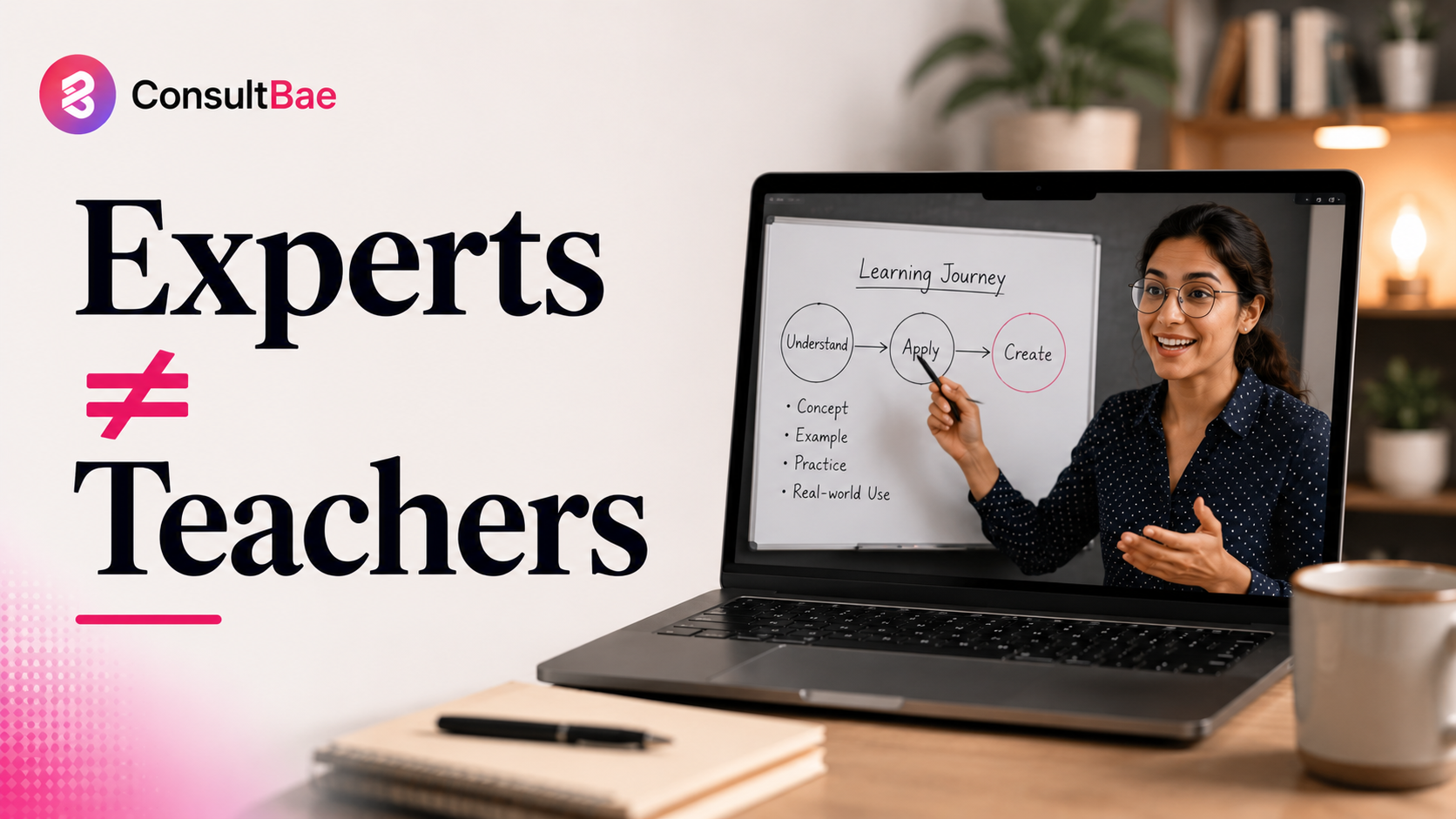
An instructional designer takes the expert's knowledge and restructures it around how learning actually works. They identify the assumed context, fill the gaps, sequence the content so each piece builds on what came before, and write objectives that describe what the learner will be able to do rather than what the course will cover.
Assessment writers build questions that test understanding rather than recall. The difference matters enormously for whether a course produces behaviour change or just certificate completion.
Screen recorders and professional actors handle the delivery layer. Subject matter experts are often deeply uncomfortable on camera, and it shows. The knowledge is present but the presentation creates friction that pulls the learner's attention away from the content. A professional actor who has been thoroughly briefed on the material can deliver it with the clarity and presence the learner needs. For screen-based content, a dedicated screen recorder captures the process cleanly, with the right pacing and the right emphasis on each step.
The subject matter expert provides the core knowledge: the concepts, the examples, the judgments that only come from real experience in the field. That is their role and it stays theirs.
Around that, ConsultBae brings in instructional designers to restructure the content for learning, assessment writers to build evaluation that actually tests understanding, and professional actors or on-camera specialists to handle delivery where the expert is not comfortable presenting.
The expert reviews and approves at each stage. The expertise remains central. What changes is that every other part of the course production is handled by someone trained specifically for that part.
Why this matters more than most e-learning teams acknowledge
The e-learning industry has spent years optimising for production speed and content volume. More courses, faster delivery, lower cost per hour of content. What has not kept pace is the question of whether the content actually produces the learning outcomes it was built for.
A course that completes without producing understanding is not a course. It is an expensive checkbox. The learner sits through it, passes the assessment that tests recall of surface information, and returns to their work with no change in what they are able to do.
Fixing this does not require replacing subject matter experts. It requires stopping the practice of asking them to carry the entire production process when their actual value is confined to one part of it. The knowledge they hold is the reason the course exists. The production layer around that knowledge is what determines whether the course delivers on that reason.
ConsultBae's e-learning vertical exists precisely to provide that production layer, built around the subject matter expert rather than in spite of them, so the expertise that makes a course worth taking is the same expertise the learner actually receives.
Shivani Aggarwal leads the E-Learning vertical at ConsultBae, overseeing end-to-end course production across technology and non-technology domains.
Building a course around a subject matter expert?
ConsultBae provides the full production layer: instructional design, assessment writing, professional recording, and delivery. Let us talk about what you are building.
Talk to us