The popular version of the AI-in-e-learning story goes like this: artificial intelligence writes the course, costs come down, platforms produce more content faster, human involvement shrinks. It is a tidy narrative and it is mostly wrong in one critical respect.
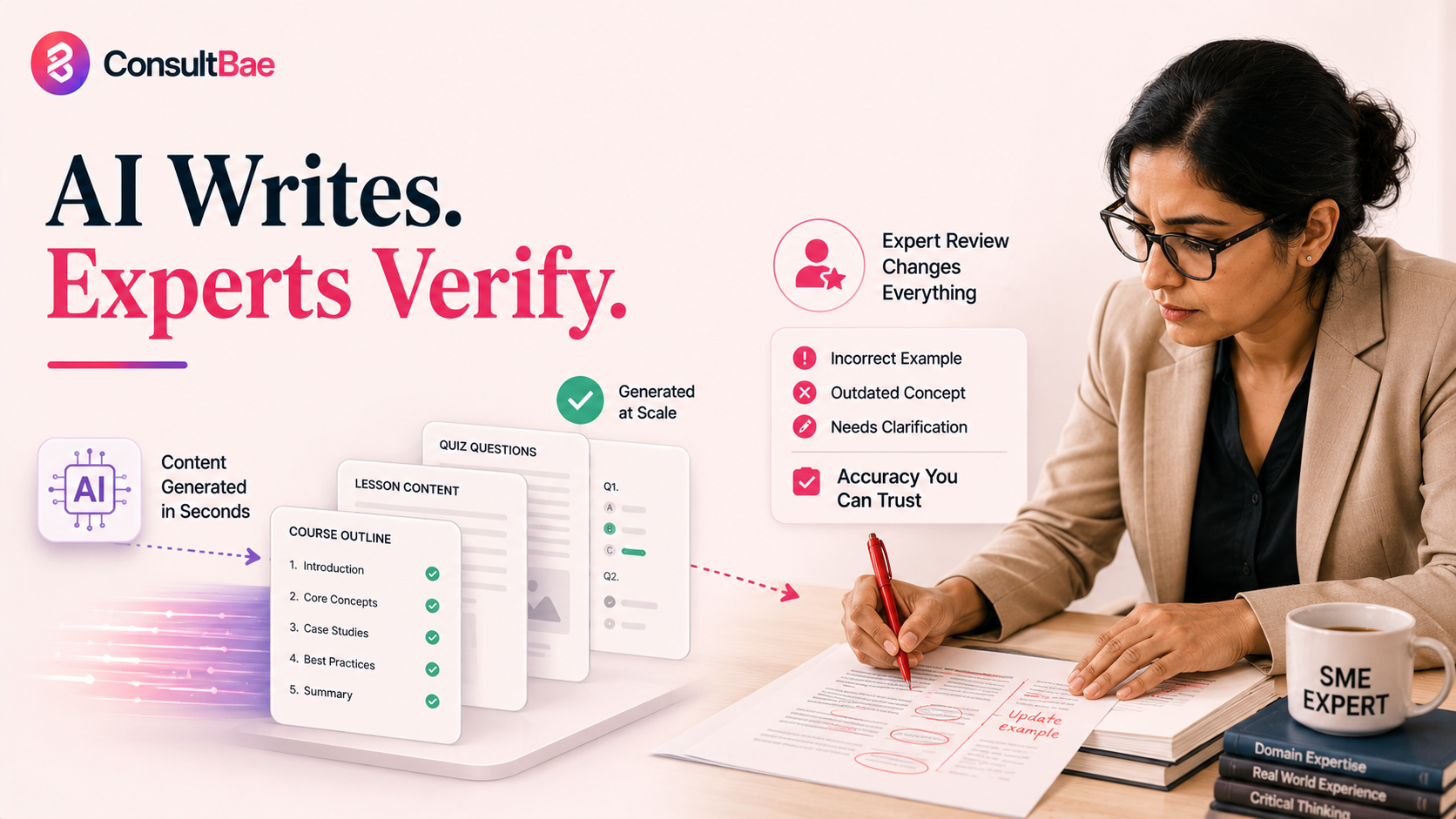
What actually happened is that AI took over the first draft. The structural work of outlining a course, generating quiz questions, producing explanatory prose for standard concepts: these tasks are now handled faster and cheaper than they were before. But the value of a certification course to the learner has never come from structural correctness. It has come from practical accuracy, which means alignment between what the course claims and what actually happens in the real world when a practitioner uses the tool or applies the skill being taught. That accuracy cannot be generated. It can only be verified, by someone who has done the work recently enough to know the difference.
The result is that AI has not reduced the need for subject matter experts. It has changed their role from content creator to validator, and that change has made finding the right expert both more important and more difficult than before.
What AI-Generated Course Content Actually Looks Like
A platform building certification courses today may use artificial intelligence to generate a first-pass curriculum structure, draft the explanatory text for each module, produce a set of multiple-choice assessment questions, and suggest a sequence for presenting concepts. This content can be remarkably coherent. It can pass a surface-level quality check. It will describe the correct steps for using a given tool and explain the underlying logic in terms that are technically accurate as of a certain point in time.
What it cannot do is reflect the specific texture of how practitioners actually use the tool today. The shortcut that everyone in the field knows. The edge case that the official documentation doesn't mention. The workflow that has emerged in the past eight months because a new integration changed how people work. The way the interface behaves when you combine it with a specific other tool. These details are not in the training data that generated the course. They are in the working memory of someone who uses the tool every day.
This is the gap that a subject matter expert is asked to close. Not to rewrite the course. Not to create content from scratch. To review what has been generated, identify where the practical reality diverges from the generated text, and provide the corrections, additions, and real-world context that lift the course from technically adequate to professionally credible.
Why Validation Is a Different Skill from Creation
An expert who would have been excellent at creating a course from scratch is not automatically excellent at validating one. The skills are related but distinct.
Creating a course from scratch requires the ability to structure knowledge for a new learner: identifying what needs to be taught first, what assumptions cannot be made, where common misunderstandings occur, and how to build the learner's confidence progressively. This is a pedagogical skill, and it takes a particular kind of communicator.
Validating an AI-generated course requires a different orientation. The validator needs to read what was generated and immediately recognise where it is outdated, oversimplified, or practically misleading. This requires not just expertise but a critical disposition, the ability to read a technically correct description and still identify that it will fail a practitioner who tries to follow it in a real work context. Not every expert has this. Some subject matter experts are so expert that they find the basic-level content correct and don't notice what is missing for a learner who is not already expert.
"What we need is someone who has hands-on, day-to-day experience with the specific tool. Not someone who used it two years ago. Not someone who teaches it theoretically. Someone who opened it this week and can tell us what it actually does."
The Three Humans Every AI-Assisted Course Still Needs
The misconception that AI reduces the human requirement in course production usually comes from conflating different types of human involvement. There are, in practice, at least three distinct human roles that no AI-generated course can eliminate, and confusing them with each other is what causes most hiring mistakes in this space.
The first is the subject matter expert: the practitioner who validates content accuracy, provides real-world context, and in some cases records tool demonstrations that show the software in action from the perspective of someone who actually uses it. This person's value is their current, practical knowledge, not their ability to perform.
The second is the on-camera talent or actor: the person who delivers the course to the learner in a way that is engaging, clear, and appropriately paced. This person's value is their communication skill and screen presence, not their knowledge of the subject. In most production pipelines, these are different people from the subject matter expert, because the skills rarely overlap in the same individual at the required level for both.
The third is the voiceover artist: the person who records narration for screen demonstrations, explainer segments, or translated versions of the course. This role is distinct from both the expert and the actor and requires its own specific capability, including a neutral accent appropriate for the target audience and the technical ability to record clean audio in a home or studio environment.
What Platforms Get Wrong When They Hire for This
The most common mistake is treating subject matter expert selection as a credentials exercise. The platform identifies the domain, searches for professionals with relevant titles and qualifications, and offers the role to whoever looks most impressive on paper. This produces a shortlist of people who know the subject but may not meet the actual requirements of the validation role.
A credential confirms past knowledge. A certification from two years ago says that the person was qualified at the time of certification. It says nothing about whether they have kept pace with a tool or practice area that may have changed substantially since then. It says nothing about their communication clarity, their availability, or their willingness to engage with AI-generated content critically rather than deferring to it.
What actually matters is recent practical experience, meaning real use of the specific tool or skill in professional work within the past twelve months. It is communication clarity, demonstrated through an introductory video rather than inferred from a title. It is availability for the project timeline, confirmed explicitly rather than assumed. And it is a disposition toward critical engagement with the material: the ability to read a course and identify what is wrong with it, not just confirm that the broad strokes are correct.
Has the expert used this specific tool or practice in active professional work within the last 12 months?
Can they identify a concrete example of where the official documentation or a typical AI-generated description would mislead a practitioner?
Do they communicate clearly in an introductory video without extensive coaching?
Are they available for the full project duration, including revision rounds?
Have they reviewed and agreed to the deliverable expectations before work begins?
How to Build a Sourcing Pipeline That Scales
The demand for AI content validators is growing alongside the volume of AI-generated content. Platforms that understand this are not hiring one subject matter expert at a time for each new course. They are building pipelines: curated pools of pre-vetted practitioners across specific tool categories and domains, who have been screened, onboarded, and are ready to engage when a new project brief arrives.
This requires an ongoing investment in relationship management that most platforms are not structured to make internally. The expert pool needs to be refreshed regularly as tools evolve and as practitioners' knowledge currency changes. A validator who was excellent for a course on a particular project management tool 18 months ago may no longer be the right person if that tool has undergone a significant redesign. Keeping the pool current requires someone whose job is to know the pool, maintain the relationships, and update the qualification criteria as the tool landscape shifts.
AI has made course production faster and cheaper at the content-generation stage. It has, in doing so, concentrated the quality premium on the validation stage, because that is now where the difference between a credible course and a generic one lives. The platforms investing in validator pipelines today are building the competitive advantage that the market will reward as AI-generated content continues to spread and learners become better at recognising when a course is authentically expert-validated versus when it is not.
Need Subject Matter Experts for AI-Assisted Course Production?
ConsultBae maintains a pool of vetted practitioners across 40 plus domains for e-learning validation, tool demonstrations, and course delivery. We match experts to briefs and manage the engagement end to end.
Talk to Our E-Learning Team