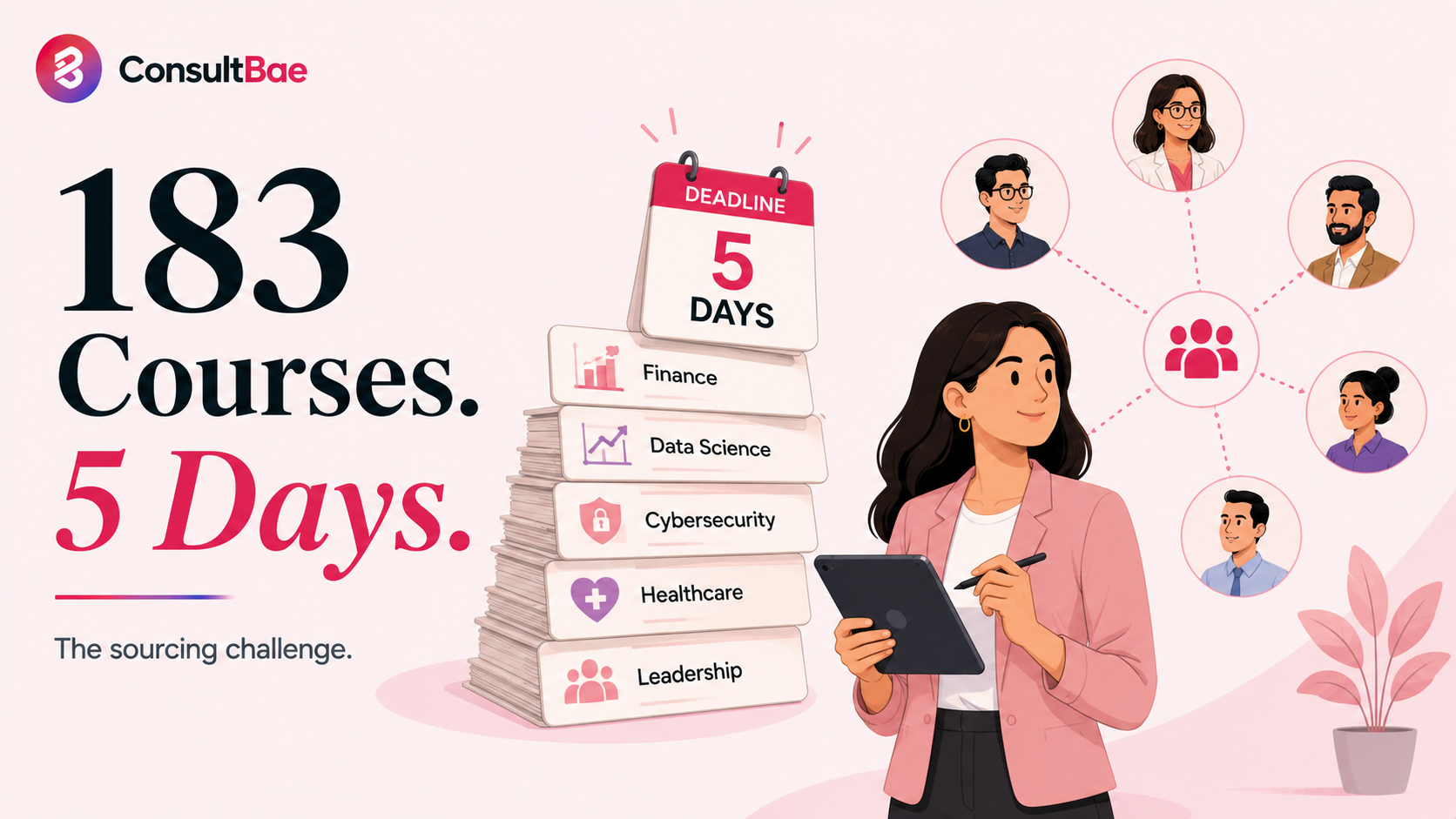
The call came in at 9 in the evening. By morning, the deadline was already on the calendar: 183 certification courses, subject matter experts needed, 5 days to submit profiles. Not 5 weeks. Not 5 months. Five working days.
Most people reading that sentence will think the hard part is finding 183 experts. It isn't. The hard part is finding the right number of experts so that the actual working number, after drop-offs, scheduling conflicts, communication gaps, and simple human unavailability, is still enough to keep the project moving. That is a very different problem, and it's one that most e-learning platforms quietly face every time they try to scale production.
What the Production Pipeline Actually Looks Like
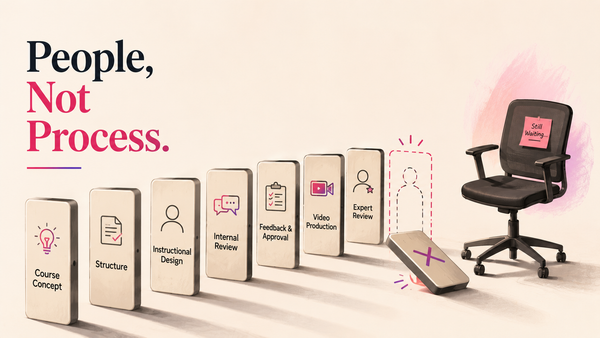
A certification course, at the level of quality a major learning platform demands, does not get built by one person. The person who knows the subject is rarely the person who can design the curriculum. The person who designs the curriculum is rarely the person who can perform it on camera. The person who performs it on camera is rarely the person who can do the voiceover with a neutral accent for a global audience. And none of those people is the Storyline or Articulate developer who integrates everything into the platform.
In practice, a single course can pass through four or five distinct hands before it goes live. Subject matter expert, instructional designer, on-camera talent or voiceover artist, content integrator, and a final reviewer who checks the output against industry standards. When a platform needs to produce 183 of these simultaneously, the coordination problem grows faster than the headcount does.
What makes this particularly difficult is that each role requires a different kind of sourcing. You cannot find a subject matter expert the same way you find a professional actor. You cannot find an instructional designer the same way you find a voiceover artist. Each pool of people has its own platforms, its own expectations, its own rate of availability, and its own reasons for saying no at the last minute.
Why One Subject Matter Expert Is Never Enough
The instinct, when a client says they need one expert per course, is to find exactly that: one expert per course. It feels clean. It feels efficient. It is almost always wrong.
Subject matter experts are, by definition, people with full-time careers. A cardiologist, a marketing director, a data engineer, a certified financial planner: these are people whose primary identity is not "course contributor." They are doing this work on the side, for a variety of reasons, from building credibility to earning supplemental income to genuinely enjoying teaching. That means their availability is unpredictable, their timelines are subject to the demands of their primary jobs, and their ability to meet a production schedule is not guaranteed.
On a single-course project, this is manageable. You build a relationship, you work around the expert's schedule, and you deliver. On a 183-course project with a hard deadline, it is a structural risk that needs to be addressed through volume, not trust.
The working assumption that experience has taught us: for every expert who will actually complete the project on schedule, you need two more in reserve who have been vetted and briefed and are ready to step in. That means a 183-course project doesn't require 183 vetted subject matter experts. It requires closer to 550.
The Backup-for-the-Backup Problem
There is a version of this conversation that sounds excessive. Why would you need three candidates for every course slot? Isn't that overhiring? The answer becomes obvious the moment you run a project at scale and watch what actually happens in the first two weeks.
The expert you selected for course 47 is travelling for work that week. The expert for course 112 has a family situation. The expert for course 88 was initially enthusiastic but has gone quiet on follow-ups. The expert for course 23 wants to participate but cannot sign the agreement on the timeline required. None of these people did anything wrong. These are simply the normal failure modes of working with humans who have other priorities, at volume, under a tight deadline.
If you hired one expert per course, your project is now running behind before week two. If you hired one expert and one backup per course, you are still exposed. If you hired one expert and two backups per course, you have room to absorb the normal rate of attrition and keep the pipeline healthy. The backup for the backup isn't pessimism. It's project management.
"You hire 150 people and end up working with 60. But you cannot hold freelancers fully accountable for that. It's your responsibility to ensure the project still moves."
How Vetting Goes Beyond the Resume
A subject matter expert for a certification course is not the same as a job candidate for a permanent role. The hiring criteria are different, and applying the wrong framework wastes time on both sides.
What a platform actually needs is not a person with an impressive title. It needs a person with hands-on, recent, practical experience using the specific tool or skill the course is teaching. A senior professional who used a particular software three years ago and has since moved on is not the right fit, even if their credentials look ideal on paper. The platform's learners are practitioners. The course has to hold up to scrutiny from people who will immediately spot gaps between what the expert is saying and what the tool actually does today.
Vetting for this means asking for introductory videos, not just resumes. It means checking communication skills, because even a technically brilliant expert who cannot explain clearly will not produce a usable course. It means checking availability explicitly, not assuming it. And it means checking the fit between the expert's real-world experience and the specific course brief, not just the general domain.
Recent, hands-on experience with the specific tool or skill being taught, not just the broader domain.
An introductory video that demonstrates communication clarity and on-screen presence.
Confirmed availability for the project timeline, including buffer time for revisions.
A signed agreement that aligns expectations on deliverables, timelines, and usage rights before work begins.
What a Capacity Partner Actually Does
There is a version of what we do that sounds simple: we find people. That description is accurate but incomplete. Finding people is the starting point. What comes after is the part most platforms underestimate when they decide to manage sourcing in-house.
Once a subject matter expert is vetted and onboarded, the relationship doesn't end. The capacity partner becomes the communication layer between the expert and the production team. When a brief is unclear, the capacity partner clarifies it before the expert wastes time going in the wrong direction. When a deadline is shifting, the capacity partner manages the expectation on both sides. When a payment milestone falls due, the capacity partner processes it so the expert's workflow isn't interrupted by an unresolved invoice. When the project needs someone different, the capacity partner has the backup ready and can make the substitution without the production team needing to restart the search from scratch.
This is not glamorous work. It is coordination, communication, and process management at volume. But it is exactly the work that determines whether a 183-course project delivers on time or quietly misses its window.
The e-learning industry is growing quickly, and the production volumes are growing with it. The platforms that scale successfully are not the ones that found the best individual experts. They are the ones that built the most resilient sourcing pipelines behind those experts, with the reserves and the infrastructure to absorb the inevitable variability that comes with working with human beings at scale.
That pipeline is the part nobody talks about in the case studies. It is usually the reason things worked.
Building Courses at Scale?
ConsultBae provides end-to-end capacity support for e-learning platforms, from subject matter expert sourcing to instructional designers, actors, and voiceover artists.
Talk to Our E-Learning Team