
Building a 200+ PhD Talent Pipeline in 30 Days
How a structured sourcing and screening model built a 200+ STEM PhD talent pipeline in 30 days and onboarded around 50 experts for AI training and evaluation projects.
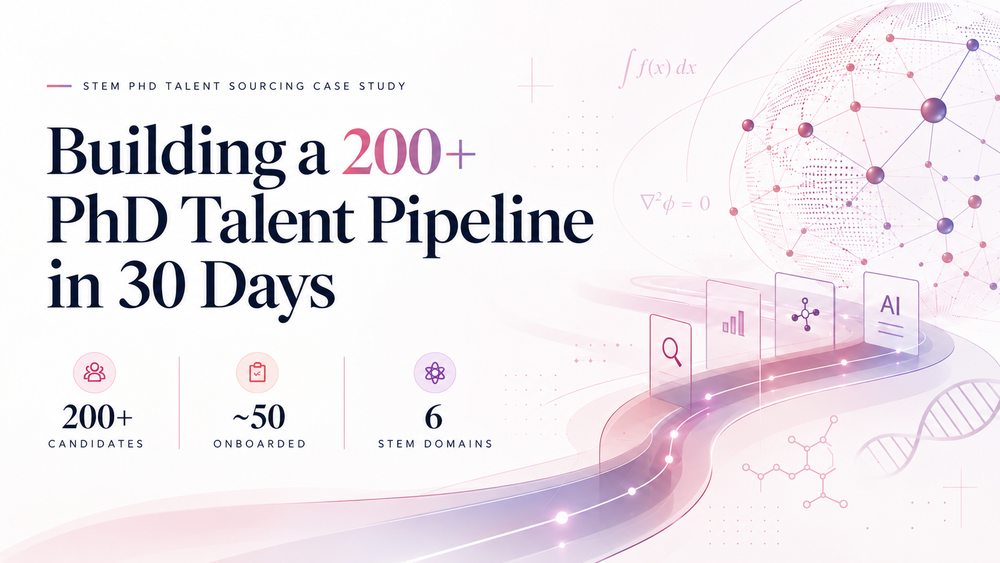
Building a 200+ PhD Talent Pipeline in 30 Days
A leading AI research and data company needed to build a large pool of PhD-qualified STEM experts for AI training and evaluation projects. The requirement spanned six technical domains (Mathematics, Biology, Physics, Chemistry, Engineering, and Material Science), with separate coding and non-coding tracks depending on the nature of the work.
The timeline was aggressive: one month.
The challenge was not simply to identify PhD holders. The client needed candidates who combined advanced academic qualifications with relevant domain expertise and, for coding tracks, strong programming capability, particularly Python.
At the same time, the hiring had to happen at scale without lowering the screening bar.
Within 30 days, the project generated a pipeline of more than 200 candidates, with approximately 50 PhD experts successfully onboarded and actively working.
The Requirement
The client needed PhD-level experts across six STEM disciplines:
Mathematics
Biology
Physics
Chemistry
Engineering
Material Science
Each discipline was divided into two distinct talent tracks.
The coding track prioritised candidates with strong programming capability, particularly Python. The non-coding track focused more heavily on deep subject-matter expertise.
This meant the search could not treat STEM PhDs as one homogeneous talent pool. A Mathematics PhD with strong Python skills represented a very different profile from a Chemistry PhD being assessed primarily for subject expertise.
The sourcing model therefore had to deliver both breadth and precision: enough reach to build a large pipeline quickly, while maintaining sufficient structure to ensure each candidate remained relevant to the exact domain and workstream.
Why the Search Was Difficult
PhD-level talent is naturally more limited than conventional professional hiring pools.
Many qualified researchers, postdoctoral professionals, and subject specialists are not actively applying for jobs. They may be working in academia, research institutions, consulting, or specialised project environments, which makes them difficult to reach through a single recruitment channel.
The available pool becomes even narrower when domain specialisation and programming requirements are added.
The client also needed volume, which created a difficult balance between speed and selectivity.
A high-volume sourcing strategy without clear segmentation could easily produce hundreds of irrelevant profiles.
A highly selective approach without sufficient sourcing breadth could fail to generate enough candidates.
The project therefore had to solve both problems at the same time: build scale quickly while preserving quality and relevance.
The Approach
The assignment was treated as a pipeline-building exercise rather than a collection of individual vacancies.
That distinction shaped the delivery model.
Instead of sourcing reactively for one role at a time, the process was designed to create a continuous flow of qualified candidates across multiple domains and keep enough depth in the pipeline to support ongoing onboarding.
Segmenting the Talent Pool
The first step was to map each STEM domain separately and divide candidates into coding and non-coding tracks.
This created clearer sourcing profiles and reduced ambiguity around what constituted a qualified candidate.
Python-proficient candidates were prioritised for coding roles, while domain depth remained the primary consideration for non-coding positions.
In practical terms, the search focused on specific combinations such as:
Mathematics + PhD + Python
Biology + PhD + subject expertise
Engineering + PhD + coding capability
and equivalent profiles across the remaining domains.
This segmentation prevented broad STEM sourcing from becoming unfocused.
Multi-Channel Sourcing
Relying on one platform would not have produced the required volume or diversity.
Sourcing was therefore conducted across multiple job platforms and professional communities at the same time to reach PhD holders, postdoctoral researchers, and domain specialists across all six disciplines.
This widened the search beyond candidates already active in traditional recruitment channels.
For specialised academic talent, that was especially important because many strong candidates sit outside conventional hiring pipelines.
Screening for Actual Fit
Each candidate was assessed against the core requirements before progressing further.
The screening focused on:
Relevant STEM domain
Required qualification level
Coding capability where applicable
Python proficiency for coding tracks
This helped prevent the pipeline from becoming inflated with candidates who appeared relevant at a broad level but were not suited to the actual work.
The objective was to build a qualified pipeline, not simply a large database.
Creating Client-Ready Profiles
Candidate documentation was collected and organised before submission so that profiles reached the client in a structured, complete, and easy-to-review format.
This reduced avoidable back-and-forth during the review process.
For a high-volume engagement, small administrative delays can compound quickly. Missing qualification details, incomplete documentation, or unclear skill profiles can slow down dozens of decisions when repeated across a large pipeline.
Standardising the candidate package helped make the review process more efficient.
Batch Submission and Pipeline Tracking
Shortlisted candidates were shared with the client in batches instead of waiting for the entire search to be completed.
Each candidate's progress was tracked from outreach through screening, submission, selection, and onboarding.
This kept the pipeline active throughout the month and gave the client a continuous flow of qualified options.
It also made bottlenecks easier to identify. Rather than only seeing the final number of hires, the team could track where candidates were progressing, dropping out, or waiting for decisions.
Supporting Onboarding
Selected experts were guided through the client's onboarding requirements before beginning work.
This stage mattered because the real value of a sourcing pipeline is not measured by the number of profiles identified.
It is measured by how many qualified people successfully move through the process and begin contributing to the project.
The Result
Within one month, the project delivered:
200+ candidates in the talent pipeline
Approximately 50 PhD experts onboarded and actively working
Coverage across 6 STEM domains
Both coding and non-coding tracks
A repeatable sourcing and screening process that could support future bulk-hiring requirements
The result was not simply a large number of profiles.
It was a structured talent pipeline capable of supporting a specialised AI programme across multiple STEM disciplines at the same time.
Why the Model Worked
Several elements contributed to the outcome.
Clear segmentation kept sourcing focused and made screening more consistent.
Multi-channel sourcing expanded the reach beyond what a single recruitment platform could deliver.
Complete candidate documentation reduced unnecessary back-and-forth and helped speed up client decisions.
Most importantly, pipeline thinking created depth.
The objective was not to deliver a handful of candidates and restart the search every time a new requirement appeared. The goal was to maintain enough qualified options so the client could continue onboarding talent as the project scaled.
Key Takeaway
Bulk hiring for highly specialised talent is not simply a sourcing problem.
It is a pipeline-design problem.
The process needs enough reach to generate volume, enough segmentation to preserve relevance, enough screening discipline to protect quality, and enough operational structure to move candidates efficiently from outreach to onboarding.
For this project, that approach resulted in 200+ PhD candidates entering the pipeline in 30 days and approximately 50 experts progressing to active project work.
The engagement demonstrated that even scarce, highly qualified talent can be recruited at scale when the sourcing model is built around structure, segmentation, and pipeline depth rather than individual vacancies.