When a company begins looking for a data collection partner and asks how contributors are sourced, the answer they expect usually involves some combination of a large database, a crowdsourcing platform, and a few clicks of a filtering tool. This is roughly how recruitment sourcing works. It is almost entirely unlike how AI data contributor sourcing works, and the confusion between the two is responsible for a significant proportion of the collection projects that fail to deliver their promised demographics or volume.
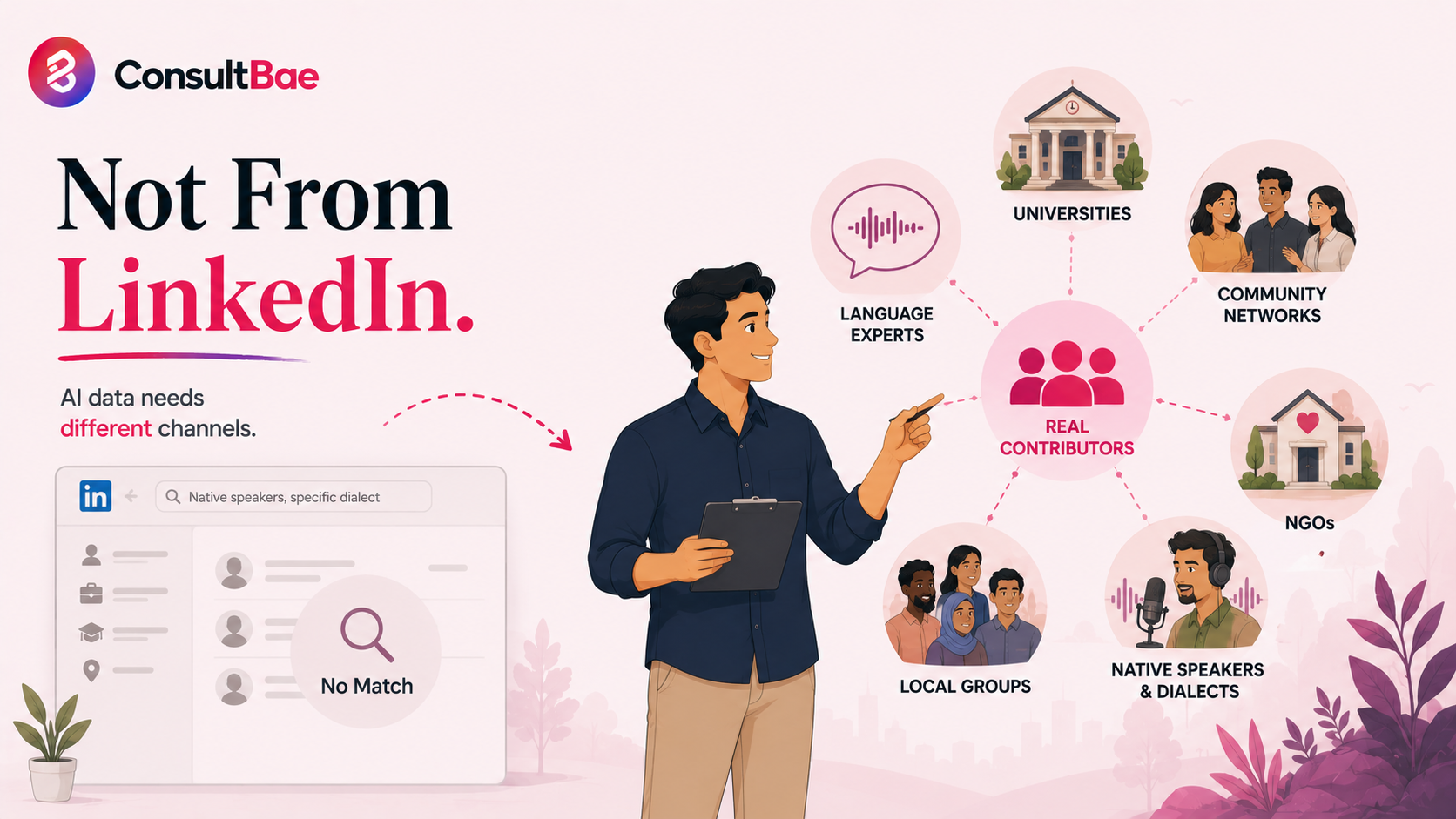
A recruitment database is built around professional identity: job titles, skills, work histories, educational credentials. A data collection project needs none of that. It needs demographic attributes that are almost entirely absent from professional profiles: native language, regional dialect, accent, age range, geographic location at a granular level, and in some cases specific physical or social characteristics that affect the quality of the data for the model's intended use case. The people who have those attributes are not concentrated on LinkedIn or any other professional platform. They are distributed across the general population in ways that require completely different sourcing approaches to reach.
Why Standard Talent Platforms Don't Work for Data Collection
Professional talent platforms are designed to connect employers with workers who have marketable skills. Their search infrastructure is built around job function, industry, experience level, and geography at a city or country level. These attributes are useful for recruitment. For data collection, they are almost entirely irrelevant.
A project requiring 200 native speakers of a specific regional dialect does not benefit from a database of professionals in that region. The professional database may contain some of those speakers, but it has no way to identify them as such because native language and dialect are not fields that professional profiles capture with any reliability. A filter for location will return everyone in the area regardless of linguistic profile. A filter for language skills will return people who list the language under proficiencies, which is a meaningless proxy for native speaker status with a specific regional accent.
The same limitation applies to image and video collection projects that require specific demographic distributions. Age, gender, and ethnicity are not fields in professional databases. Reaching a target demographic requires going directly to the communities where those people are, not searching a database that was designed to capture something else entirely.
The Three Channel Types That Actually Produce Contributors at Scale
The channels that work for AI data contributor sourcing fall into three broad categories, each with different reach, different reliability, and different requirements in terms of the relationship investment needed to activate them.
The first is dedicated crowdsourcing platforms built specifically for micro-task and data collection work. These platforms have pools of contributors who have opted in to doing this type of work, and they operate in certain languages and geographies with reasonable depth. Their limitation is coverage: they tend to be strongest in English-language markets and in countries with established gig economy infrastructure. For less common languages, minority dialects, or specific geographic demographics in markets where crowdsourcing platforms have shallow reach, these channels produce insufficient volume and insufficient demographic precision.
The second is community-based sourcing, which means identifying and engaging the communities, organisations, and networks where the target population is already concentrated. This includes cultural associations, community radio stations, diaspora networks, religious organisations, regional media outlets, and any other entity that has an existing relationship with the demographic profile required. These channels require relationship investment, they do not activate with a platform credit card, but they produce contributor pools with genuine demographic authenticity that no automated platform can replicate.
The third is institutional partnerships, primarily with universities, research institutes, and non-governmental organisations. University linguistics departments routinely work with native speaker communities for their own research. They have existing consent frameworks, participant networks, and academic credibility that makes contributor recruitment significantly easier in some markets than direct community outreach. Non-governmental organisations in target geographies may have community networks and local trust that make them effective sourcing intermediaries for populations that are otherwise difficult to reach.
"We started engaging with professors in universities, with small organisations based in those countries, with NGOs that can contribute. In every new country, the first question is not which platform to use. It is who already has access to the people we need."
How Community Networks and Academic Partnerships Fill the Gap
The value of community networks and academic partnerships for data collection sourcing is not just their access to the right people. It is the trust they carry with those people. A message from an unknown company asking members of a linguistic community to record audio samples for an AI training project will not convert well, regardless of how it is positioned. The same request coming through a community organisation or a university research program that the community already trusts converts at a meaningfully higher rate, with better demographic compliance and better quality output.
This trust differential is not small. It is the difference between a contributor pool that is genuinely representative of the target demographic and one that is nominally representative on paper but filled in practice with whoever happened to sign up through a cold channel. For a speech model that needs authentic regional accent variation, the quality of the trust relationship that brought the contributors in is directly reflected in the quality of the data they produce.
Building these institutional relationships takes time and is market-specific. A professor at a linguistics department in one country is not a connection that transfers to another country. A community organisation that serves a specific diaspora in one city does not have reach into the same community in a different city. Each relationship is local, each one requires individual outreach, and each one produces a sourcing asset that cannot be replicated by any amount of investment in platform-based infrastructure.
What Channel Mix Looks Like for Different Data Modalities
The right channel mix for a data collection project depends heavily on what type of data is being collected, because each modality requires a different type of contributor with different demographic considerations and different sourcing challenges.
Voice and audio collection, which involves native speakers recording speech samples in specific languages, accents, and dialects, relies most heavily on community and institutional channels. The demographic specificity required, not just language but dialect and regional accent, is too fine-grained for automated platforms to deliver reliably. The community channel is typically dominant for voice projects, supplemented by crowdsourcing platforms in geographies where their linguistic coverage is adequate.
Image collection, which may require contributors in specific age ranges, presenting specific physical characteristics, or located in specific environments, uses a broader mix. Crowdsourcing platforms can work for generic demographic distributions. More specific requirements, such as images of hands performing tasks in specific cultural contexts, or faces representing specific ethnic or age demographics, require community sourcing for the same reason as voice: the specificity exceeds what automated platforms can reliably deliver.
Text and annotation work has the broadest channel coverage because it is less demographically constrained. General crowdsourcing platforms work well for many annotation tasks, supplemented by specialist contributor networks for domain-specific annotation that requires expertise rather than just demographic profile. The domain expert network developed through the e-learning and recruitment verticals is directly applicable here, which is one of the ways the three verticals reinforce each other at the sourcing level.
Voice and audio: Community organisations, cultural associations, diaspora networks, university linguistics departments. Crowdsourcing platforms as a supplement where linguistic coverage is adequate. Institutional partnerships for difficult or low-resource languages.
Image and video: Community sourcing for demographically specific requirements. Crowdsourcing platforms for generic demographic distributions. Local field coordinators in markets where remote contributor management is insufficient.
Text and annotation: General crowdsourcing platforms for high-volume, low-specificity tasks. Domain expert networks for specialised annotation requiring professional knowledge. Academic and research networks for linguistic or cultural annotation tasks.
Physical AI and sensor data: Specialised recruitment through professional networks for contributors who can perform specific physical tasks in specific environments. Community-based sourcing for demographic diversity in physical characteristic data.
How Infrastructure Across 100 Countries Gets Built
Building sourcing infrastructure in a new country does not begin with a platform search. It begins with a landscape assessment: who are the relevant community organisations, what academic institutions have relevant linguistic or demographic research programs, what local companies operate in adjacent spaces and might have community connections, and what communication channels are actually used by the target population in that market.
This assessment produces a list of first contacts: the professor, the community organisation director, the local partner who has existing trust with the target population. Each contact requires individual outreach tailored to the context. A linguistics professor in a European university requires a different type of conversation than a community radio station in Southeast Asia or a diaspora association in West Africa. The pitch, the value exchange, and the relationship management all differ by context.
What this infrastructure produces, once it is built, is a sourcing capability that a new entrant cannot replicate quickly. The relationships are specific to the market, specific to the organisation, and specific to the trust that has been built over time through delivering what was promised. A competitor with better technology and a larger general database cannot shortcut the relationship work that produces authentic demographic sourcing in a market they have not been operating in. That is the durable competitive advantage of contributor channel infrastructure, and it is why the investment in building it country by country, organisation by organisation, is worth the time it requires.
Need Contributors in Specific Languages, Demographics, or Geographies?
ConsultBae operates contributor networks in 100 plus countries across all four data modalities, built through community, institutional, and platform channels matched to the specific demographic requirements of each project.
Talk to Our AI Data Team