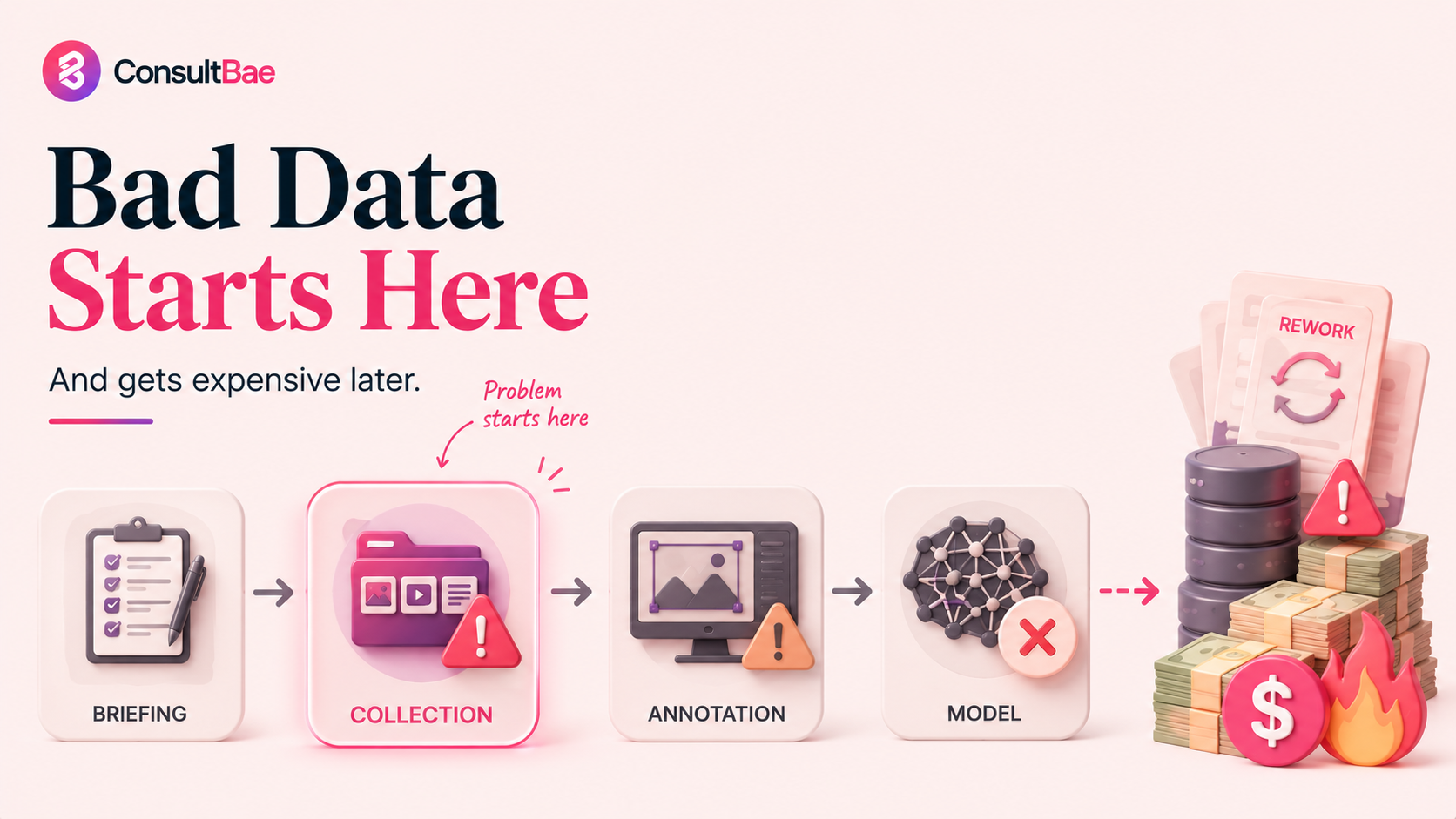
Every problem in an AI data project has a cost curve, and the shape of that curve is consistent across almost every project. The same issue, a misunderstanding about how a certain case should be handled, a gap in the demographic coverage, an ambiguity in the labelling approach, costs almost nothing to fix during project design, something to fix during collection, considerably more to fix after delivery, and the most of all once a model has already trained on the flawed data. The cost rises by roughly an order of magnitude at each stage.
Knowing this curve should change where teams put their attention. The cheapest, highest-leverage place to get a data project right is the stage before any data is collected at all. Yet most teams engage most intensively at the expensive end, scrutinising delivered datasets and debugging model behaviour, while treating the pre-collection design phase as a quick formality to get through so the real work can start.
The cost curve of a data problem across four stages
Consider a single problem: an ambiguity in how a particular edge case should be labelled. Trace it through the four stages of a project and the cost of fixing it at each one.
During project design, fixing it means clarifying the guideline before anyone has annotated anything. The cost is a conversation and a revision to a document. Nothing has been built on the ambiguity yet, so resolving it affects nothing downstream.
During collection, fixing it means catching the ambiguity once some annotation has already happened, clarifying the guideline, and re-doing the affected work. The cost is the rework on whatever was annotated before the fix, plus the coordination to propagate the clarification. Higher than at design, but still contained.
After delivery, fixing it means discovering the ambiguity in a completed dataset, identifying every affected record across the full volume, and correcting them. The cost is now a remediation project in its own right, and it lands after the team thought the work was done.
After model training, fixing it means discovering the problem through the model's behaviour, tracing the behaviour back to the data, correcting the data, and retraining. The cost now includes the training run that was wasted, the diagnostic work to trace the problem, the data remediation, and the retraining. This is the most expensive stage by a wide margin, and it is where many teams first engage seriously with data quality.
The same data problem costs a conversation to fix at design, rework to fix during collection, a remediation project to fix after delivery, and a wasted training run to fix after the model. The curve is steep and it always points the same way.
Why front-loading feels like delay and is actually savings
The pre-collection design phase feels like delay because it postpones the visible work. The team wants to be collecting data, seeing volume accumulate, making tangible progress. Spending time clarifying guidelines, defining edge case handling, and specifying quality criteria before any data exists feels like time not spent on the real work.
This perception is backwards. The design phase is where the cheapest version of every future problem gets solved. An hour spent resolving an ambiguity at design saves the rework that ambiguity would cause during collection, the remediation it would require after delivery, and the wasted training it would cause if it reached the model. The design phase is not delay before the work. It is the highest-return work in the entire project.
What the pre-collection design phase should resolve
A thorough pre-collection phase resolves the questions that, left unresolved, become expensive problems later. The annotation guidelines are stress-tested against edge cases before collection rather than after the first batch reveals them. The demographic and coverage requirements are specified so the collection does not default to whatever is easiest to source. The quality criteria and acceptance thresholds are defined so there is no dispute later about what good means. The metadata schema is validated against what the training pipeline will need. The handling rules for ambiguous cases are established so contributors are not left to resolve them with individual judgment.
Each of these, resolved at design, costs little. Each of them, left unresolved, becomes a problem at one of the more expensive stages.
Why teams skip the cheapest stage
Teams skip or compress the design phase for understandable reasons. There is timeline pressure to start producing data. The design work is less tangible than collection and harder to show progress on. And the cost of skipping it is invisible at the time, because the problems it would have prevented have not surfaced yet. The bill comes later, at the expensive end of the curve, and by then it is rarely connected back to the design phase that was rushed.
The teams that have run enough projects to have paid the expensive-end cost a few times tend to become believers in the design phase. They have learned, through the cost of not doing it, that the cheapest place to fix a data problem is before the data exists.
At design: a conversation and a document revision.
During collection: rework on what was already done, plus coordination.
After delivery: a remediation project across the full dataset.
After training: a wasted training run, diagnostic work, remediation, and retraining.
The cost rises sharply at each stage. The cheapest place to engage is the one most teams treat as a formality.
How ConsultBae approaches this
We front-load project design because it is the cheapest place to get things right, and because we have seen what the expensive end of the curve costs. Before collection starts on our projects, the guidelines are stress-tested, the coverage requirements are specified, the quality criteria are defined, and the edge case handling is established. This takes time at the start that can feel like delay to a client eager to see data accumulate.
It is the opposite of delay. It is the work that prevents the rework, the remediation, and the wasted training that an under-designed project produces. The projects that go smoothly are almost always the ones where the design phase was taken seriously. The projects that struggle are almost always the ones where it was rushed to get to collection faster.
Mohit Singh Katewa leads the AI Data vertical at ConsultBae, overseeing data collection, annotation, and quality operations across 100+ countries.
Starting a data project?
ConsultBae front-loads project design because it is the cheapest place to get things right. Let us scope yours properly before collection begins.
Talk to us