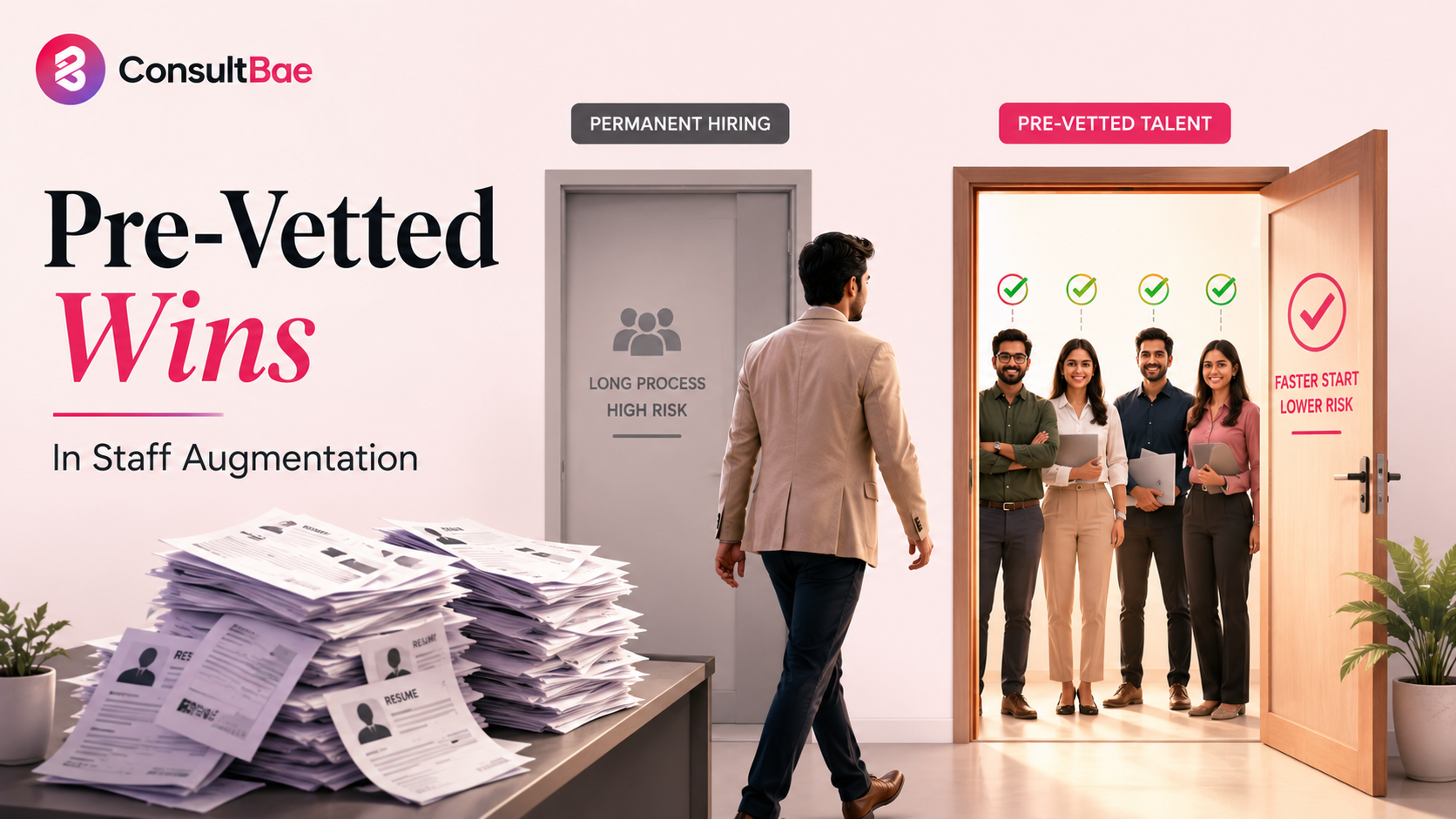
Permanent hiring gives you time. You can run a multi-stage process, take references, deliberate, and make a considered decision over weeks. Staff augmentation does not give you that time. When a company needs a consultant on a project starting next week, the luxury of an extended evaluation does not exist. The consultant has to be ready to deliver almost immediately, which means the evaluation has to have happened before the need arose.
This is what pre-vetting solves, and it is the difference between staff augmentation that works and staff augmentation that becomes a problem. A pre-vetted pool of consultants who have already been evaluated can be engaged immediately because the assessment that permanent hiring spreads over weeks has already been done. The depth of that pre-vetting determines whether the consultant who shows up on day one delivers or whether the company discovers a mismatch when it is already too late to do anything about it.
Why staff augmentation has a fundamentally different time constraint
The entire value of staff augmentation is speed. A company turns to it because they need capability faster than permanent hiring can deliver. A project has started or is about to, a skill gap needs filling immediately, a team needs to scale for a defined period. The need is now, not in two months.
This compresses the evaluation window to almost nothing. There is no time to run a consultant through the kind of multi-stage assessment that permanent hiring uses. If the evaluation has not already happened, it either gets skipped, which is how mismatches reach clients, or it delays the engagement, which defeats the purpose of staff augmentation in the first place. The only way to provide both speed and quality is to have done the evaluation in advance.
What pre-vetting actually involves
Pre-vetting a consultant means assessing them thoroughly before any specific engagement, so that when a matching need arises they can be deployed with confidence. This involves verifying their technical capability through genuine evaluation rather than self-reported skills. Confirming their actual experience, not just what their profile claims. Assessing how they work, how they communicate, and whether they operate well in the kind of embedded consulting context that staff augmentation requires. And maintaining an ongoing understanding of their availability and current skills, because a vetting done two years ago and never updated is not reliable today.
The depth matters. A light-touch vetting that confirms a consultant has the right keywords on their profile is not pre-vetting in any meaningful sense. Real pre-vetting evaluates the consultant to the standard that the client would want to apply themselves if they had the time, so that the client does not have to.
Pre-vetting is permanent-hiring-level evaluation done before the need arises, so that staff augmentation can deliver permanent-hiring-level quality at a speed permanent hiring never could.
Why a pre-vetted pool is operationally expensive to build and maintain
A genuinely pre-vetted pool is a significant operational investment, which is why many staffing providers do not actually maintain one despite claiming to. Vetting consultants to a real standard takes time and expertise. The pool has to be large enough and diverse enough in skills to match the range of needs clients bring, which means vetting many consultants who may not be engaged immediately. And the pool has to be kept current: consultants' skills evolve, their availability changes, and a vetting that is not refreshed becomes stale.
Maintaining this is an ongoing cost that exists whether or not there is an active engagement. A provider that has genuinely built and maintained a pre-vetted pool has invested in capability ahead of demand. A provider that vets reactively, only when a specific need arises, is not offering pre-vetting at all, they are offering regular hiring under time pressure, with the corner-cutting that time pressure produces.
What companies risk when they use un-vetted contract staffing
The risk of un-vetted staff augmentation lands fast and is expensive to recover from. A consultant who was not properly evaluated arrives on a live project and turns out not to have the capability their profile claimed. By the time this becomes clear, the project has lost time, the team has absorbed the disruption of onboarding someone who cannot deliver, and the company is back to square one but with the clock further advanced.
Because staff augmentation is used specifically for time-critical needs, a bad consultant is more damaging than a bad permanent hire in the short term. The permanent hiring mistake has time to be corrected. The staffing mistake lands directly on a project that needed the capability immediately, and the cost is measured in project delay on top of the wasted engagement.
Technical capability that does not match the profile claims. Experience that is overstated or misrepresented. Communication or working styles that do not suit embedded consulting. Availability that is not actually what was indicated. Skill currency, whether the consultant's expertise is still current or has fallen behind. All of this is caught in advance, so the consultant who reaches the client is one who can actually deliver from day one.
How ConsultBae approaches this
ConsultBae maintains a pre-vetted pool of technology consultants who can be engaged on remote or on-site roles at immediate basis across India, and increasingly for clients in the US and Europe. The pre-vetting is what makes immediate engagement possible. The consultant who reaches a client has already been evaluated to the standard the client would want applied, which is what allows staff augmentation to deliver both the speed it is meant to provide and the quality the client actually needs.
The investment in maintaining the pool ahead of demand is the unglamorous operational work that makes the visible promise, a capable consultant available immediately, actually deliverable. Companies evaluating staff augmentation providers should ask directly how the pool is vetted and how current the vetting is, because the answer separates providers who can genuinely deliver immediate quality from those who are improvising under time pressure when the need arrives.
Mohit Singh Katewa leads the AI Data vertical at ConsultBae, overseeing data collection, annotation, and quality operations across 100+ countries.
Need a consultant who can deliver from day one?
ConsultBae maintains a pre-vetted pool of technology consultants for immediate engagement across India, the US, and Europe. Let us talk.
Talk to us