The AI industry's attention in recent years has been almost entirely on the training data problem: how to source, annotate, and deliver the enormous datasets that foundational models need to learn from in the first place. That problem is real, and the infrastructure built to solve it has been considerable. But it represents one phase of an AI model's lifecycle, and the work that comes after a model is initially trained is becoming the more interesting and less well-resourced part of the data picture.
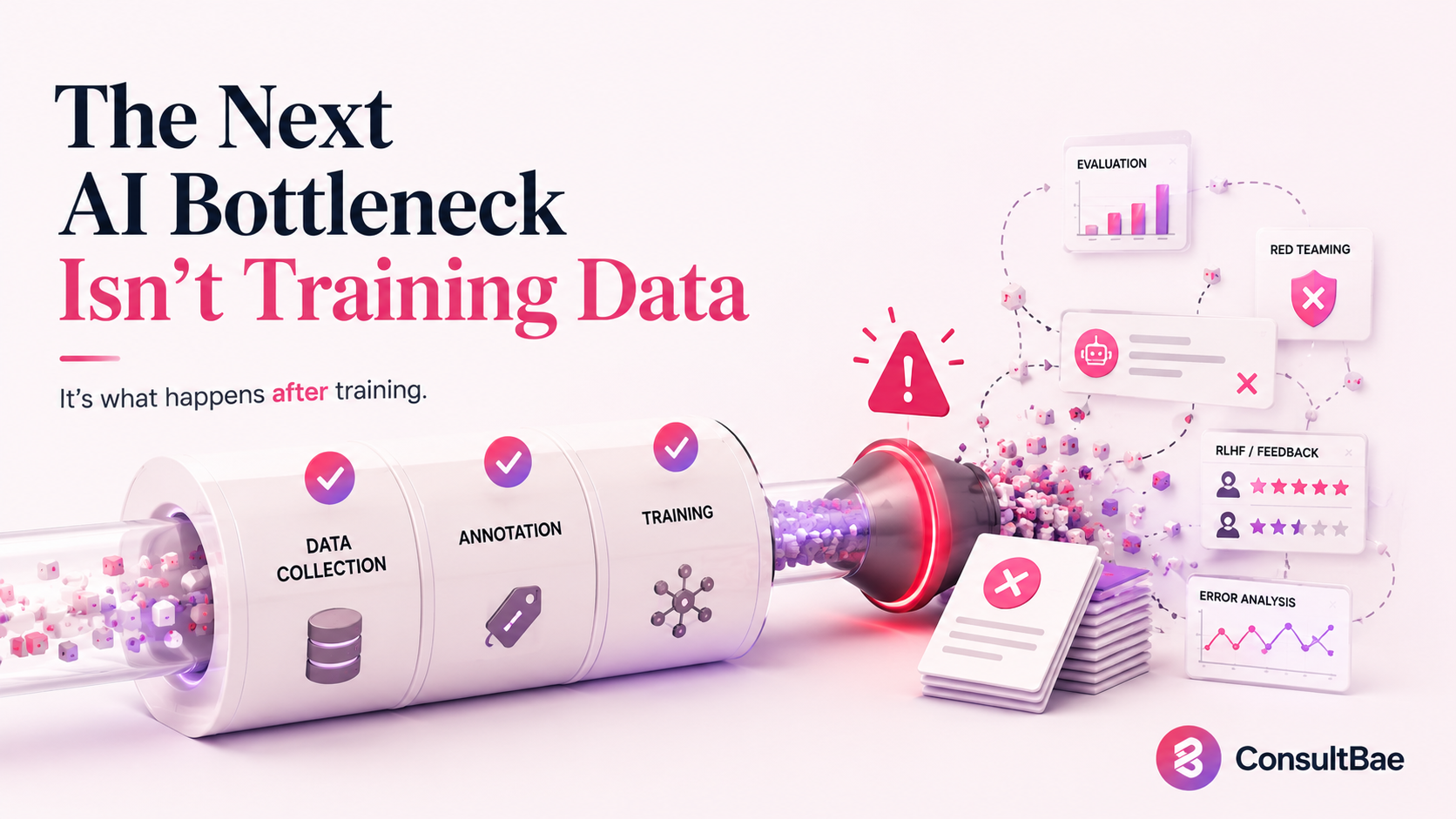
Post-training data work is what happens to a model once it has learned the basics from its initial training set and now needs to be aligned, evaluated, improved, and maintained as it encounters real users and real situations. This is where reinforcement learning from human feedback, evaluation, red-teaming, and ongoing fine-tuning live. It is also where many teams are now discovering that the data infrastructure they built for training does not extend to this stage.
What happens after a model is trained
A model that has completed initial training is not finished. It is a starting point. From there, several distinct streams of data work are required to get the model to a state where it can be deployed responsibly.
Reinforcement learning from human feedback. Human raters review model outputs and rank them, teaching the model which responses are better. This work requires people who can evaluate nuance, identify subtle quality differences, and apply consistent judgment across thousands of comparisons. It is not annotation. It is structured evaluation, and it shapes the model's behaviour at a deep level.
Evaluation against benchmarks. Once the model exists, its performance has to be measured. That requires designing evaluation tasks, sourcing humans to perform them, scoring outputs against criteria, and producing the kind of structured measurement that gives the team a reliable picture of where the model is strong and where it is weak.
Red-teaming. The deliberate effort to find ways the model fails: prompts that produce harmful outputs, situations where it generates incorrect information confidently, demographics or use cases where it underperforms. This requires people who can think adversarially about the model, identify weak points, and document them in a way the engineering team can act on.
Ongoing fine-tuning. Once the model is in production, new data continues to be needed. Edge cases that the original training did not cover, new domains the model is being asked to handle, corrections for failures observed in production. The data pipeline that supports this looks different from initial training data work.
The training data problem is solved by volume and operations. The post-training data problem is solved by judgment, expertise, and adversarial thinking. They are not the same problem.
Why post-training work is qualitatively different
The data work at the post-training stage looks operationally similar to annotation in some ways: people producing structured outputs based on guidelines, with quality processes and review layers. The difference is in what the work actually requires from the people doing it.
Initial training data work is largely about volume and consistency. A well-designed annotation guideline applied carefully across many records produces a usable dataset. Post-training work depends on judgment, often involving comparisons where there is no single correct answer, only better and worse responses calibrated against criteria that are themselves under development.
Red-teaming in particular requires a profile of contributor that the initial training data world is not optimised to source: people who can think creatively about how a system might fail, who can articulate why a specific output is problematic, who bring domain perspective from areas where the model's failures matter most.
Why most teams are unprepared for this
The data infrastructure built for training is well-developed at this point. Annotation platforms, contributor pools, quality processes, delivery pipelines. The infrastructure for post-training data work is comparatively undeveloped, partly because the field has only recently begun investing in it at scale and partly because the requirements are different enough that the existing infrastructure does not extend cleanly.
The contributor profiles are different. A crowd worker who is excellent at consistent bounding box annotation is not automatically the right person to evaluate the quality of a chatbot's response to a sensitive query. The latter requires reading comprehension, judgment, and often domain familiarity that the former does not.
The quality processes are different. Inter-annotator agreement on a labelling task is straightforward to measure. Inter-rater agreement on subjective evaluation tasks is harder to define and harder to maintain. The framework for measuring quality has to be designed for the specific type of judgment the work requires.
The volumes are different. Post-training data work tends to be lower volume but higher complexity per unit of work. The cost structure looks different and the operational rhythm is different.
Contributors with reading comprehension and judgment, not just labelling consistency. Domain expertise across the areas where model failures matter most. Adversarial thinkers for red-teaming who can identify weaknesses systematically. Quality frameworks built for subjective evaluation, not just objective labelling. Operational rhythms that handle lower volume and higher per-record complexity. Communication with the model engineering team that goes beyond delivery acceptance.
How ConsultBae is building for this
The post-training data layer is where our subject matter expert network across 40-plus domains becomes most directly relevant. The same specialists we have used for e-learning content development and specialist annotation work are equipped for the kind of evaluation, red-teaming, and quality assessment that post-training work requires. A practising clinician can evaluate medical AI outputs in ways that a generalist cannot. A lawyer can stress-test legal AI generations. A financial analyst can assess outputs in their domain at a level no crowd worker could replicate.
We are building the operational layer to support this work as a distinct stream of our AI data vertical. The infrastructure is partly the same as our initial training data work and partly different, calibrated for the judgment-heavy, expertise-intensive nature of post-training tasks.
The next chapter of AI data work has arrived. The teams that built infrastructure for the training data wave are now discovering they need a different infrastructure for what comes after. ConsultBae is positioned for both.
Mohit Singh Katewa leads the AI Data vertical at ConsultBae, overseeing data collection, annotation, and quality operations across 100+ countries.
Working on the post-training stage of a model?
ConsultBae's expert network is built for evaluation, RLHF, and red-teaming work. Let us talk about what your model needs.
Talk to us