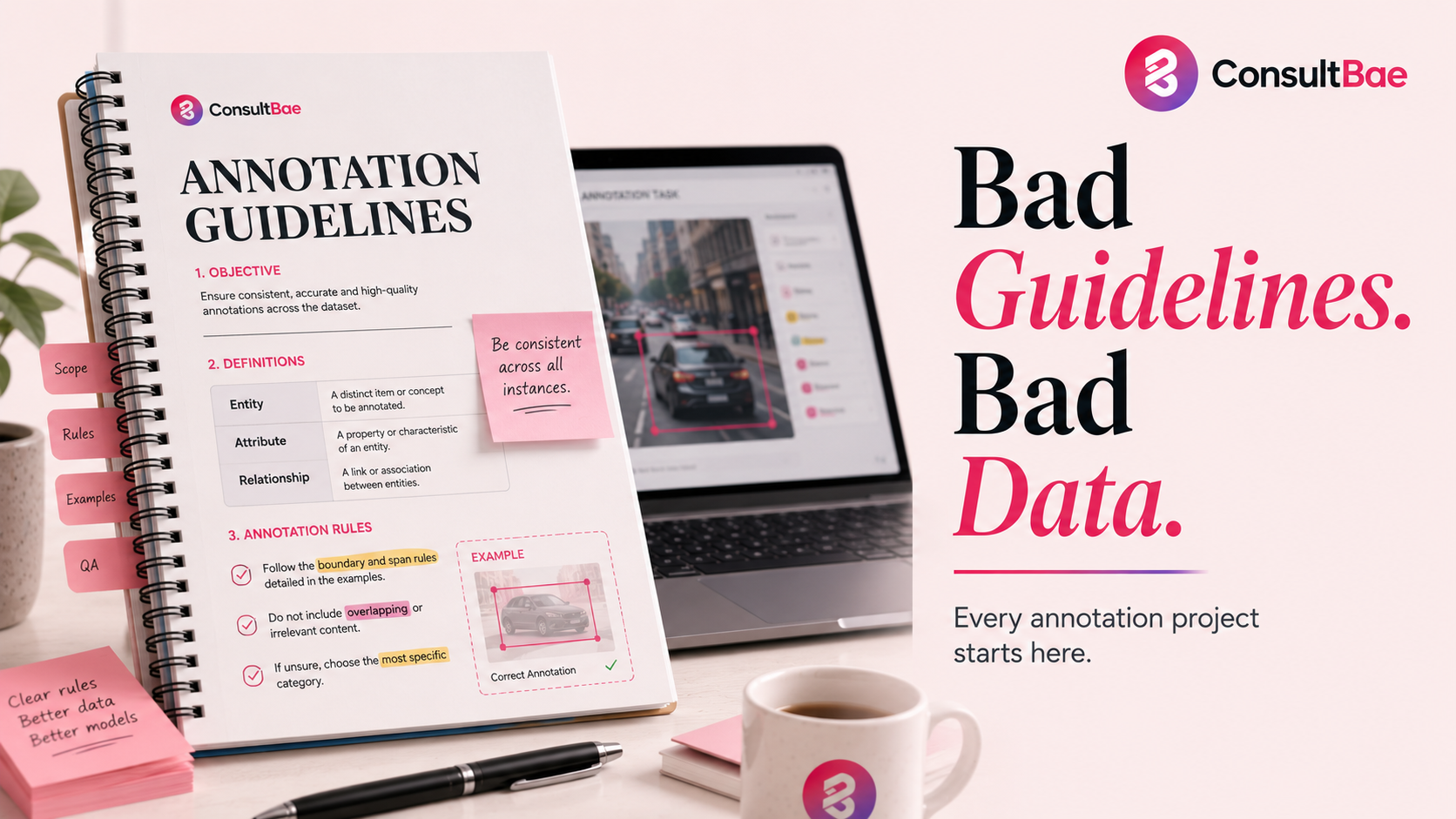
The annotation guideline is usually treated as a setup document. Something to write quickly at the start of a project so the real work, the annotation itself, can begin. It gets drafted, shared with the annotators, and set aside as the project moves into production. This treatment is backwards. The annotation guideline is not a setup document. It is the single most important artefact in the entire project, because it determines the quality of everything that follows, and the projects that struggle almost always have a guideline problem at the root.
An annotation guideline is the instruction set that turns raw data into labelled data. Every annotation decision, across every record, by every annotator, traces back to it. A clear, complete guideline produces consistent, usable annotations. A vague or incomplete one produces a dataset where the inconsistencies were baked in from the first day, no matter how skilled or careful the annotators were. The guideline is the ceiling, and the annotators cannot rise above it.
What an annotation guideline actually is and does
An annotation guideline defines what the annotators are being asked to do, precisely enough that different annotators working independently will make the same decisions on the same data. That precision is the entire point. The value of a guideline is measured by how consistently it produces the same annotation from different people, because that consistency is what makes the resulting dataset usable for training.
A guideline that leaves room for interpretation produces a dataset that reflects the interpretations of the individual annotators rather than a single consistent standard. The model trained on that data learns from the inconsistency as much as from the signal, which degrades its performance in ways that are hard to trace. The guideline's job is to remove the interpretation, to make the right annotation unambiguous, and the degree to which it succeeds at that determines the quality of the dataset.
Why a weak guideline produces a weak dataset no matter how good the annotators are
It is tempting to think that good annotators can compensate for a weak guideline through their own judgment and care. They cannot, and the reason is structural. A weak guideline leaves decisions to the annotator. A careful annotator will make those decisions thoughtfully, but two careful annotators making thoughtful decisions independently will not necessarily make the same decision, because the guideline did not specify a single right answer. The result is a dataset that is individually reasonable and collectively inconsistent.
The better the annotators, in fact, the more confidently they fill the gaps a weak guideline leaves, and the more the dataset reflects their individual judgment rather than a shared standard. Annotator skill amplifies the signal a good guideline provides and amplifies the inconsistency a bad guideline allows. The guideline is the foundation, and no amount of annotator quality compensates for a foundation that does not specify what good actually is.
Good annotators cannot rise above a bad guideline. Two careful people making thoughtful decisions independently will still disagree if the guideline never told them what the right answer was.
What a strong guideline contains
A guideline that actually produces consistent annotation has a few essential components, each of which is often underdeveloped in guidelines written quickly.
Clear definitions. Every category, label, and term the annotator will use needs a precise definition, not an intuitive one. What exactly counts as this category and what does not. The boundary cases are where definitions earn their value, and a definition that only covers the obvious cases leaves the hard ones to interpretation.
Worked examples. For each category and each kind of decision, concrete examples of correct annotation, ideally including examples that are near the boundary and could plausibly go either way. Examples communicate the intent of a guideline in a way that abstract definitions cannot, and they are the fastest way for an annotator to calibrate to the standard.
Edge case handling. Explicit guidance on the cases that do not fit cleanly. A guideline cannot anticipate every edge case, but it can establish the principles for handling them and a process for escalating the ones it did not anticipate, so that annotators flag genuinely novel cases rather than resolving them silently with inconsistent individual judgment.
Decision rules. Where annotation involves choosing between options, explicit rules for how to choose. When two categories could both apply, which takes precedence. When the data is ambiguous, what the default is. These rules remove the interpretation that would otherwise produce inconsistency.
Why writing a good guideline is harder than it looks
Writing a strong guideline is difficult because it requires anticipating, in advance, the full range of situations the annotators will encounter, and specifying how each should be handled. The easy parts of any annotation task are easy to write guidelines for. The hard parts, the edge cases, the ambiguous boundaries, the situations that only become apparent once real data is being annotated, are exactly the parts that determine dataset quality and exactly the parts that quick guidelines leave underspecified.
Good guideline development is therefore partly iterative: a strong initial guideline, stress-tested against real sample data, with the gaps it reveals fed back into revisions before full production begins. This takes time and expertise at the start of a project, which is precisely why it is often shortchanged under timeline pressure, and precisely why so many projects carry a guideline problem into production that surfaces later as inconsistent data.
Precise definitions that cover boundary cases, not just obvious ones. Worked examples for every category, including near-boundary cases. Explicit edge case handling with an escalation process for the unanticipated. Clear decision rules for choosing between options and resolving ambiguity. Iterative refinement against real sample data before full production. Enough investment at the start that the guideline removes interpretation rather than inviting it.
How ConsultBae approaches this
We invest in guideline design before collection because it is the highest-leverage document in the project. Our guidelines are developed with precise definitions and worked examples, stress-tested against sample data to surface the edge cases that quick guidelines miss, and refined before full production rather than after the first batch reveals the gaps. The annotators we work with are skilled, but we do not ask their skill to compensate for an underspecified guideline, because we know it cannot.
The annotation guideline rarely gets the attention it deserves because it looks like preparation rather than work. It is the work, in the sense that it determines the quality of everything built on it. A project with a strong guideline has a foundation that the annotation can be excellent on. A project with a weak one has a ceiling on quality that no amount of careful annotation can raise. Getting the guideline right is the most important thing a project does before any data is labelled.
Vanshika Jain works in AI Data Collection and Annotation at ConsultBae, focused on annotation operations and data quality across projects in multiple modalities and domains.
Starting an annotation project?
ConsultBae invests in guideline design before collection because it is the highest-leverage document in the project. Let us get yours right.
Talk to us