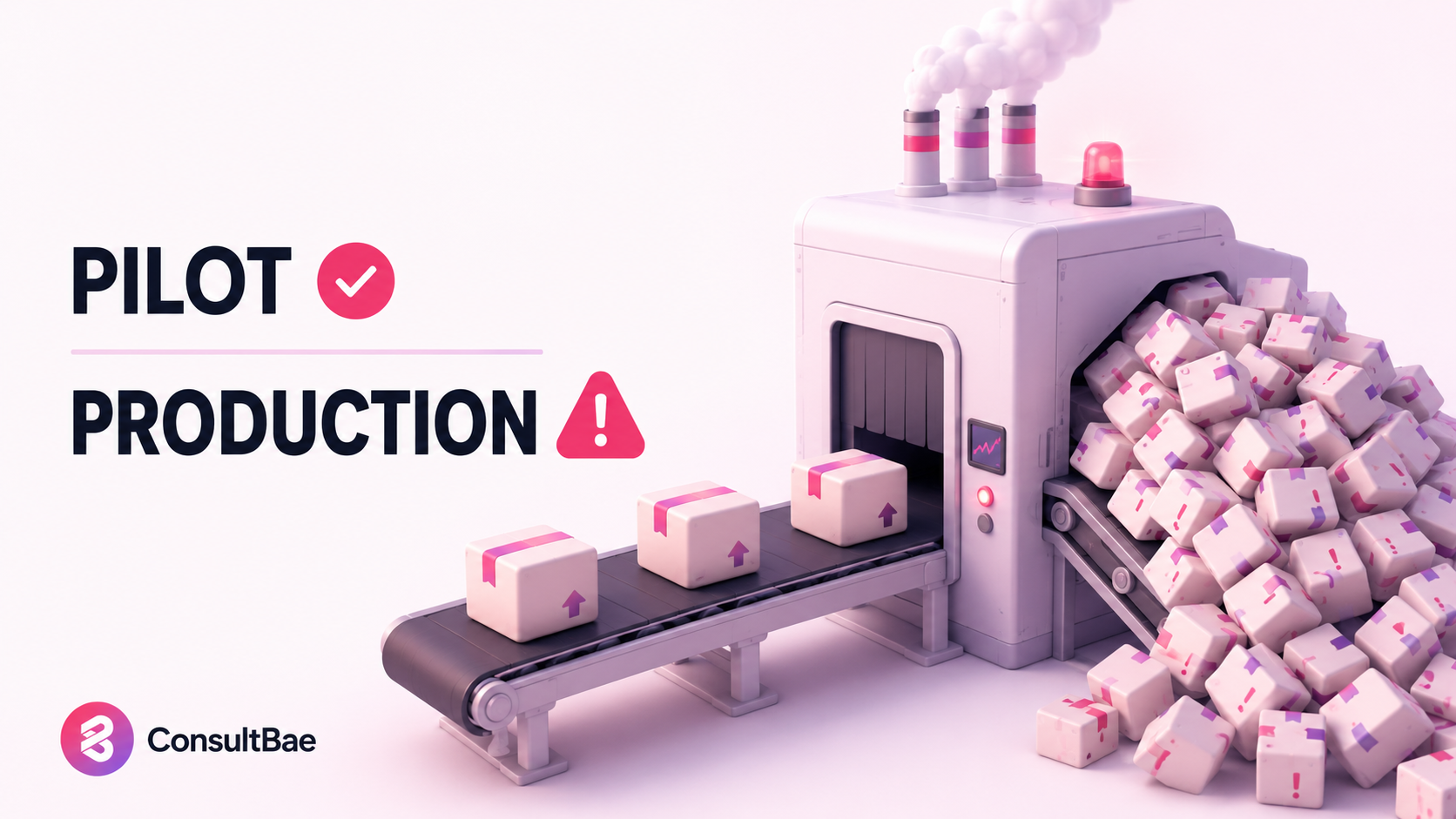
The most common point of failure in an AI data programme is not the first project. It is the second. The pilot ran well. The team that produced 1,000 high-quality records is now asked to produce 100,000, and the operational infrastructure that worked at the smaller scale does not extend to the larger one. The output looks similar on the surface. The actual quality, consistency, and reliability of delivery are different in ways that surface gradually and then all at once.
Most teams treat the scaling step as a logistics problem. More contributors, more annotators, more reviewers, larger storage budget. In practice it is a structural problem. The systems that work at pilot scale rely on individual attention and informal quality control that simply does not exist when the work is being done by hundreds of people across multiple time zones.
What pilots actually prove and what they do not
A successful pilot proves that the data type can be collected, that the annotation guidelines work in principle, and that a small team can hit the quality bar the project requires. These are useful things to know. They are also a much smaller subset of what production-scale operations need to demonstrate.
What a pilot does not prove: that the vendor can maintain that quality bar across hundreds of contributors who have never worked with each other, that the guidelines hold up when annotators encounter the long tail of edge cases that small samples never surface, that the delivery cadence is sustainable when collection runs concurrently across multiple geographies, and that the quality review process catches problems fast enough at volume to prevent them from compounding through the dataset.
Each of those is a different operational capability. Each one needs to be built before the production project starts, not discovered mid-delivery when the first batches arrive and the pattern of small failures begins to repeat at scale.
The four things that break when you scale data collection
Across enough projects, the same four operational dimensions are where pilot-to-production transitions actually fail.
Contributor management. At pilot scale, a project lead can know each contributor, understand their strengths, and assign work accordingly. At production scale, contributor management becomes a system: onboarding workflows, briefing materials that work without one-on-one explanation, performance monitoring that flags issues before they propagate, and replacement processes when contributors do not meet the standard. None of this exists by default. It has to be built, ideally before the production project starts.
Quality maintenance under volume. Quality review at pilot scale can be exhaustive. Every record reviewed by a senior reviewer. At production scale, exhaustive review is not viable and the quality process has to combine first-line annotator review, automated checks where possible, statistical sampling of completed work, and expert review of edge cases. The transition from exhaustive to sampled review is where most projects lose quality, because the sampling design is rarely thought through carefully enough.
Edge case handling at scale. A small sample rarely surfaces the full range of edge cases that production data will contain. At pilot scale, edge cases can be resolved in conversation between the project lead and the client. At production scale, those conversations have to be replaced by documented decisions that propagate to hundreds of contributors quickly and consistently. If the documentation lags, contributors fill the gap with their own judgment, and the dataset becomes inconsistent in ways that are hard to identify after delivery.
Delivery cadence. Pilots deliver once. Production projects deliver in batches, often weekly or biweekly, often while collection on the next batch is already underway. Coordinating collection, annotation, quality review, and client delivery in parallel rather than sequentially is a different operational rhythm, and teams that have not run it before tend to miss the dependencies between stages until something breaks.
A pilot proves the work can be done. A production project proves the work can be run. Those are different proofs and they need different infrastructure underneath them.
Why most teams skip this transition planning
The transition planning gets skipped because the pilot felt smooth, which creates a reasonable but incorrect assumption that the production version will scale linearly from it. The pilot was smooth because it was small enough to manage through individual attention. The production version cannot rely on that, but the difference is not visible until the volume increases.
Timeline pressure compounds this. The client has approved the pilot results and wants to move quickly into production. Building production infrastructure properly takes time that feels like delay. The vendor agrees to start, the project ramps up, and the operational gaps start to show three or four weeks in, when the volume has increased but the infrastructure to support it has not.
What production-grade data collection actually requires
A production-ready data operation has a few things in place before the first batch of full-scale work begins. The contributor pool is identified, onboarded, and calibrated against the guidelines. The annotation tooling and workflow can handle parallel work without bottlenecks. The quality review process is designed for sampling rather than exhaustive coverage, with clear thresholds for when sampled findings trigger broader review. The edge case escalation path is documented and the project lead has the authority to make calls on undocumented cases in real time.
None of this is exotic. All of it requires the work to be designed before the volume arrives, not improvised once it does.
Before moving from pilot to production: confirm the contributor network can support the target volume, confirm the annotation workflow handles parallel batches, define the sampling-based quality review process, document edge case decisions from the pilot and propagate them to the full contributor pool, agree on the delivery cadence and the dependencies between stages, and identify the named owner for issues that need real-time decisions during the production run.
How ConsultBae approaches this
At ConsultBae, we treat pilot-to-production as a discrete phase of the engagement rather than an automatic next step. Before scaling, we walk through the operational infrastructure each side needs in place: what we will run on our end, what the client should expect to provide, and what the cadence and review processes will look like.
We have run enough projects across the full lifecycle to know that the transition is where good pilots become unsuccessful programmes if it is not planned carefully. We have also run enough of them well to know how to build the bridge properly when there is time and willingness to do the work upfront.
Amitt Agrawaal is the Founder of ConsultBae. He has spent six years building ConsultBae's operations across recruitment, e-learning, and AI data collection across 100+ countries.
Moving from pilot to production?
ConsultBae plans the operational transition before the volume arrives. Let us walk through what your project needs.
Talk to us