

Search for the best data annotation companies and you will get a dozen ranked lists. Most are written by the companies on the list, or by sites paid to feature them. They are confident, they are tidy, and they tell you almost nothing about the one thing you actually need to know, which is whether a given vendor can deliver your project without it falling apart.
I run annotation projects from the inside, and I have sat on both sides of that question. So instead of another ranking, here is what the companies worth working with have in common, and how you can spot them before you commit.
Why "best" is the wrong question to start with
There is no single best annotation company, in the same way there is no single best vehicle. Best for what, carrying gravel or winning a race? A vendor who is excellent at drawing bounding boxes on images can be useless on multilingual audio. A team that handles text beautifully may have never touched the messy reality of video.
The right question is not who is best. It is who is the best fit for this modality, this domain, this quality bar and this deadline. Once you frame it that way, the dozen ranked lists stop mattering, because none of them were answering your question in the first place.
The gap between who says yes and who can deliver
Here is something I see constantly from the supply side. When a real requirement goes out, plenty of people say yes. Saying yes is free. Most of them are looking for an opportunity, not confirming they can actually do the work.
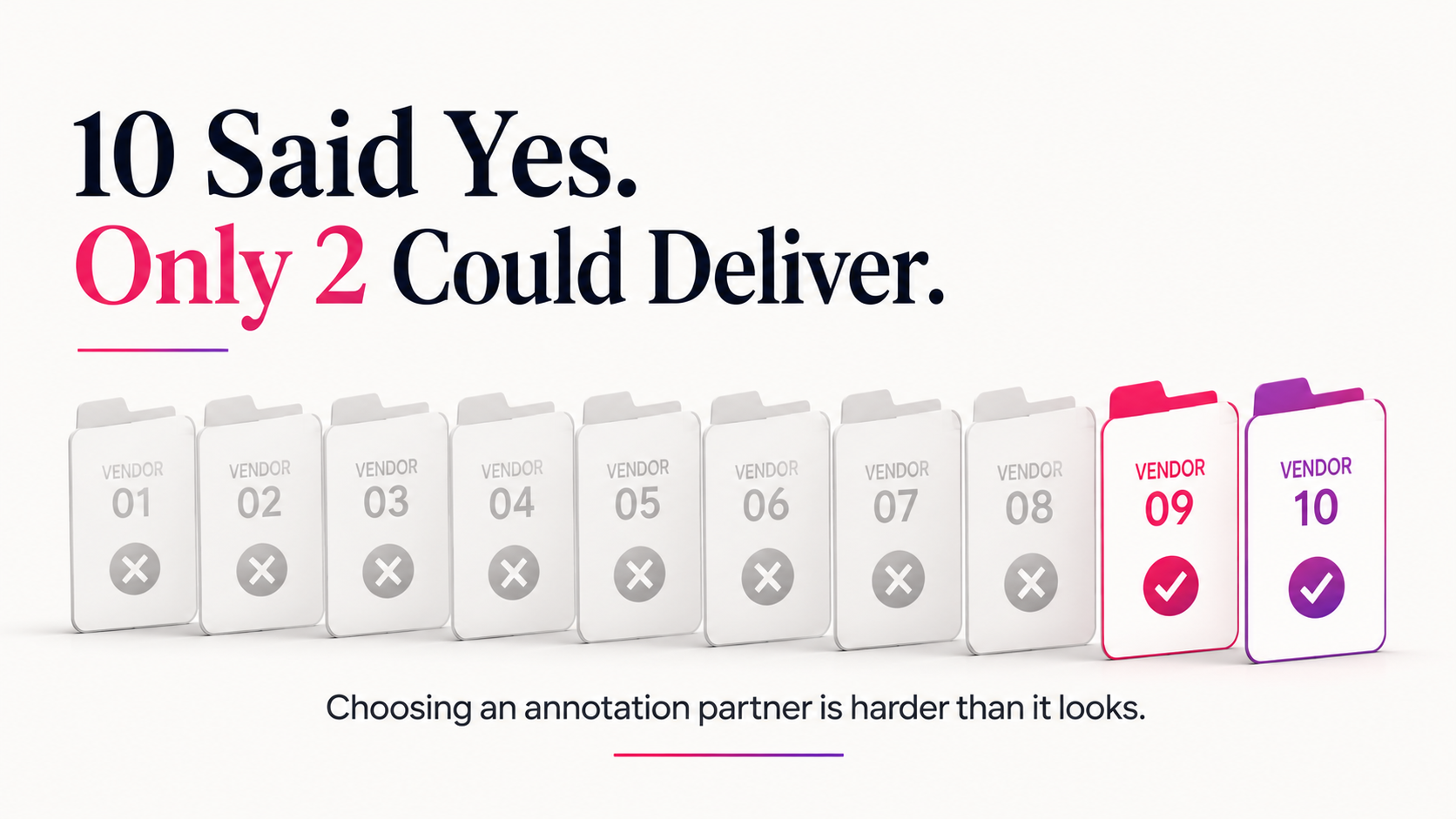
When I put a project out and ten people respond saying they can handle it, the number who can really do it after an honest conversation is closer to two. The rest fold the moment you ask a specific question about the hard part. The same maths applies when you are the buyer evaluating vendors, including us. Enthusiasm on a sales call is not capability.
Ten will tell you they can do it. After you actually talk to them about the hard part, maybe two still can.
Five things worth checking before you sign
You can close most of that gap with five questions, asked properly.
The first is relevant track record. Not "we do annotation," but "we have done this modality, in this domain, at this scale, and here is the proof." General experience is easy to claim. Specific, comparable experience is what predicts whether your project will go smoothly.
The second is their quality process. Ask how many review passes the data goes through, who does the checking, and what happens when an error is found. A vendor with a real answer here has thought about quality before you asked. A vendor without one is hoping it works out.
The third is how they handle the hard cases. Any team can label the easy ninety percent. The difference between a good company and a frustrating one lives entirely in the last ten, the ambiguous, edge-case files where judgment is needed. Ask them to walk you through a tricky example.
The fourth is communication. Annotation runs across teams of people, and a single misread instruction multiplies across all of them. A vendor who takes a precise brief and holds it consistently is worth more than a cheaper one who needs everything repeated three times.
The fifth is honesty about limits. A vendor who says yes to absolutely everything is showing you a warning sign, not a strength. The companies I trust most are the ones willing to say a particular project is not their strength. That honesty is exactly what you want when something goes wrong mid-project.
Why quality process beats raw headcount
Almost every annotation company advertises scale. Thousands of annotators, global coverage, capacity on demand. It sounds reassuring, and it is also the easiest thing to claim and the least useful on its own.
Headcount without process simply produces wrong data faster. A large team with no real checking layer will hand you a large pile of errors. A smaller team with disciplined review will hand you data you can actually trust. When you evaluate companies, weigh the checking far more heavily than the headcount, because the checking is the part you are really paying for.
How a small pilot tells you the truth fast
The single most useful thing you can do is refuse to decide on a sales call. Give your shortlist a small, representative slice of the real work, and deliberately include a few of the hard examples you care about most.
Then watch two things. What comes back, and how they behave while doing it. Do they ask sharp questions, or go quiet and guess? Did the tricky files get handled with care, or wave through? A pilot of a few hundred items will tell you in a week what a page of client logos and a glowing list never could.
A representative sample of the real data, not a clean demo set the vendor would never see in production.
A handful of deliberately hard or ambiguous cases, so you can see how judgment is handled.
The exact quality bar and label definitions you will use at full scale.
A clear channel for questions, so you can judge how they communicate when something is unclear.
About the author
Mohit Singh Katewa leads the AI data vertical at ConsultBae, where he runs the collection and quality pipelines behind the company's annotation work. He spends most of his time on the part of the job buyers never see, the checking that decides whether data can be trusted.
The fastest way to judge a partner is to give them real work.
Send us a small slice of your project, hard cases included, and see what comes back before you commit to anything.
Start a pilot with our data team