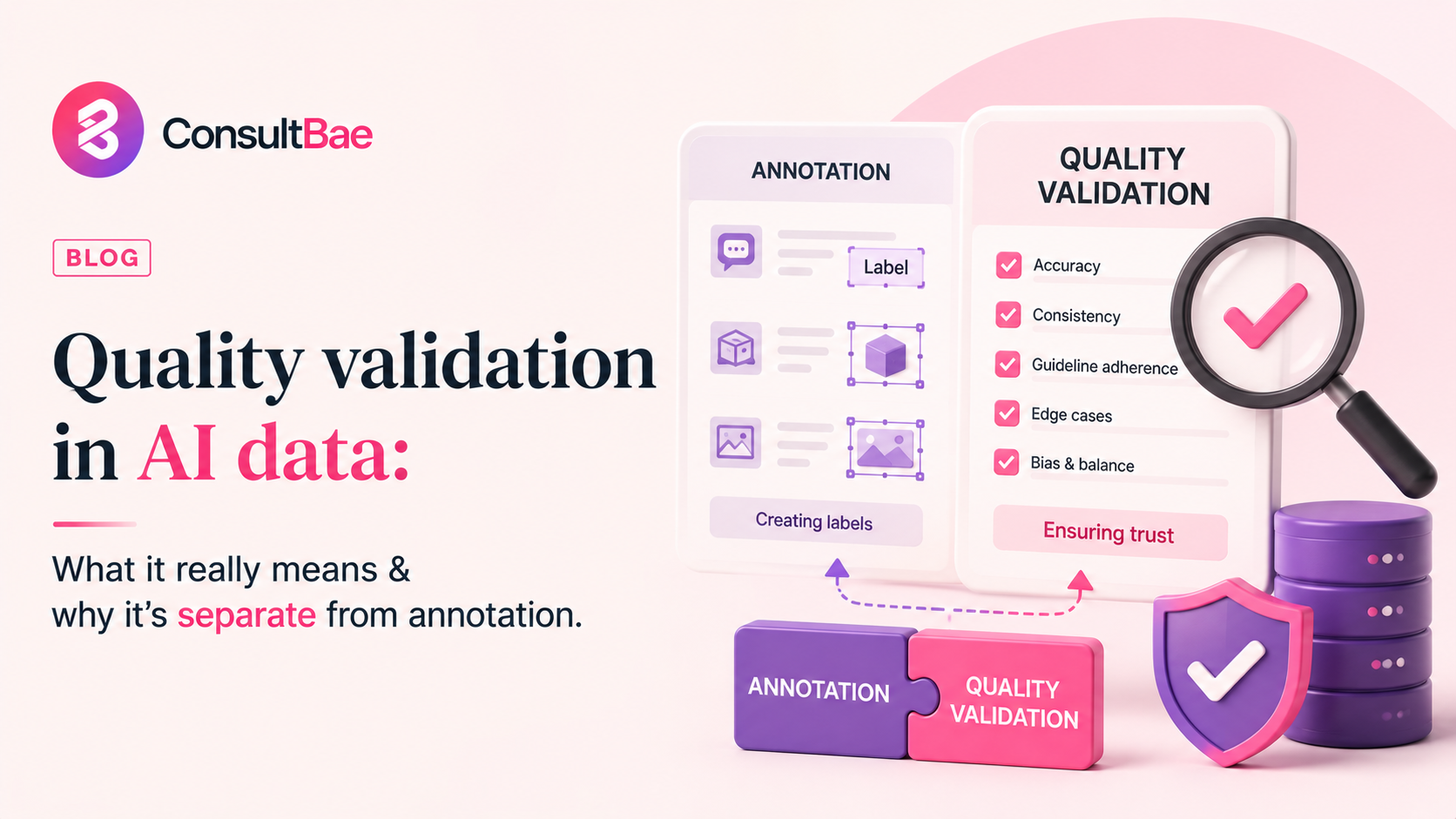
When companies think about data quality, they usually think about it as something that happens inside the annotation process. The annotators do the work, a review layer checks it, and the dataset that comes out the other end is as good as that process made it. This is true as far as it goes. But there is a separate kind of quality work that sits outside the original collection and annotation entirely: independent validation of a dataset that someone else produced.
Quality validation is the practice of taking a dataset, regardless of who built it, and rigorously checking whether it is actually fit for the purpose it is meant to serve. It is a distinct service from annotation, and the companies that need it most are often the ones who do not realise they need it until a model trained on the data has already underperformed and the investigation has worked its way back to the source.
The difference between quality control during annotation and validation as an independent check
Quality control during annotation is internal to the process. The team producing the data checks its own work as it goes. Reviewers sample completed annotations, agreement is measured, errors are sent back for correction. This is necessary and good, but it has a structural limitation: the team checking the work shares the assumptions, the guideline interpretations, and the blind spots of the team that produced it. Problems that stem from a misunderstanding baked into the guidelines will not be caught by a review process operating from those same guidelines.
Quality validation is external to the process. A fresh team, working independently, evaluates the dataset against what it is actually supposed to do. They are not checking whether the work matches the guidelines. They are checking whether the dataset, as it exists, will actually serve the model it is meant to train. This is a different question, and it surfaces a different category of problem.
When companies need independent validation
Three situations make independent validation particularly valuable, and in each one the original process cannot catch its own problems.
Data collected in-house. A company that built its own dataset has a process designed by the same team that will use the data. Whatever assumptions went into the collection went into the validation too. An independent validation pass brings a perspective the internal team structurally cannot have, and frequently surfaces issues that were invisible from inside.
Data from another vendor. A company that received a dataset from a vendor has limited insight into how it was actually produced. The dataset passed the vendor's acceptance criteria, but the buyer has no independent confirmation that those criteria match what the buyer actually needs. Validation gives the buyer a way to verify quality before committing the dataset to expensive training, rather than discovering problems after the model is built.
Data of uncertain provenance. A company that acquired data through a merger, a partnership, or a source whose collection process is not fully documented has a dataset whose quality is genuinely unknown. Validation establishes what they actually have before they build on it.
A team cannot fully validate its own data, because the assumptions that produced the problems are the same assumptions doing the checking. Independent validation is the only way to surface what the original process could not see.
What a validation pass actually examines
A thorough validation pass looks at several dimensions that go beyond whether individual labels are correct. Label consistency across the dataset, checking whether similar cases were handled the same way throughout. Distribution and coverage, checking whether the dataset actually represents the range it is supposed to. Edge case handling, examining how the dataset treats the difficult cases that matter most. Metadata completeness and accuracy. And alignment between what the dataset contains and what the model it will train actually needs.
The validation produces a clear picture of where the dataset is strong, where it is weak, and what would need to happen to make it fit for purpose. In some cases the dataset is in good shape and validation confirms it can be used with confidence. In others, validation surfaces specific problems that can be corrected before training, at a fraction of what they would cost to fix after a model has already been built on flawed data.
Why a fresh set of eyes catches what the original team's process missed
The value of independent validation is structural, not a comment on the competence of the original team. Any team that produces a dataset develops a set of working assumptions about what the data should look like, how edge cases should be handled, and what good means for this project. Those assumptions are usually reasonable. They are also invisible to the people holding them, which means problems that stem from them do not get caught by a review process those same people designed.
An independent validation team does not share those assumptions. They approach the dataset asking whether it actually serves its purpose, not whether it matches the process that produced it. This is exactly the perspective that catches the problems an internal review cannot, and it is why validation is a genuinely distinct service rather than just another layer of the same quality process.
Before committing an in-house dataset to expensive model training. After receiving a dataset from a vendor whose process you cannot fully verify. When you have acquired data of uncertain provenance and need to know what you actually have. When a model has underperformed and you need to determine whether the data is the cause. When the stakes of the model are high enough that the cost of validation is small relative to the cost of training on flawed data.
How ConsultBae approaches this
Quality validation is one of the AI data services we provide, alongside collection and annotation. Some clients come to us to build datasets from scratch. Others come to us to validate datasets they built themselves or received from elsewhere, before they commit to training on them.
The validation work draws on the same quality infrastructure and the same expert network we use for our own collection and annotation, applied independently to data we did not produce. The fresh perspective is the point. A dataset that has been independently validated is one a company can build on with confidence, knowing that the problems which would have surfaced in production were surfaced earlier, when they were still cheap to fix.
Mohit Singh Katewa leads the AI Data vertical at ConsultBae, overseeing data collection, annotation, and quality operations across 100+ countries.
Need a dataset validated before you train on it?
ConsultBae provides independent quality validation as a distinct AI data service. Let us check what you have before you build on it.
Talk to us