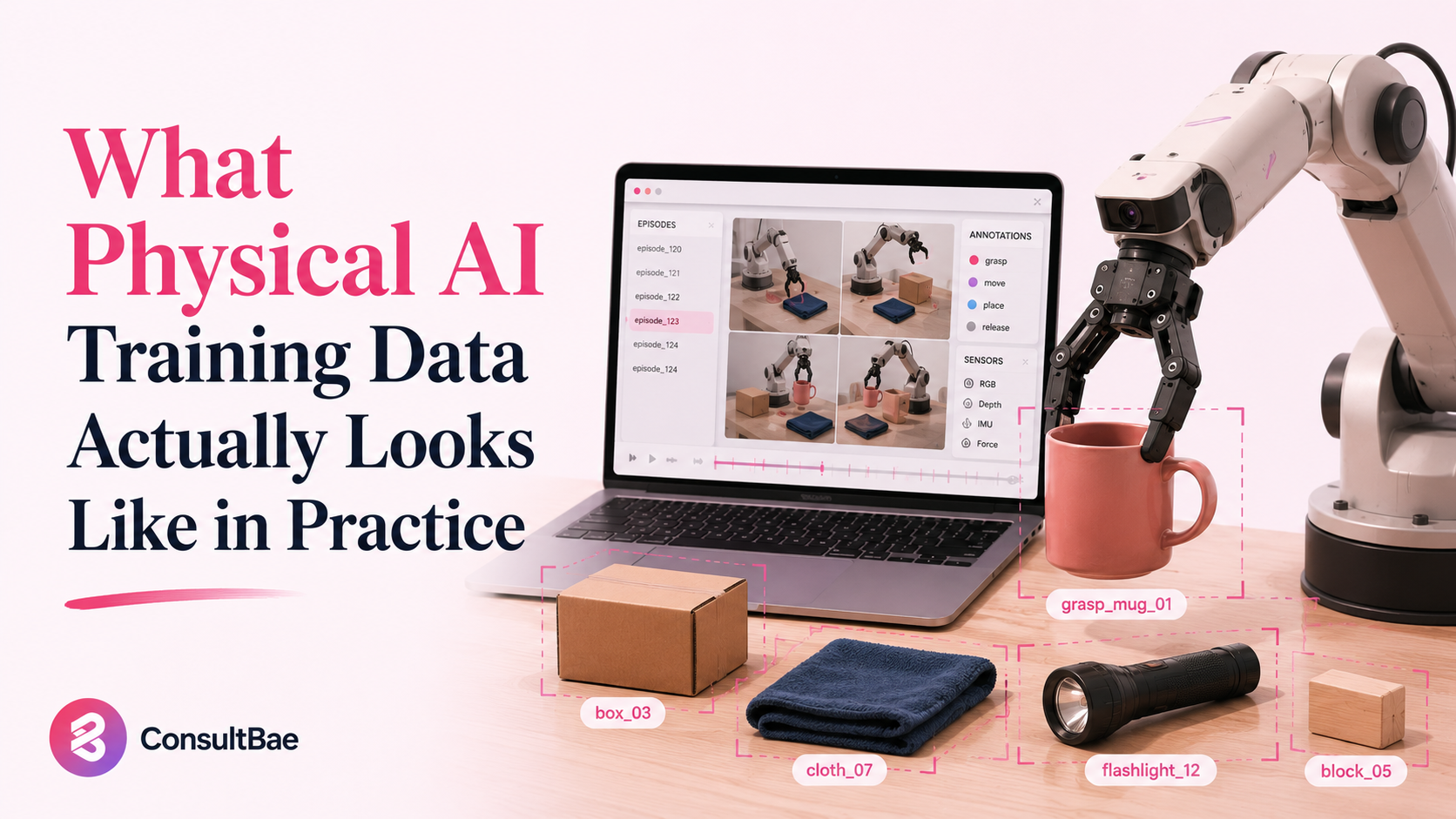
When the AI industry talks about "physical AI training data," the term sounds abstract enough that most people picture something exotic. The reality is concrete and operationally specific. A person sitting in a controlled room with three cameras pointed at them. A defined task script: pick up a cup from the table, move it to a shelf, return your hand to neutral position. The person performs that task twenty times, then thirty variations of it, then forty more across different lighting conditions and different starting positions. The cameras record every frame. That footage, multiplied across hundreds of contributors and hundreds of tasks, is the data a robot will eventually learn from.
This is the work that the next wave of AI development depends on. It is also work that almost nothing in the existing AI data infrastructure was built to support, and the operational requirements are different enough from text, speech, or even general video data collection that most teams underestimate what running it actually involves.
What physical AI training actually is
Physical AI, sometimes called embodied AI, refers to AI systems that operate in the physical world rather than purely in software. Industrial robots, warehouse automation systems, autonomous service robots, assistive robotics in healthcare, and the next generation of consumer robots all fall under this umbrella. What they share is a need to understand and execute physical actions in real environments.
Training these systems requires data the world does not produce naturally. A language model can learn from existing text on the internet. A speech model can learn from audio recordings that have already been made for other purposes. A physical AI system cannot learn from any of those sources. It needs to see humans performing specific physical tasks, captured in ways that make the motion, the context, and the physical logic of the action learnable. That kind of footage does not exist at scale anywhere outside the projects deliberately collecting it.
What a physical data collection project actually involves
A physical AI data collection project has more in common with film production than with annotation work. The pre-production phase alone involves decisions that simpler data projects do not encounter.
Locations have to be secured. Not just any locations, but environments that match the conditions the robot will eventually operate in. A robot meant for warehouse work needs training data captured in warehouse-like environments. A robot meant for kitchens needs kitchen-like environments. The setting is part of the data.
Equipment has to be specified. Multiple synchronised cameras, calibrated to capture the same scene from different angles, often paired with depth sensors or other instrumentation depending on what the model needs to learn. The capture rig is engineered for each project, and getting it consistent across locations is operationally non-trivial.
Contributors have to be briefed in detail. Performing a physical action twenty times consistently, in the way the model needs to see it, is harder than it sounds. Contributors drift between takes. They unconsciously adjust their motion. They get tired. The briefing and on-site coaching are what produce footage that is actually usable.
Capture protocols have to be standardised. What counts as a successful take. What variations need to be captured. How long sessions can run before fatigue degrades quality. How to verify a clip is usable before the contributor leaves.
A physical AI project is a film shoot operating to research-grade quality standards. The infrastructure required is closer to production logistics than to digital data collection.
Why this is harder than people think
The difficulty of physical AI data collection comes from the combination of variables that have to be controlled simultaneously, all of which compound when the project scales across multiple locations.
Temporal consistency matters more than in any other modality. A two-second clip of a person picking up a cup contains roughly sixty frames of information, and inconsistencies across those frames degrade the entire clip. Environmental control has to hold for the duration of every clip, across every contributor, across every location. Contributor performance has to be coached actively because the natural human tendency is to vary the motion, and what the model needs is consistency with deliberate variations rather than uncontrolled drift.
All of this has to be coordinated across the geographies the project requires. A model that will operate globally needs training data captured across the demographic and environmental variation of the regions it will serve. The logistics of running consistent capture sessions across that range is a significant operational layer that most teams underestimate.
What makes a good physical AI dataset
A usable physical AI dataset has a few things that distinguish it from one that will not transfer well to model training.
The motions are performed with the deliberate variation the model needs to learn from, not the accidental variation that comes from inadequate briefing. The capture conditions are consistent across the entire dataset for the variables that matter, and intentionally varied for the variables the model needs to generalise across. The demographic and environmental diversity reflects the real-world population the robot will encounter. The metadata is complete and accurate, with each clip tagged for the variables a training pipeline will need to filter and balance on.
The opposite, a dataset where motions drift, capture conditions are inconsistent in unintended ways, demographics are skewed, and metadata is incomplete, produces a robot that learns the wrong things or fails to generalise once deployed.
Pre-production planning that maps every variable the project needs to control. On-site coordination that maintains capture consistency across the full duration of the project. Contributor briefing and active coaching during sessions, not just at the start. Quality verification at the point of capture rather than at delivery. Demographic and environmental coverage that matches the deployment target. Complete metadata captured in real time, not retrofitted at the end.
How ConsultBae approaches this
Physical AI data collection sits at the intersection of capabilities ConsultBae has spent years building. The geographic network across 100-plus countries gives us the operational reach. The contributor management infrastructure built for other data collection work translates to coordinating physical capture sessions. The quality processes designed for high-stakes annotation work apply directly to verifying capture quality on the ground.
What is distinct about physical AI work is the production-style coordination it requires on top of the data operations foundation. We plan these projects in pre-production with the same rigour a film team plans a shoot, while running the data operations layer with the same standards we apply to every other collection project.
This is one of the areas of AI data work where the gap between doing it adequately and doing it well is largest. Robots learning from inadequately captured data perform poorly in deployment in ways that are difficult to diagnose and expensive to fix. The investment in getting the data right pays back many times over in model performance once the system is in production.
Amitt Agrawaal is the Founder of ConsultBae. He has spent six years building ConsultBae's operations across recruitment, e-learning, and AI data collection across 100+ countries.
Building a robot? Need the data?
ConsultBae runs physical AI data collection projects across geographies. Let us talk about what your system needs to learn.
Talk to us