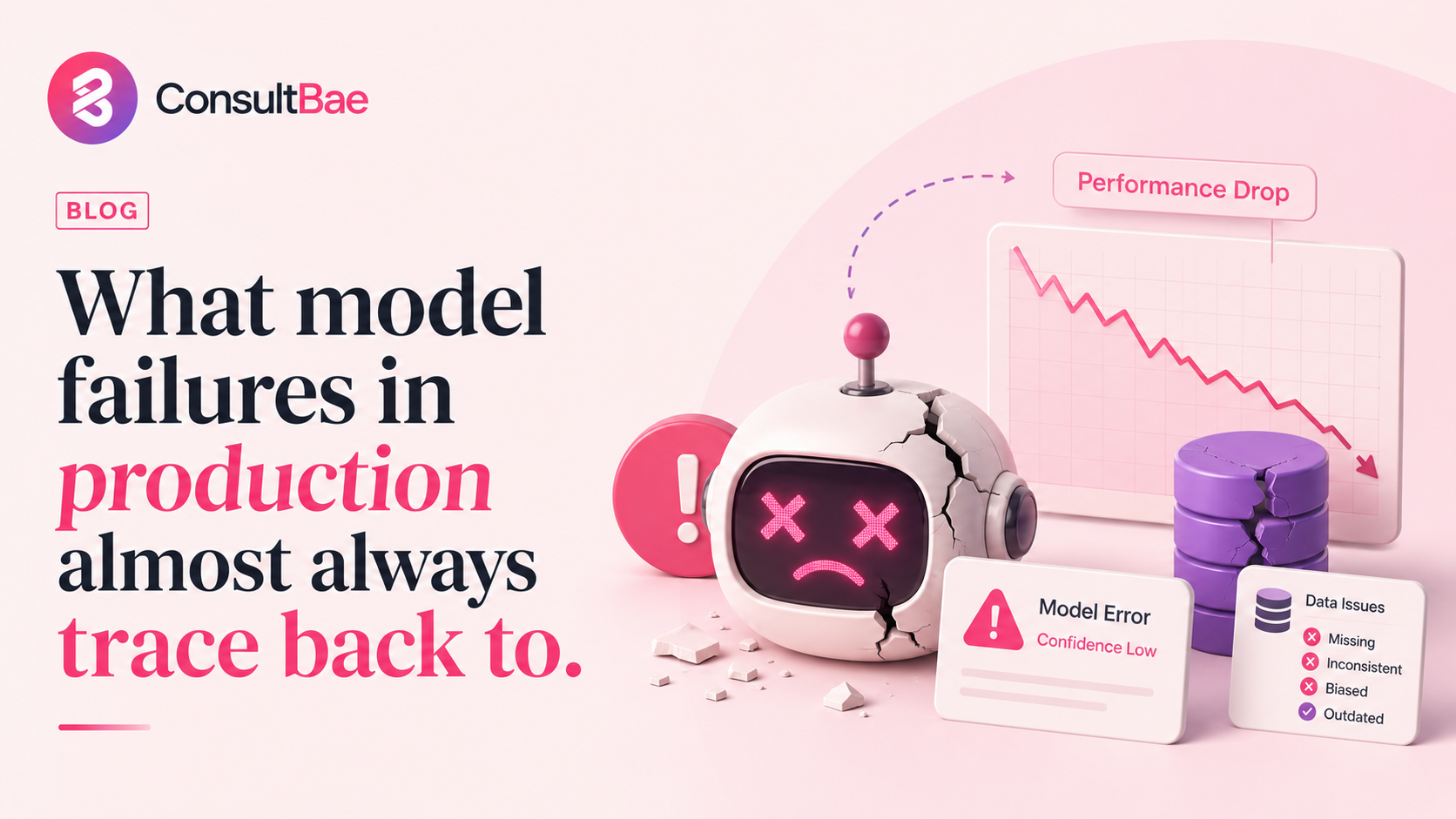
When an AI model behaves badly in production — outputs that are biased, confident hallucinations, performance that drops sharply on specific inputs — the call goes to the engineering team. They are expected to diagnose the issue and fix it. They start by examining the model architecture, the training process, the hyperparameters. Most of the time, none of that is where the problem actually lives.
The fix almost always lives upstream of the model, in the data the model learned from. By the time the failure surfaces in production, the cost of getting back to the data and correcting it is much higher than it would have been to catch the underlying problem during collection. The engineering team is the wrong place to start, but it is where most production failures are first investigated.
Why engineering is the wrong place to start
A model is a learned representation of its training data. Whatever patterns are in the data become patterns in the model. Whatever gaps are in the data become gaps in the model's understanding. The engineering team can adjust the learning process at the margins, but they cannot teach the model something its data did not contain or correct a bias the data baked in.
This means that when a model fails in production, the engineering team is being asked to fix a symptom whose cause lives elsewhere. They will often try, with techniques like fine-tuning, prompt engineering, or output filtering. These can help. They are also patches on a problem whose actual fix requires going back to the data and addressing what was missing or wrong in the first place.
The four most common production failures and what they trace back to
Across enough deployed models, the failure modes that show up most consistently in production cluster into four categories, each with a recognisable signature in the training data.
Distribution mismatch. The model performs well on inputs that look like its training data and degrades on inputs that fall outside that distribution. Users encounter situations the model was never trained on, and the model either fails outright or produces confidently incorrect outputs. This traces back to a training set that did not cover the demographic, linguistic, or contextual range of the real-world deployment environment.
Label inconsistency. The model behaves erratically on inputs that look similar. It treats one example as a positive case and another, nearly identical example, as a negative case. This is the fingerprint of inconsistent labelling in the training data, often caused by annotators making different judgement calls on ambiguous cases without those decisions being aligned across the dataset.
Edge case gaps. The model handles the common cases well and breaks on the rare ones. Often these rare cases are exactly the situations that matter most: the unusual transaction, the unexpected medical presentation, the high-stakes outlier. This traces back to a training set where edge cases were either absent or under-represented, often because they are operationally harder to collect than common cases.
Contamination. The model produces strange or inappropriate outputs in ways that are difficult to explain from the architecture alone. Investigation reveals that the training data contained material that should not have been there: low-quality content that slipped past quality review, contributor errors that compounded across the dataset, or in some cases data that violated the project's intended scope.
Models do not have bugs in the way software does. They reflect their training data. If the model is wrong in production, the data is usually where the wrongness was introduced.
Why these are visible to a data partner during collection
The interesting thing about all four failure modes is that they are detectable at the data collection stage by a partner that is paying attention. Distribution gaps can be flagged when demographic coverage is being managed. Label inconsistency can be measured through inter-annotator agreement during collection rather than discovered through model behaviour later. Edge case coverage can be tracked explicitly as part of project design. Contamination is exactly what quality review processes are built to catch.
What makes the difference is whether the data operation is set up to look for these things or whether it is set up only to hit volume targets. A partner that is focused on delivering numbers rather than data hygiene will produce datasets that pass acceptance and fail in production. A partner that treats hygiene as part of the work catches these issues during collection, when they cost a fraction of what they will cost to fix later.
What good data hygiene at collection prevents
Data hygiene at collection covers a few specific practices. Demographic sampling that is monitored against the project's coverage requirements throughout, not measured at the end. Inter-annotator agreement tracking with feedback loops to annotators when their consistency drifts. Edge case logging where contributors and reviewers can flag unusual cases for review rather than resolving them silently. Quality processes that catch contamination at multiple stages rather than relying on a final review pass.
None of these are exotic. All of them require operational discipline that is harder to maintain at scale than to claim in a proposal. The difference between a data partner that does these things and one that does not is visible in the model the data eventually trains, even though it is invisible in the dataset at delivery.
Before diving into the model, ask three questions about the data. Was the training data representative of the inputs the model is now encountering. Was annotation consistency measured and maintained across the dataset. Were edge cases explicitly collected or did the dataset reflect only what was easy to source. If the answer to any of these is unclear or negative, the data is where the investigation should start.
How ConsultBae thinks about this
We work on the upstream side because the downstream side is where the fixes are expensive. Our quality processes are designed to catch the kinds of issues that surface as production failures, not just the ones that fail acceptance review. We monitor demographic coverage during collection, measure inter-annotator agreement actively, and treat edge cases as a deliberate part of project design rather than a contingency we deal with only when they appear.
None of this guarantees that a model trained on data we collected will be flawless in production. Models can fail for reasons that have nothing to do with their training data. But the failures that do trace back to data, which is most of them in our experience, are significantly less likely when the collection operation was built around the categories of problem the model will encounter once it is deployed.
Mohit Singh Katewa leads the AI Data vertical at ConsultBae, overseeing data collection, annotation, and quality operations across 100+ countries.
Seeing failures in production you cannot trace?
ConsultBae works on the upstream side because the downstream side is where the fixes are expensive. Let us look at your data.
Talk to us