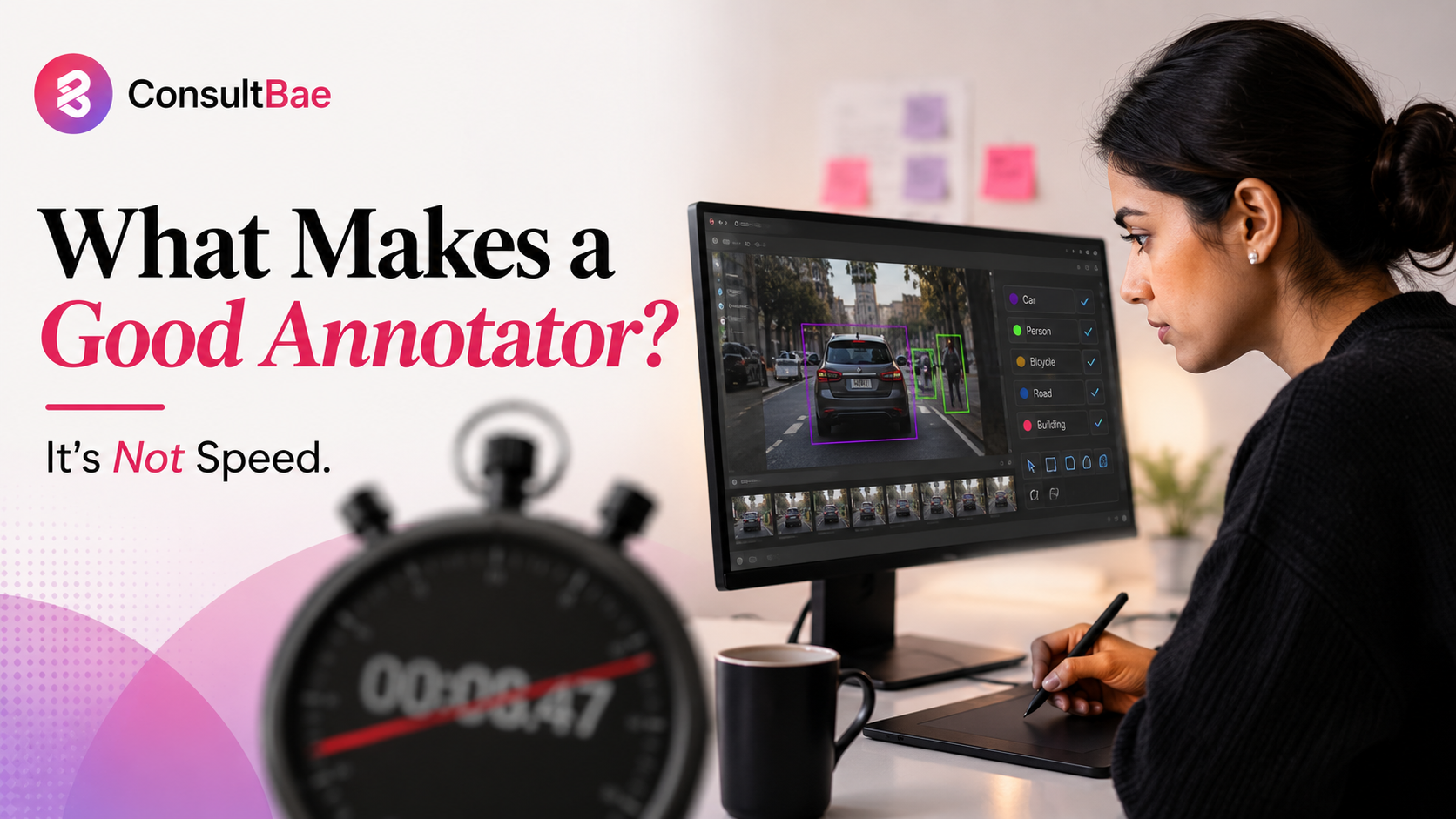
If you ask most annotation platforms how they evaluate annotator performance, the answer centres on speed. Labels per hour. Batches completed per day. Time-to-delivery against the project schedule. These are real operational metrics and they matter for running a data business. The problem is that they measure the wrong thing entirely when the goal is dataset quality.
An annotator who labels fast and labels inconsistently is not an asset to a training dataset. They are a liability that compounds at scale. Every inconsistent label is a signal the model has to make sense of alongside contradictory signals from other records. At low volumes, inconsistency is a minor problem. At the volumes AI training requires, it becomes a structural defect in the dataset that is nearly impossible to trace once the damage is done.
After working inside annotation operations across projects spanning multiple modalities and domains, the qualities that consistently separate good annotators from average ones have nothing to do with how fast they work. They have everything to do with how carefully they think.
The speed myth and where it comes from
The annotation industry inherited its performance metrics from task-based gig work, where volume is genuinely the right measure. If someone is delivering packages, more deliveries per hour is better. If someone is transcribing audio, more minutes transcribed per hour is better, assuming accuracy holds.
Annotation looks superficially similar. There is a task, there is a volume target, and there is a deadline. The difference is that annotation quality is not binary in the way delivery or transcription is. A package either arrived or it did not. A label can be technically present but wrong in ways that only surface when a model trained on it behaves unexpectedly in production.
Speed pressure does not just fail to improve annotation quality. It actively degrades it. An annotator working against a throughput target will resolve ambiguous cases faster, drift from guidelines under fatigue, and guess at edge cases rather than flag them. Each of those decisions makes sense individually under time pressure. Together, they produce a dataset with invisible quality problems distributed unevenly across thousands of records.
The annotator is not a step in the pipeline. They are the quality ceiling of the dataset. Whatever judgment they bring to each label is the best the dataset can be.
The five qualities that actually matter
Across annotation projects at ConsultBae, the annotators whose work holds up consistently share five qualities that have nothing to do with their output rate.
Guideline adherence under fatigue. Annotation guidelines are easy to follow on the first hundred records. Maintaining that adherence across a full session, when the task has become repetitive and the temptation to shortcut is high, is where most annotators drift. The best annotators treat record five thousand the same way they treated record five. That consistency is not natural to everyone. It is a disciplined habit, and it is the single most important quality for large-scale annotation work.
Edge case recognition rather than edge case resolution. Every annotation task has edge cases the guidelines did not fully anticipate. An average annotator resolves them with their best guess and moves on. A good annotator flags them, notes why the existing guideline does not clearly apply, and escalates for clarification. This slows them down. It also means the dataset does not accumulate a hidden layer of inconsistently resolved cases that nobody knows about until the model behaves strangely.
Reading comprehension at the level the guidelines require. Annotation guidelines for non-trivial tasks are detailed documents. They have to be, because the task has complexity that cannot be summarised in three bullet points. An annotator who reads the guidelines once and works from memory will start making assumptions within the first session. An annotator who genuinely internalises the guidelines, refers back when uncertain, and understands the reasoning behind each rule produces work that reflects what the guidelines intended rather than what the annotator remembered of them.
Consistency across a long session. Related to guideline adherence but distinct from it: the ability to apply the same judgment to the same type of data point regardless of where it falls in the session. This is harder than it sounds. Fatigue introduces drift. Boredom introduces drift. A subtle shift in how an annotator interprets a specific category on hour three versus hour one is invisible at the record level and significant at the dataset level.
Domain awareness where the task requires it. Not every annotation task needs domain expertise. Many do, more than most annotation platforms account for. An annotator working on medical content who does not understand basic clinical terminology will make labelling decisions that look plausible on the surface and are technically wrong in ways a clinician would immediately recognise. Matching annotator background to task requirements is not a premium option. For domain-specific datasets, it is a baseline requirement.
Inconsistent labels on similar data points, often traceable to a specific annotator whose work drifted across a session or resolved an ambiguous case differently at different points.
Edge cases labelled with false confidence, where the annotator applied the nearest applicable guideline rather than flagging that the case did not fit cleanly.
Guideline drift across the dataset, where early batches reflect the guidelines accurately and later batches reflect what annotators had started to assume the guidelines meant.
Domain errors in specialist content, where labels are structurally correct but substantively wrong because the annotator lacked the background to catch the distinction.
Why this is an annotator selection problem, not a QA problem
The instinctive response to annotation quality problems is to add more QA. More review passes, tighter acceptance thresholds, more rejections sent back for rework. QA matters and multi-stage review catches real problems. But QA is remediation. It catches failures after they have happened. It does not change the underlying quality of the annotation work being reviewed.
If the annotator pool has a fundamental speed-over-accuracy orientation, adding QA stages does not fix it. It just filters the most visible errors while leaving the subtler ones, the guideline drift, the quietly resolved edge cases, the fatigue-induced inconsistencies, intact in the records that passed review.
The right place to solve annotation quality is at selection. Choosing annotators whose natural working style fits the requirements of careful, consistent, guideline-driven work. Training them on the specific task before production begins. Calibrating them against sample data with known correct answers. Monitoring consistency metrics across the session rather than just accuracy at the record level.
How ConsultBae approaches annotator selection
At ConsultBae, annotator selection starts with the task requirements, not the available pool. We identify the cognitive profile the task needs: the level of reading comprehension the guidelines require, whether domain awareness is necessary and at what level, how long the annotation sessions run and what that demands in terms of sustained attention.
We calibrate annotators against sample data before production begins, not to test speed but to test judgment. How they handle ambiguous cases. Whether they flag edge cases or resolve them silently. Whether their work on record one hundred looks like their work on record ten.
Speed is a secondary consideration. An annotator who produces consistent, guideline-adherent work at a moderate pace is worth more to a dataset than one who produces twice the volume with half the consistency. The dataset does not remember how fast the labels arrived. It only reflects the quality of the judgment behind them.
Vanshika Jain works in AI Data Collection and Annotation at ConsultBae, focused on annotation operations and data quality across projects in multiple modalities and domains.
Need annotation work done right?
ConsultBae builds annotation pipelines where quality is designed in from selection, not patched in at review.
Talk to us