A data project that runs across one country is hard enough. The contributor pool needs to be sourced, the briefing has to be communicated, the quality has to be monitored, the delivery has to be aggregated. All of this is operationally manageable inside a single geography because the working assumptions are stable: shared language, shared timezone, comparable working norms, a single coordination layer that can stay on top of the work.
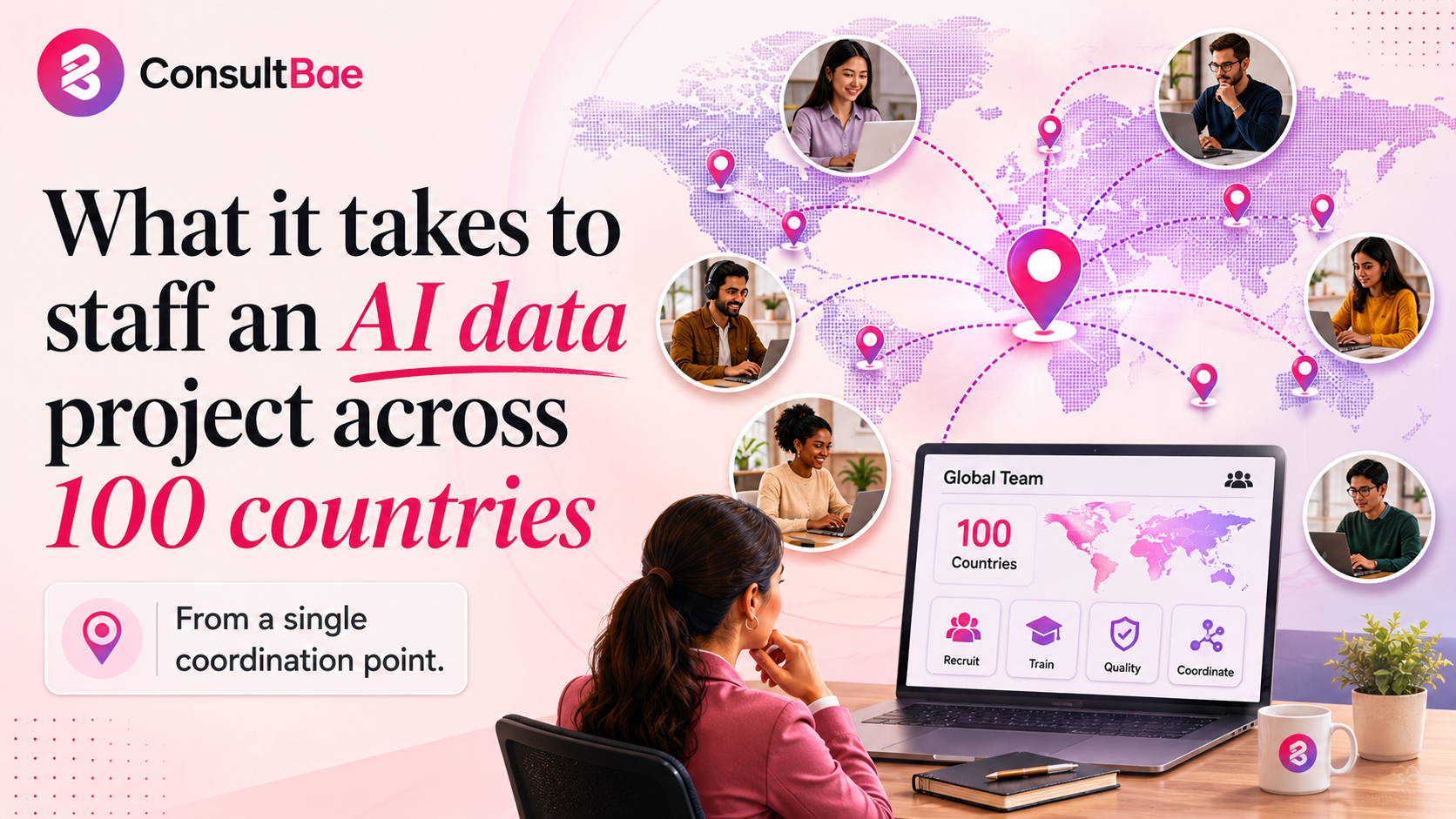
A project that runs across one hundred countries is a different category of operational challenge. The working assumptions that hold within one geography break across that range, and the infrastructure required to run consistent work across that span looks nothing like a single-country operation extended carelessly. Most vendors that claim to operate globally are actually running smaller-scale work and routing it through partners they do not directly control. The infrastructure to genuinely run cleanly across a hundred countries from a single coordination point is unusual, and the operational layers it requires are not the ones that show up in vendor proposals.
Why most vendors do not actually operate globally even when they claim to
Global capability is one of the more frequently overstated claims in the AI data vendor space. The reality is that most vendors operate intensively in a small number of geographies where they have built real infrastructure, and route work in other geographies through reseller relationships, third-party platforms, or partnerships whose quality they do not directly manage. The vendor name on the contract is consistent. The actual operation behind the work in each country varies considerably.
This is not necessarily a problem for projects with light coverage requirements. It becomes a problem when consistency across geographies matters, because consistency requires a coordination layer that genuinely understands and controls the work in each location. Routed work tends to produce country-by-country variation in quality that the buyer only discovers when the integrated dataset reaches their training pipeline.
The four operational layers required for genuine global coordination
Running a project across many geographies from a single coordination point requires four operational layers that are easy to underspecify and hard to build retroactively.
Contributor sourcing across geographies. A contributor pool that covers a hundred countries is not a single pool. It is a network of relationships built over time across crowd workers, freelancers, universities, NGOs, and local organisations in each country. Each relationship was built deliberately. Each one represents access to a specific population of contributors who can be activated when a project requires it. This network does not exist by default and cannot be assembled quickly for a specific project. It is the result of years of operational investment.
Briefing localisation. The same project brief works differently across languages, cultures, and working norms. Localising briefs is not translation. It is adapting the brief so that contributors in different geographies understand the same instructions, apply the same standards, and produce work that is consistent across the dataset. This requires people who understand both the brief's intent and the local context well enough to bridge them.
Quality coordination across timezones. A project running in twenty timezones cannot have quality issues that wait for one team to come online each morning. Quality coordination at this scale requires either a follow-the-sun operational structure with handoffs that preserve context, or dedicated coordination in each major timezone band, or some combination. The default of running the entire operation from one timezone produces delays that compound into delivery problems.
Delivery aggregation. Data collected across many geographies has to be aggregated into a coherent dataset. Format standardisation, metadata reconciliation, quality verification at the aggregate level. This aggregation step is where geographically distributed work either produces a clean integrated dataset or surfaces gaps that require going back to specific geographies for rework.
The vendors that genuinely operate across a hundred countries are the ones that built the four coordination layers over years. The vendors that claim to but route work through partners produce datasets where the gap between geographies shows through, even when each country's work looked acceptable individually.
Why each layer breaks at scale without dedicated infrastructure
Each of the four layers has a failure mode that is easy to ignore until the project is mid-delivery.
Sourcing breaks when the vendor relies on local partners they do not directly manage. The partner's contributor quality, their reliability, their willingness to maintain standards across a long engagement, all of these become risks the central coordination has limited control over.
Briefing breaks when localisation is treated as translation. The brief gets translated word-for-word, contributors in different geographies interpret it differently, and the dataset develops country-by-country variation that nobody specified.
Quality coordination breaks when issues that need same-day attention have to wait for a single team to be online. By the time the issue is addressed, the affected work has already propagated through the dataset, and the rework cost increases significantly compared to catching it in real time.
Delivery aggregation breaks when each geography is treated as a separate stream that only gets reconciled at the end. Reconciliation late in the project surfaces gaps that should have been caught much earlier, and fixing them requires going back to geographies where the active work has already moved on.
What a 100-country project actually requires to run cleanly
A project running across that range needs all four layers in place from the start, not improvised once the volume arrives. The contributor network has to already exist with directly-managed relationships in each country the project covers. The briefing localisation has to be designed with people who can adapt the brief without losing intent. The quality coordination has to be structured for the timezones the project actually runs across. The delivery aggregation has to be planned alongside the collection, not bolted on at the end.
None of this can be built from scratch for a single project. The infrastructure either exists at the vendor or it does not, and the vendor proposals do not always make clear which is the case. Buyers can ask, directly: how the vendor operates in specific geographies, who they actually work with on the ground, how quality coordination happens across timezones, what their aggregation process looks like. The answers reveal whether the global capability is real or claimed.
In country X, who are your contributors actually working through, and what is your relationship with that channel? How is the project brief localised for each geography, and by whom? How do you handle quality issues that surface outside your primary timezone? At what point in the project is data aggregated across countries, and what is your reconciliation process? Can you describe a specific multi-country project you have run end to end?
How ConsultBae operates this
The contributor network we run across 100-plus countries was built over six years through direct relationships with crowd workers, freelancers, university contacts, NGOs, and local organisations in each country we cover. We do not route through reseller partners we cannot manage. Briefing localisation is done by people who understand the project intent and the local context. Quality coordination is structured for the operational reality of running across many timezones. Delivery aggregation is planned from the start of every project.
None of this is exotic. All of it is the operational discipline that distinguishes genuinely global capability from the version that exists on a website. Buyers running projects across many geographies should ask the questions that surface which version they are working with, because the difference is invisible in the proposal and very visible in the dataset.
Vanshika Jain works in AI Data Collection and Annotation at ConsultBae, focused on annotation operations and data quality across projects in multiple modalities and domains.
Running a project across multiple geographies?
ConsultBae operates directly across 100+ countries with the coordination layers most vendors do not have. Let us talk.
Talk to us