

Most people who work adjacent to the AI industry have a reasonable sense of what it took to train the large language models and image generation systems that became household names over the past few years. Text scraped from the internet. Images tagged by human annotators. Preference data from people rating model outputs. The data collection infrastructure built to support this wave of AI development was primarily digital: you could gather it remotely, process it in the cloud, and deliver it to a training pipeline without anyone physically going anywhere.
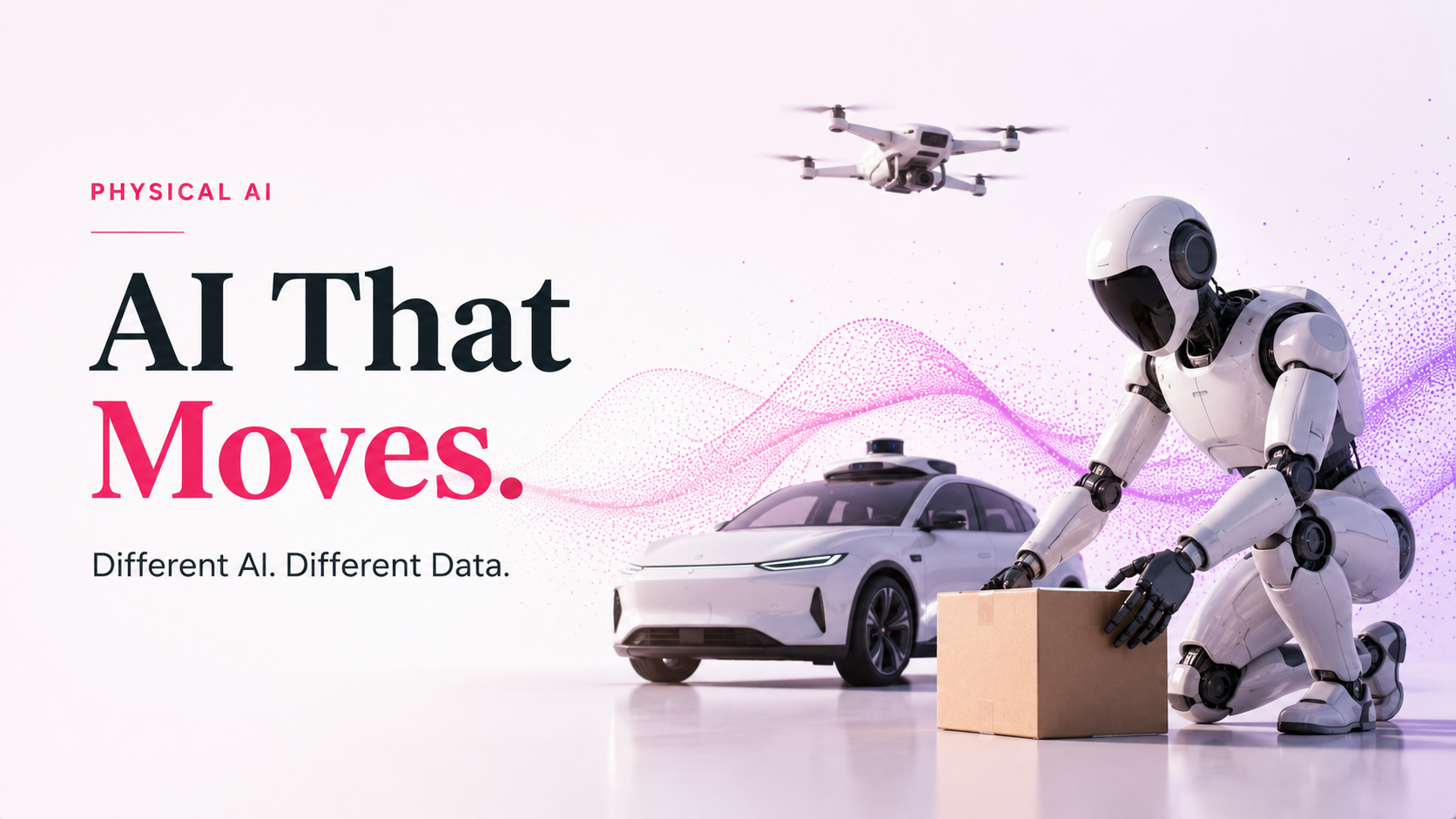
Physical AI is different in a way that matters practically. It refers to AI systems that need to operate in the physical world: robots that pick and place objects, autonomous vehicles that navigate real roads, drones that perform tasks in real environments, warehouse automation systems that handle goods in conditions that vary constantly. These systems need to be trained on data that reflects the physical world as it actually is, not as a description of it, and that data cannot be collected remotely. It requires people, places, equipment, and environments, all coordinated to capture the specific physical realities the model needs to learn from.
The pattern we are seeing in project inflow right now is clear. Physical AI is where the next wave of serious data collection demand is building, and the companies who get ahead of what it requires for training data are the ones who will be positioned to serve it when the volume arrives.
What Physical AI Actually Means
Physical AI, at its core, is the application of machine learning to systems that perceive and act in the physical world rather than in purely digital environments. The defining characteristic is embodiment: the AI is not processing text or generating images in a server. It is operating a physical system that interacts with real objects, real spaces, and real variability in ways that digital environments do not produce.
The category is broader than most people initially picture. Autonomous vehicles are the most discussed example, but physical AI includes industrial robots learning to handle diverse objects on a production line, surgical robots developing the fine motor precision required for minimally invasive procedures, agricultural automation systems learning to pick fruit at varying stages of ripeness across different weather and lighting conditions, and humanoid robots being trained to perform everyday physical tasks in human environments.
What unites all of these is the relationship between perception, decision, and physical action. A language model reads text and generates text. A physical AI system reads the state of the world through sensors and cameras and then moves something in response. The training data for this kind of system has to capture the full chain: what the world looked like before the action, what action was taken, and what the world looked like after. Building that training dataset requires capturing real physical sequences, not just labelling static images or transcribing audio.
Why Training Data for Physical AI Is Different From Language or Vision Data
The data that trained GPT-style language models was primarily collected once, at very large scale, from existing digital sources. The training data for physical AI systems has to be collected continuously, in specific physical environments, by contributors performing specific physical tasks, with sensor equipment capturing multiple simultaneous data streams. The scale at which a single physical AI project requires coordinated human action is fundamentally different from the scale at which language or standard image annotation operates.
Consider the difference between annotating a static image of a kitchen counter and collecting the training data for a robot that needs to pick objects off a kitchen counter. The image annotation task can be done remotely, in any country, by any contributor with a screen and an internet connection. The robot training data requires someone to be physically present in a kitchen, performing the grasping motion with the specific object types the robot will encounter, with multiple cameras and potentially force sensors capturing the action from angles that make the motion learnable. The same task, in different kitchens, with different objects, in different lighting conditions, performed enough times by enough different people that the robot develops the generalisation capability to handle the real-world variation it will face in deployment.
This creates sourcing and logistics requirements that AI data collection has not historically had to address. Geographic specificity matters because the physical environments need to match the deployment context. Equipment matters because the capture conditions need to produce data that the training pipeline can use. Contributor coordination matters because multiple people need to perform the same physical task in controlled and documented ways across many sessions. None of this is solvable by scaling up the same crowdsourcing infrastructure that worked for text and image annotation.
"The pattern I am seeing right now is in physical AI. It is where the serious data demand is heading next. These projects need people to actually do things in the real world. You cannot collect that data from a laptop at home."
Autonomous Vehicles as the Clearest Example of What Physical AI Data Requires
Autonomous vehicle training data is the most mature segment of physical AI data collection and the one where the requirements are most clearly understood. A self-driving system needs to be trained on data that covers an enormous range of driving conditions: urban and highway environments, varied weather, different times of day and night, unusual road configurations, edge cases that experienced human drivers handle intuitively but that a model needs to have seen in training to handle reliably.
The data collection for this involves sensor-equipped vehicles driving real routes, capturing simultaneous video streams from multiple cameras, LIDAR point clouds, radar data, and GPS telemetry, all synchronised to build a complete picture of each moment in the drive. Human annotators then label the data: every pedestrian, every vehicle, every traffic sign, every lane marking, every relevant object in the scene, along with its precise location, its movement trajectory, and its classification. The annotation work for a single hour of driving footage can take dozens of hours of human annotation time to complete to the standard required for training.
The geographic dimension of autonomous vehicle training data adds another layer of complexity. A system trained primarily on data from one country will have gaps when deployed in another, because road layouts, traffic patterns, signage conventions, and driving behaviours differ significantly across markets. A genuinely robust autonomous driving system needs training data from the specific markets it will operate in, which means coordinated data collection across multiple geographies with local contributors who know the specific driving environments being captured.
Robotics Training and What Human Demonstration Data Looks Like
Beyond autonomous vehicles, the other rapidly growing segment of physical AI data demand is robotics. The approach to training manipulation robots, systems that need to pick, place, sort, assemble, or otherwise interact with physical objects, increasingly relies on human demonstration data: recordings of humans performing the same tasks the robot needs to learn, captured in enough detail that the model can extract the motion patterns, the force dynamics, and the spatial reasoning that the human is applying.
This is a genuinely different type of data collection from anything that preceded it. The contributor is not sitting at a computer labelling images or recording speech. They are performing physical tasks: picking up objects of different shapes, weights, and textures; sorting items by properties that require tactile discrimination; assembling components in sequences that require precise spatial awareness. The data capture equipment records this in multiple dimensions simultaneously, and the resulting dataset needs to cover enough variation in objects, conditions, and individual human performance styles that the robot develops robust generalisation rather than learning a brittle approximation of one person's technique.
The sourcing challenge for this type of collection is significant. The contributor pool needs to be physically present in the collection environment, which means the geographic reach of a remote crowdsourcing platform provides no advantage. The contributors need to be capable of performing the physical tasks consistently across multiple sessions, which means recruitment and onboarding look more like hiring for a skilled physical task than like recruiting for a digital gig. And the coordination of the collection sessions requires on-the-ground project management in a way that purely remote data collection does not.
Why Sourcing Contributors for Physical AI Is a Different Problem
The contributor profile required for physical AI data collection overlaps only partially with the contributor profile for standard annotation or speech collection. Some of the same principles apply: demographic diversity matters, geographic distribution matters, contributor reliability and compliance with the collection protocol matters. But the physical nature of the task adds requirements that digital data collection does not have.
Physical availability in the right location is the most basic constraint. A contributor pool that is geographically dispersed across a hundred countries is valuable for collecting speech data or text annotations from diverse backgrounds. For collecting robotic manipulation demonstrations in a specific type of industrial environment, the contributor pool needs to be physically present at the collection site, which means sourcing for geographic proximity rather than geographic breadth.
Physical capability for the task is the second constraint. Some physical AI data collection tasks are accessible to any able-bodied adult. Others require specific physical capabilities, professional experience with specific tools or environments, or the ability to perform precise fine-motor tasks consistently across many repetitions. A collector who can perform a task well once does not necessarily produce useful training data; the model needs to learn from consistent, well-executed demonstrations, which means the vetting process for physical AI contributors needs to include task performance assessment that standard digital contributor onboarding does not.
The equipment requirement is the third differentiating factor. Physical AI data collection typically requires capture hardware, cameras, motion capture systems, tactile sensors, that is not the contributor's own device. The collection operator needs to either provide equipment to the collection site or coordinate collection at locations where the required equipment is available. This creates logistics and cost structures that remote data collection does not involve, and it means the planning horizon for a physical AI collection project is significantly longer than for a comparable digital collection at the same scale.
What the Demand Pattern Looks Like From Inside an AI Data Operation
The shift toward physical AI data demand is visible in the project briefs arriving now compared to two years ago. The early AI data projects were almost entirely digital: speech recordings, text annotations, image labels, conversational datasets. These projects could be specified remotely, collected remotely, and delivered remotely. The operational infrastructure required was primarily about sourcing contributors across geographies and managing remote quality control.
The current pattern includes a growing proportion of projects that require physical presence, specialised capture equipment, and environment-specific collection protocols. Requests for video data of specific physical tasks performed in specific types of spaces. Requests for sensor data from real-world environments rather than simulated ones. Requests for human demonstration data across a range of physical tasks that spans from basic manipulation to domain-specific professional activities.
The companies driving this demand are building AI systems that will operate in hospitals, factories, warehouses, vehicles, and homes. Each of these deployment environments has specific physical characteristics that need to be represented in the training data, and collecting that data requires the kind of on-the-ground contributor sourcing and coordination infrastructure that the digital data collection wave did not need to develop. The companies that built this infrastructure early will be positioned to serve the physical AI wave at the scale it eventually requires. The ones that did not will be building it under the time pressure of project briefs that are already arriving.
Contributors must be physically present at the collection location. Unlike speech or annotation tasks that can be distributed to any contributor with an internet connection, physical AI data collection requires contributors to be at a specific place, performing specific tasks in a specific environment. Sourcing for geographic proximity and physical availability replaces sourcing for geographic breadth and digital access.
Data capture requires specialised equipment. The sensor arrays, multi-camera rigs, motion capture systems, and synchronisation infrastructure required for physical AI data collection are not consumer devices. They need to be provisioned, calibrated, and operated by someone with the technical capability to ensure the data is captured at the quality and format the training pipeline requires. This adds logistics overhead that remote collection does not have.
Quality control has a physical dimension. Standard AI data quality control evaluates whether the digital deliverable meets the specification. Physical AI data quality control also evaluates whether the physical performance being captured was executed correctly and whether the environment during collection matched the specified conditions. This requires quality review processes that assess the capture context, not just the data file.
Building a Physical AI System That Needs Real-World Training Data?
ConsultBae is building the contributor networks, collection protocols, and quality infrastructure for physical AI data across robotics, autonomous systems, and real-world environment capture. Talk to our team about what your project requires.
Talk to Our AI Data Team