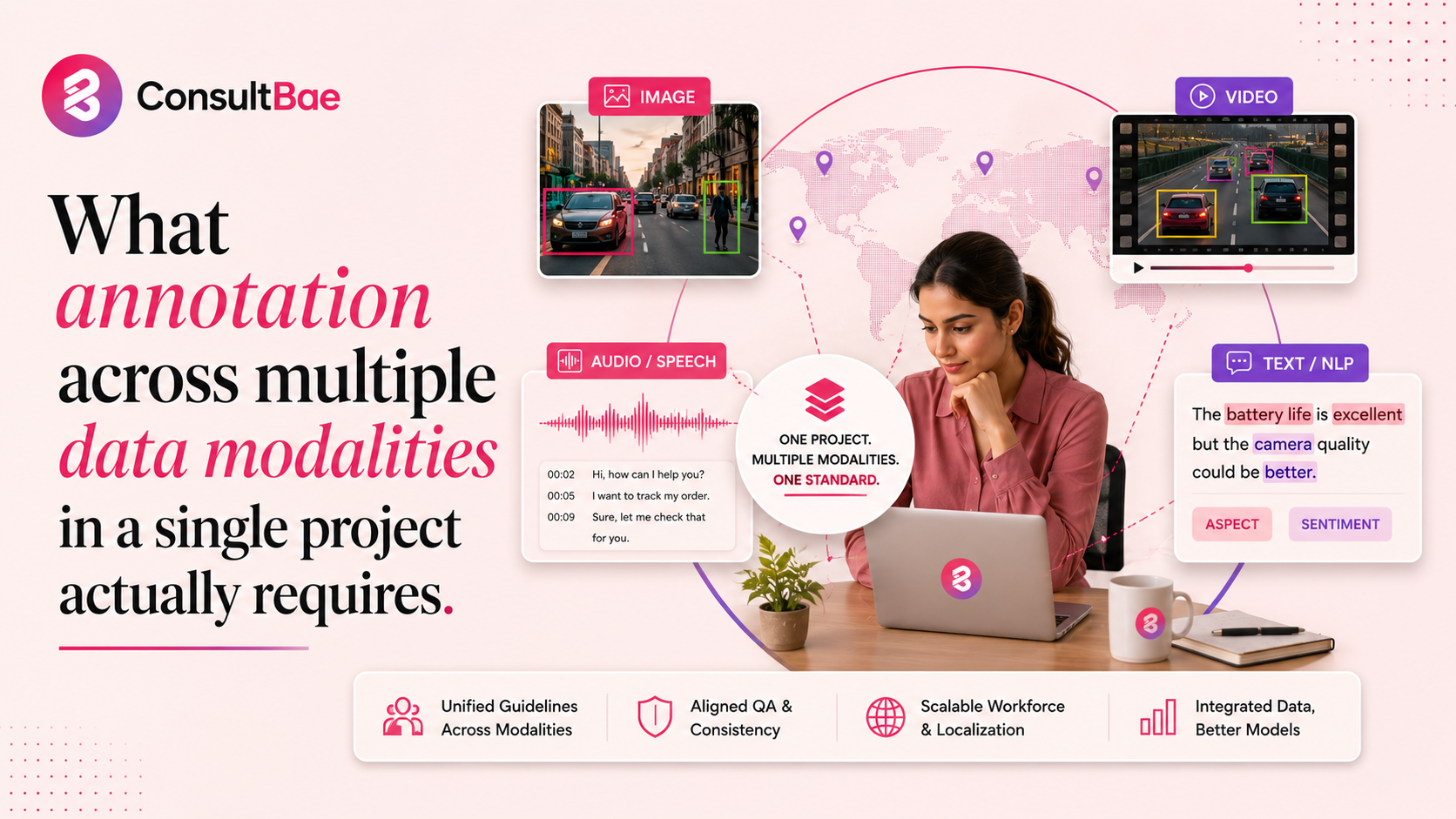
Most AI data vendors specialise in one or two modalities. Some are strong on speech and audio. Others have built their operation around image and video. A smaller number focus on text and language work. When a project needs annotation that spans multiple modalities consistently, the vendor pool narrows considerably, and the operational realities of running that work look meaningfully different from single-modality projects scaled up.
Multimodal annotation has become more common as AI models themselves become multimodal. A speech model that also processes the visual context of the conversation. A computer vision system trained alongside the text annotations that describe what is being shown. A robotics dataset that combines synchronised video, audio, and metadata about the physical environment. These projects need annotation that is consistent across data types in ways that single-modality projects do not have to coordinate, and the vendor running the work either has the operational structure to do it or does not.
Why multi-modality projects are operationally distinct
A single-modality annotation operation can build all of its infrastructure around one data type. The contributor pool develops expertise in that type. The annotation tooling is optimised for it. The quality processes are calibrated to its specific failure modes. The reviewer team operates inside one domain of work.
Multimodal work cannot rely on this. The same dataset has speech that needs transcription, images that need bounding boxes, and text that needs entity annotation. These three tasks have nothing in common operationally except that the project requires them to produce consistent results when integrated. The vendor running the project either has parallel operational capability across all three, with coordination layers that connect them, or has to run three separate workstreams that get reconciled at the end with predictable gaps.
What changes when annotation needs to be consistent across modalities
Three things specifically need to be in place for multimodal annotation to produce a coherent dataset rather than three separate datasets stitched together.
Cross-modal labelling guidelines. The annotation guidelines for each modality need to be designed together, not separately. If a speech annotation labels a moment as a question, the corresponding video annotation needs to be consistent about whether that moment also includes the visual signals that typically accompany a question. The label categories across modalities need to align in ways that let the model learn from the relationship between them. Designed in isolation, these guidelines develop inconsistencies that show up in the integrated dataset.
Coordinated quality processes. Quality review for speech, image, and text annotation has different metrics, different sampling approaches, and different reviewer profiles. Running them in parallel without coordination produces a dataset where one modality may pass quality at one threshold and another at a different threshold, leaving the integrated whole inconsistent. The quality processes need to be coordinated centrally, with cross-modality checks that verify the integrated dataset rather than just each modality on its own.
Contributor teams that can work across types. Some annotation tasks benefit from the same annotator working across modalities in a single record. A clip that needs speech transcription, speaker identification, visual scene labelling, and gesture annotation can be done by separate teams or by a single annotator who understands the full clip. Both approaches have their place, but the choice has to be made deliberately, and many vendors do not have the capability to offer the latter even where it would produce better results.
A multimodal dataset is not three datasets in the same folder. It is a single integrated dataset where the relationships between modalities matter as much as the labels within each one.
Why most platforms cannot run this work well
Most annotation platforms are built around a particular data type and the workflows associated with it. The tooling is optimised for that type. The contributor pool has been selected and trained for it. The quality processes are calibrated to it. Extending the platform to other modalities is operationally significant, and most platforms have chosen not to do it because their economics work better within a single specialisation.
Buyers running multimodal projects sometimes end up using multiple vendors, each handling their specialised modality, with the buyer responsible for the integration. This works at the level of getting each modality annotated, but it loses the cross-modal coordination that multimodal datasets need. The integrated dataset reflects the gaps between vendors rather than the consistency that the project required.
What a well-run multimodal annotation project looks like
A multimodal project that produces a coherent dataset has a few features in common. The annotation guidelines for all modalities are developed in concert, with explicit attention to where the modalities relate to each other and where the labels need to align. The annotator pool has experience across the relevant data types, or is structured so that cross-modality coordination happens through clear handoffs rather than through assumptions that did not get checked. The quality review includes cross-modal validation, not just within-modality consistency. The delivery format reflects the integrated nature of the dataset, with metadata that ties the modalities together explicitly.
All of this requires the vendor to have built operational capability across all four major modalities, not just claimed it. The work the vendor has done historically in each modality, the contributor pool they have for each, the tooling and quality processes they run for each, all of this becomes the foundation for multimodal projects.
Direct operational experience in each of the modalities the project requires, not just in one extended through partners. Annotation guidelines developed together across modalities, with explicit cross-modal alignment. A contributor pool that can work across data types or coordinate cleanly across teams. Quality processes that validate the integrated dataset, not just each modality. Delivery that treats the dataset as one coherent artefact rather than three separate ones.
How ConsultBae approaches this
ConsultBae has run annotation projects across all four major modalities: audio, video, image, and text. That history is what makes multimodal work feasible for us, because the operational capability in each modality is direct rather than routed through partners, and the integration between them is something we have actually done rather than something we would have to invent for a specific project.
Multimodal annotation will become more common as AI models continue moving toward multimodal architectures. The vendors who can do this work cleanly are not the ones who recently expanded into adjacent modalities to capture the opportunity. They are the ones who built operational capability across all four modalities deliberately, over time, and who understand the cross-modal coordination challenges from the inside.
Mohit Singh Katewa leads the AI Data vertical at ConsultBae, overseeing data collection, annotation, and quality operations across 100+ countries.
Running a multimodal annotation project?
ConsultBae operates across all four major modalities with the cross-modal coordination most platforms cannot offer. Let us talk.
Talk to us