Most founders in the staffing business will tell you that cold outreach does not work. They have tried it, gotten low response rates, moved on, and concluded that referrals are the only reliable way to grow. That conclusion is usually correct as a description of what happened to them. It is wrong as a general principle.
The problem is not cold outreach. The problem is that most cold outreach from staffing firms is built around the sender's capabilities rather than the recipient's specific situation. It says: we have a database, we can hire fast, we work across these industries. It does not say: I know exactly who you are, I know exactly what your problem is, and I have done this specific thing for companies in your exact position before. The first version is noise. The second version is a relevant conversation starter.
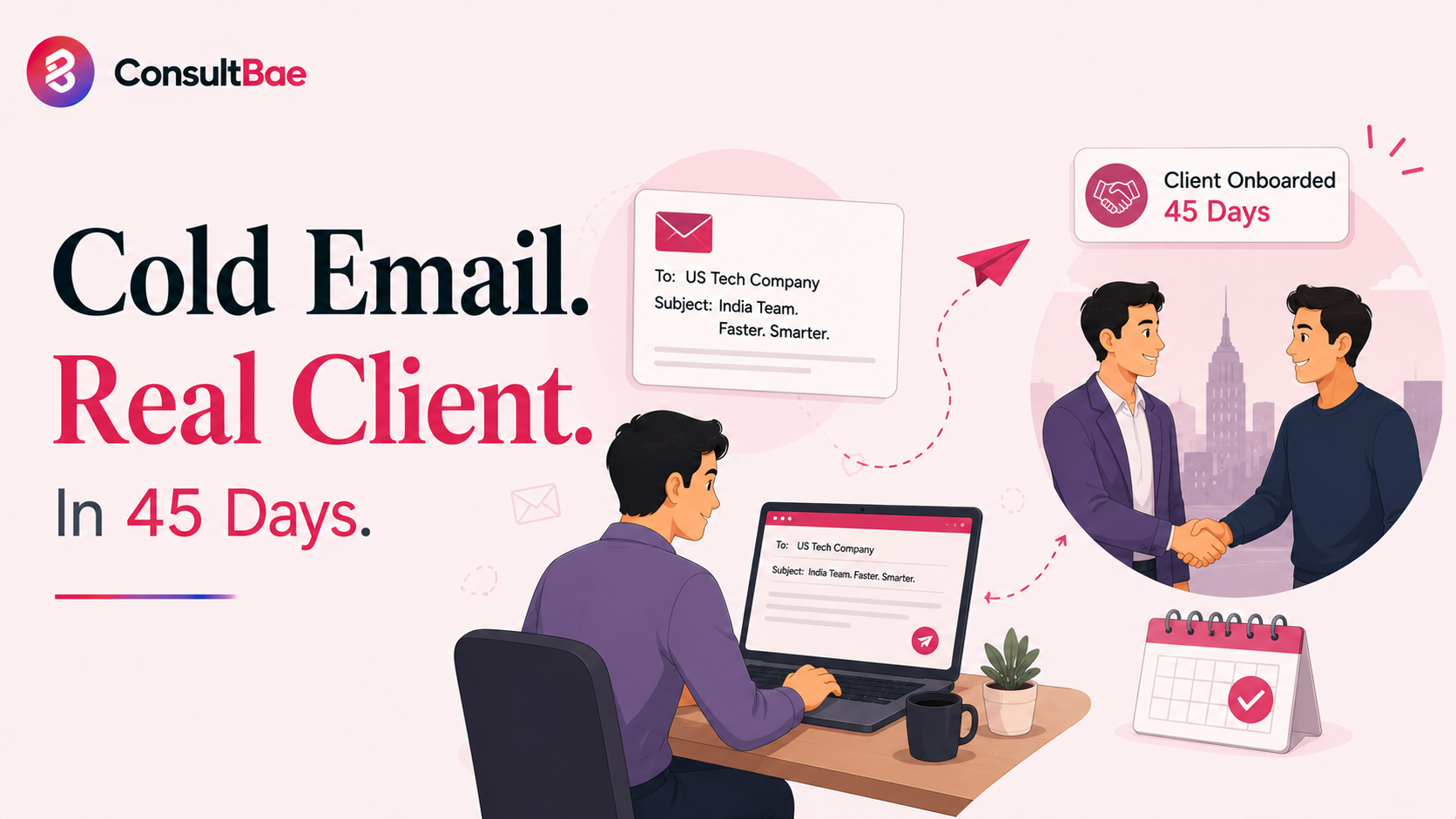
We learned the difference between the two the year we decided to target US-based technology companies looking to build delivery teams in India. One of those campaigns converted a client in 45 days. Here is what actually happened.
Why Most Cold Outreach From Staffing Firms Fails
Staffing is a trust business. Before any company gives a recruiter access to their open roles, their hiring process, and their candidates, they need to believe that the partner understands their needs, will represent them well to candidates, and will not waste their time with profiles that miss the brief. That belief is built through relationship, through referral, or through evidence so specific and relevant that the cold contact does not feel cold.
Generic capability claims do not build that belief. Saying that you have placed 500 candidates across 12 industries tells the recipient nothing about whether you understand their specific hiring challenge. It does not answer the questions they are actually asking when they receive an unsolicited message from a firm they have never heard of: why are you reaching out to me specifically, what do you know about my situation, and what makes you the right person to help with it?
Most cold outreach from staffing firms cannot answer these questions because it was not written with a specific recipient in mind. It was written to be sent to a large list, which means it was written for no one in particular, which means it feels that way to everyone who receives it.
The Targeting Logic: Indian Founders Building India Teams
The decision to focus on Indian founders based in the US was not arbitrary. It came from a clear piece of reasoning: this is a segment with a specific, identifiable need that we are positioned to solve better than most.
An Indian founder who has moved to the US to build a funded technology company carries a set of characteristics that make them an ideal prospect for a staffing partner with deep India-based talent networks. They understand the Indian talent market, so they are not skeptical of the quality argument for India-based hiring. They often have a personal and professional network in India, but that network does not run a recruitment operation. They are cost-conscious in ways that make the India delivery model genuinely attractive. And they are building fast enough that speed of hire is a real constraint, not a nice-to-have.
This is a segment with a real, concrete pain point that matches precisely what we can deliver. The outreach could be specific because the segment was specific. That specificity changed the nature of every email sent within that campaign.
"The first set of clients you get is always from your network. But once you start expanding beyond it, the question becomes: which segment of people has exactly the problem you solve? That answer determines everything about how the outreach is written."
What the Offer Actually Said
The outreach did not lead with our company history, our database size, or our service line overview. It led with the recipient's situation: you are an Indian founder building a technology company in the US, and you are likely trying to figure out how to build a delivery team in India cost-effectively without losing months to the search. Here is what we have done for companies in exactly this position, here is how quickly we moved, and here is one specific outcome we produced.
The credibility in the message was not claimed, it was demonstrated. A specific number of placements. A specific time to hire. A specific engagement type that matched what we believed the recipient needed. None of this was fabricated or speculative. It came from real engagements we had already run with similar clients, which meant we could write the message with the confidence of someone who has done the work, not the optimism of someone hoping to get the chance to do it.
The call to action was also specific: not a generic request for a meeting to discuss your hiring needs, but a pointed question about whether a particular challenge, building a technology delivery team in India within a fixed timeline, was something they were currently working on. A yes or no question is easier to answer than an open-ended meeting request. A yes opens the conversation. A no closes it cleanly and saves time for both sides.
What Happened on the Call That Converted
The first call was not a pitch. It was a diagnostic. The questions were about the company's current state: what the technology team looked like, what was missing, what the timeline looked like, what had already been tried. The goal was to understand the problem well enough to describe a solution that actually matched it, rather than to present a pre-prepared capability deck and hope something landed.
The conversion happened because by the end of that first call, the client had described their problem and we had described, in specific terms, exactly how we would approach it. Not a general staffing process, but a specific plan: the roles we would source first, the timeline we were committing to, the structure of how the team would be onboarded. The specificity of the plan was the proof of the capability. Anyone can claim to hire fast. Describing exactly how you would hire fast for this specific need, with the detail that only comes from having done it before, is what converts.
What This Taught Us About Positioning Versus Prospecting
The lesson from this campaign was not about email volume, send timing, or subject line optimisation. It was about the difference between positioning and prospecting. Prospecting is the activity of finding potential clients. Positioning is the work of being a specific, credible answer to a specific problem before the prospect even receives your message.
Firms that lead with prospecting, casting wide nets with generic capability messages, are competing on reach. Firms that lead with positioning are competing on relevance. Relevance wins in high-trust, low-frequency purchase decisions like staffing, where the recipient is not going to respond to a message unless they feel confident that the sender understands their situation well enough to be worth a conversation.
The other lesson was that this kind of outreach is not scalable in the way that volume-based outreach is. You cannot send this message to 10,000 people. You can send it to 200 people in a tightly defined segment, and if your positioning is correct, the conversion rate from that 200 will exceed what most firms get from their 10,000. Fewer conversations, higher quality, faster trust.
A specific audience with a specific pain point. Indian founders building India teams have a concrete need that maps directly to what we can deliver. The segment was chosen because the fit was real, not because the list was large.
A message built around their situation, not our capabilities. The outreach described their problem before it described our solution. That sequence matters because it signals that the sender has thought about the recipient, not just about the pitch.
A proof point that was specific enough to be believable. Claiming to hire fast is easy. Citing a specific number of placements in a specific time for a similar company is evidence. Evidence closes more conversations than claims do.
Cold outreach works when it is not really cold. It works when the targeting is precise enough, and the message is specific enough, that it feels like a relevant observation from someone who knows the space, rather than a generic solicitation from someone working through a list. Getting there requires more work per message and fewer messages sent. It also requires being honest about which segments you are genuinely positioned to serve, rather than which segments are largest. That honesty is what produces the specificity that converts.
Building a Technology Team in India?
ConsultBae partners with US-based companies to place technology and delivery talent in India, from individual hires to full pod-based engagements. We close roles in under two weeks with a pre-built, maintained pipeline.
Start the Conversation