There is a specific irony in running a recruitment company and still finding your own internal hiring to be the most consistently difficult problem on the operational calendar. The tools are available. The sourcing channels are familiar. The screening frameworks are well-developed. And yet the decisions about who to bring into the company, at which stage of its growth, for which role, turn out to require a kind of judgment that the client playbook does not fully address.
The client playbook is built for a specific situation: a company with a defined role, a budget range, and a target profile that can be articulated clearly enough to generate a search brief. Internal hiring at a bootstrapped services company in its early and middle growth stages does not always look like this. The roles are sometimes defined mid-search. The budget is constrained in ways that require tradeoffs that do not apply when the client is a well-funded technology company. And the stakes are different, because the people brought into the company at each stage become the cultural and operational foundation that the next stage of growth is built on.
Looking back at six years of building ConsultBae's own team, the hiring philosophy has changed significantly at least twice. Each change was triggered by a specific shift in what the company needed from its people, and each transition was harder than the previous stage's approach to hiring would have predicted.
Why Internal Hiring Is Harder Than Client Hiring
When hiring for a client, the recruiter operates with a useful degree of separation. The role requirements come from someone else's organisation, with its own culture, its own management structure, and its own definition of success. The recruiter's job is to understand that definition well enough to find candidates who meet it. The recruiter is not responsible for whether the definition is correct, whether the role will evolve in unexpected ways, or whether the hiring manager's intuitions about what they need are right. These are the client's problems. The recruiter's problem is finding the right candidates for the brief as given.
When hiring internally, none of this separation exists. The person doing the hiring is also the person who will manage the hire, who will define the role as it evolves, who will be accountable for whether the person succeeds or struggles, and who will carry the cost of a wrong decision in ways that are directly felt rather than reported in a client relationship review. The stakes are personal in a way that external placement is not, which changes the decision-making in ways that are not always improvements.
Internal hiring also lacks the calibration that comes from running many similar searches. A recruiter who has placed twenty senior engineers in technology companies has a calibrated sense of what the right profile looks like and where candidates tend to fall short. A founder hiring for an operational role in a specific vertical of their own company may have done it twice before, which is not enough repetition to develop the pattern recognition that produces consistently good decisions.
The Aptitude-First Phase and What It Was Right About
In the first two or three years of ConsultBae, the internal hiring logic was aptitude-first. The budget did not allow for experienced professionals at market rates. The roles were not yet defined precisely enough to specify the experience that would make someone immediately productive. And the pace of the work, which was fast and improvised and required constant adaptation to whatever the business needed that week, was better suited to someone who could learn quickly and operate without a clear playbook than to someone who had done the same thing many times before in a more structured environment.
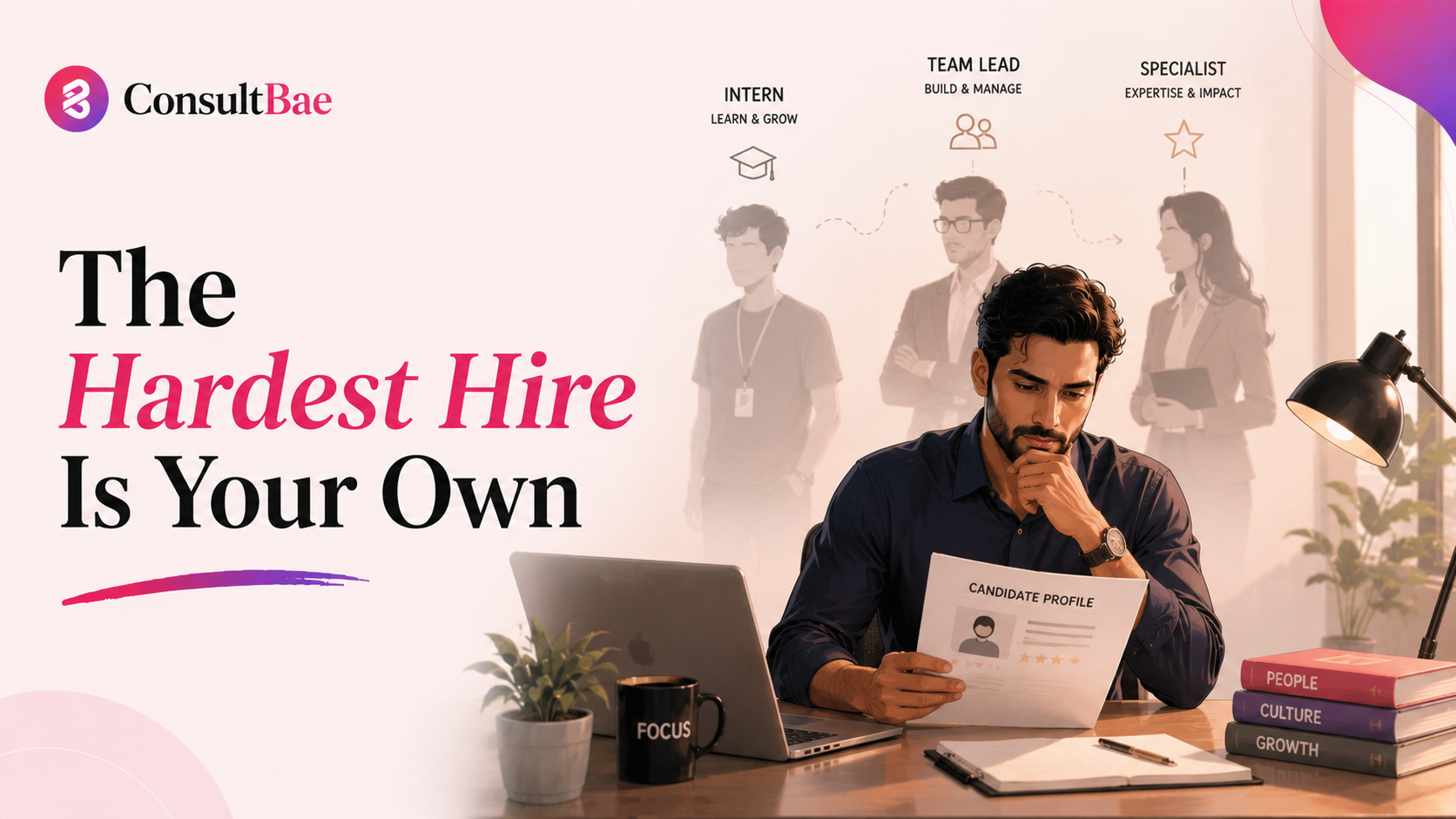
The first two hires were interns. They contributed for a few months, which was appropriate for where the company was and what it needed from them. The early full-time hires were chosen primarily on the basis of learning speed, personal drive, and alignment with the direction the company was building toward. The explicit tradeoff, accepted consciously, was that the early team would require more investment in training and would take longer to reach full productivity than experienced hires would have.
What this approach was right about: it produced a team that was genuinely invested in building the company rather than executing a defined role within it. The people hired in the aptitude-first phase grew into their roles as the company grew, which meant the institutional knowledge they developed was calibrated to the company's actual operations rather than to how things were done somewhere else. The longest-serving team member, now four years in, leads the recruitment vertical. That trajectory was possible because the hiring logic at the time created the conditions for it.
"Initially the hiring was focused on finding someone with the appetite to grow, someone who is a quick learner, someone who wants to build a career in the same direction. Now, we look for people who come with prior experience so the learning curve is small and we learn from them."
The Transition to Experience-First and What Triggered It
The shift from aptitude-first to experience-first hiring was not a single decision. It was a gradual recognition that the company had reached a stage where the value of fast learning was being outweighed by the cost of the learning curve itself. The verticals had developed enough definition that the roles within them could be articulated specifically. The client expectations had matured to the point where there was less room for the kind of on-the-job development that the aptitude-first approach produced. And the team itself had grown large enough that new hires needed to integrate into an existing culture and set of processes rather than helping to invent them.
The trigger for each significant transition was usually a specific gap: a moment when the business needed a capability at a level of sophistication that the existing team did not yet have, and where the time required to develop it internally was longer than the business could absorb. These gaps are the natural product of growth, and how they are addressed determines whether the growth is sustainable or whether the organisation develops faster than the team's capability can support.
Experience-first hiring in the current phase means looking for people who have done the specific work before in contexts similar enough that the learning curve is short, and who bring knowledge about how things are done elsewhere that the company can genuinely learn from. The explicit tradeoff in this phase is cost: experienced hires are more expensive, and the bootstrapped model means that each hire has to be justified by revenue that already exists rather than by revenue that is expected to follow. The discipline this creates is useful, because it prevents the kind of hiring-ahead-of-need that produces teams that are larger than the business can sustain at its current revenue level.
Where the Client Playbook Applies and Where It Does Not
The client recruitment playbook that ConsultBae uses for mid-senior external placements is well-developed: a three-stage sourcing and screening process, a two-week closure target, a structured handoff between the account management and delivery functions. It works well for its intended purpose, which is finding the right candidate for a clearly defined role in an organisation that has the structure to integrate and manage that person effectively.
Applied to internal hiring, the playbook works for some roles and not for others. For hiring a senior sourcing specialist or an account manager in the recruitment vertical, where the role is well-defined and the success criteria are clear, the standard process applies reasonably well. For hiring the person who will lead a new vertical, or the person who will build the sales function for a market the company has not yet fully entered, the brief is less precise in ways that the standard process is not designed to accommodate.
The most significant gap is in how the brief is defined. A client brief for an external placement is usually built on the client's understanding of what they need, which the recruiter refines through conversation. An internal brief for a role that does not yet have a clear definition requires the hiring decision-maker to work out what they need through the process of searching, which is harder and slower than refining an existing definition. The recruiter's own experience of finding candidates who do not quite match the undefined brief is often the primary input into making the brief more specific, which means the process requires more iteration than a standard external placement.
What the Internal Hiring Logic Looks Like Now Versus Six Years Ago
The current internal hiring logic is built around two questions that were not the primary considerations in the early phase. The first is: what does this person know that we do not, and how quickly can we learn from them? The second is: what is the minimum experience level required for this role to produce the output the business needs within the first ninety days, and can we justify that cost against current revenue?
These are different questions from the aptitude-first questions of the early stage, which were more focused on trajectory than on current capability. They produce different hiring decisions and different candidate profiles, and they require a different kind of interview process: one that is less focused on assessing potential and more focused on understanding what the candidate has already done and how well it maps to the specific requirement.
Phase one, aptitude-first: Hire for learning speed, drive, and directional alignment. Compensate below market and invest in training. Accept a longer ramp to productivity in exchange for hires who grow with the company and develop deep institutional knowledge. Best suited to the zero-to-one stage when roles are undefined and improvisation is a core requirement.
Phase two, hybrid: A mix of aptitude-first hires for roles that are still being defined and experience-first hires for roles where the requirement is clear and the ramp time matters. The trigger for experience-first in any role is usually a specific performance gap that cannot be closed quickly enough through internal development. Best suited to the growth stage when some verticals are mature and others are still being built.
Phase three, experience-first: Hire for specific prior experience in contexts similar enough that the learning curve is short. Prioritise candidates whose knowledge the company can genuinely absorb and learn from, not just candidates who can execute the defined role competently. The cost is higher and the justification requires current revenue rather than projected revenue. Best suited to the stage when the business is deep enough in each vertical that the gaps being filled are at the level of expertise rather than capacity.
The irony of building a recruitment company and still finding internal hiring to be the hardest problem has become less ironic over time. The insight it has produced is that the difficulty of internal hiring is not a failure of process or knowledge. It is a product of the fact that internal hiring decisions carry stakes and complexity that external placement decisions do not, because the company doing the hiring is also the company that will be shaped by who it hires. No playbook fully resolves that.
Building a Team at a Stage Where the Hire Matters Most?
ConsultBae helps companies at every stage of growth make mid-senior hiring decisions that compound rather than just fill roles. We start by understanding where you are in your growth arc before we build the brief.
Talk to Our Hiring Team