When a team new to AI data collection scopes their first video project, they usually estimate the effort by comparison with audio or image work they have done before. The logic feels reasonable: video is just images over time with audio attached. The collection pipeline should be similar, the contributor requirements not dramatically different, the annotation process a natural extension of what works for other modalities.
That estimation is almost always wrong by a significant margin, and the gap between what was expected and what the project actually required tends to surface at the worst possible moment: mid-collection, when the timeline is fixed and the scope cannot change.
Video is not harder than audio or image collection in degree. It is harder in kind. The variables that have to be controlled simultaneously, the infrastructure required to process and store at scale, and the annotation complexity that compounds with every second of footage make video a fundamentally different operational problem. And yet the models that matter most in the next wave of AI development depend on video data in ways that no other modality can substitute for.
What makes video collection hard
The difficulty of video collection comes from four variables that compound rather than add.
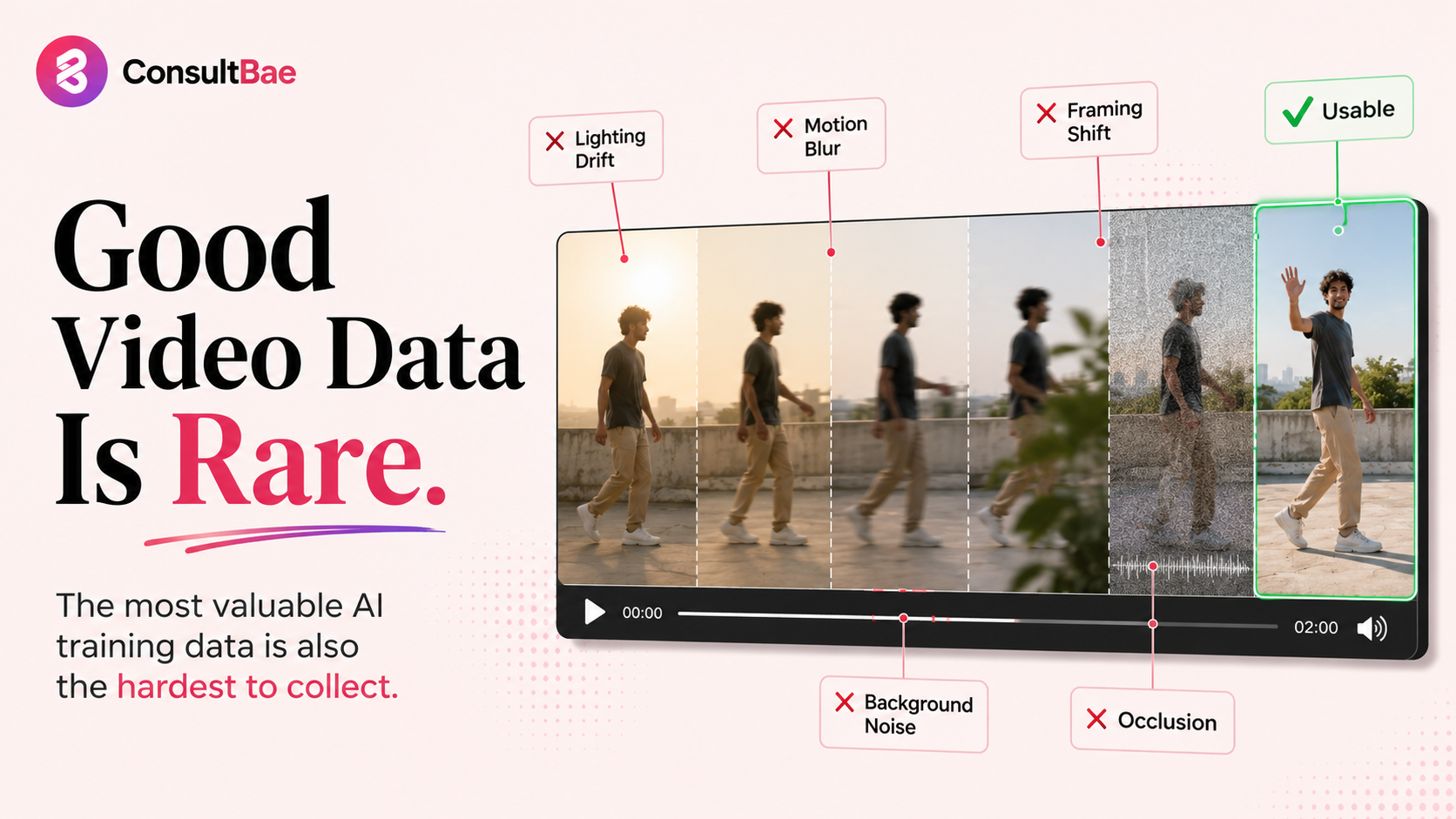
Temporal consistency. A usable image is a single frame captured under specific conditions. A usable video is a sequence of frames that must remain consistent across time: consistent lighting, consistent framing, consistent subject behaviour, consistent recording conditions. Any variable that drifts across the duration of a clip degrades the quality of the entire clip, not just the frames where the drift is visible. A contributor who shifts position mid-recording, whose lighting changes as a cloud passes, or whose microphone quality fluctuates across a session produces footage that is partially unusable in ways that are difficult to identify without reviewing the full clip.
Environmental control. Controlling the recording environment for a thirty-second audio clip is manageable. Controlling it for a two-minute video clip that needs consistent background, lighting, framing, and audio simultaneously is a different task entirely. In a distributed collection project across multiple geographies, maintaining that control across hundreds or thousands of contributors requires briefing depth, quality review processes, and re-collection rates that audio and image projects do not require at the same level.
Storage and processing at scale. A dataset of one million images at reasonable resolution is manageable in terms of storage and processing infrastructure. The equivalent in video, one million seconds of footage at training-appropriate resolution, is a different order of magnitude. The infrastructure required to ingest, process, quality-check, and store large-scale video datasets adds cost and complexity that is invisible in the collection brief and visible in the delivery timeline.
Contributor coordination complexity. Audio collection can often be done on a smartphone with a standard brief. Image collection requires slightly more attention to framing and environment. Video collection requires contributors to manage all of those variables simultaneously, over time, often while performing a specific activity that is itself the subject of the recording. The briefing, the training, the quality review, and the re-collection rate all scale up accordingly.
Video is not images plus audio. It is a modality where every variable that affects image quality and every variable that affects audio quality must be controlled simultaneously, across time, in a single recording session.
Why most video data in the wild is unusable for training
The instinctive response to the difficulty of video collection is to ask whether existing video content, from the internet, from user-generated platforms, from broadcast archives, can substitute for purpose-collected footage. In most cases, it cannot, for reasons that are not immediately obvious until you examine what training actually requires.
Existing video content is inconsistent in resolution, codec, frame rate, and aspect ratio in ways that require significant normalisation before it can enter a training pipeline. The metadata attached to it is typically incomplete or unreliable: no information about recording conditions, contributor demographics, or the specific content of the footage in a form that annotation can build on. The content itself was captured for purposes unrelated to AI training, which means the distribution of subjects, environments, and activities reflects what people chose to film rather than what models need to learn from.
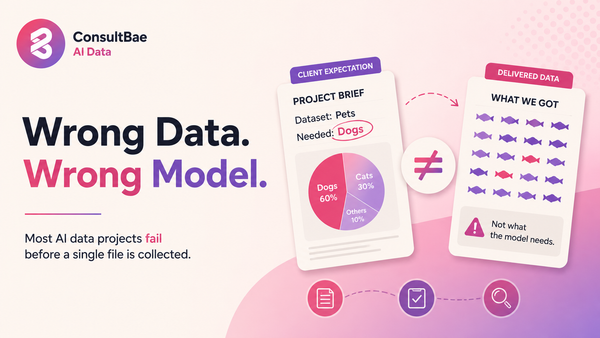
For use cases where the model needs to learn from specific activities, specific environments, or specific demographic populations, scraped video is not a viable source. The data that exists is not the data the model needs, and the gap cannot be closed without purpose-built collection.
The annotation problem
Annotating an image takes seconds for a skilled annotator working on a straightforward task. Annotating a video clip of equivalent content requires annotating every frame, or making principled decisions about sampling frequency that require expertise to get right and introduce error when that expertise is not present.
For action recognition, gesture detection, or activity classification, the annotation task is temporal: not just what is in the frame but when an action starts, when it ends, how it transitions, and how it is distinguished from adjacent actions that overlap in time. Temporal annotation requires annotators who understand the task deeply enough to make consistent judgments about boundaries that are genuinely ambiguous. It requires inter-annotator agreement checks across time as well as across frames. And it requires annotation tooling that is specifically built for temporal tasks, which is meaningfully more complex than the tooling used for image annotation.
The annotation cost per minute of video is a significant multiple of the annotation cost per image. Projects that estimate annotation effort based on image annotation rates will encounter that multiplier in the budget before they encounter it in the timeline.
Why video is the most valuable modality for next-generation models
The difficulty of collecting video data well is matched by the value of having it. The models that are most consequential in the current phase of AI development are all video-dependent in fundamental ways.
Physical AI and robotics training requires video of humans performing physical tasks in real environments. The robot learns by watching: what reaching looks like, what picking up looks like, how a human navigates around an obstacle, how a hand adjusts its grip in response to feedback. None of this can be conveyed through images or audio. It is inherently temporal and it requires video captured under conditions specific to the training objective.
Action recognition models, which are foundational to surveillance, healthcare monitoring, sports analytics, and workplace safety applications, require video of the actions they need to recognise, across the full demographic and environmental variation of the real-world conditions they will operate in. Multimodal models that integrate visual and linguistic understanding require video with synchronised audio and, in many cases, transcription and semantic annotation that makes the relationship between what is seen and what is said learnable.
The use cases that depend on video are not niche applications in the next wave of AI deployment. They are core to the physical AI, autonomous systems, and multimodal understanding that define where the industry is going. The teams that can collect video data well will have a meaningful advantage in building the models those applications require.
Activity specification: What exactly is the contributor doing, for how long, and in what sequence. Ambiguity here produces footage that is not annotatable.
Environment requirements: Background, lighting conditions, camera angle, minimum recording quality. More specific than image collection because variation compounds over time.
Temporal requirements: Clip duration, whether actions should be performed continuously or with pauses, whether multiple takes are acceptable and how they should be labelled.
Annotation specification: Frame-level or temporal annotation, what the annotator is marking, where action boundaries fall, how overlapping actions are handled.
Demographic specification: More critical than in image collection because the model needs temporal consistency within a clip as well as demographic variation across clips.
What a well-run video collection project actually requires
A well-run video collection project starts earlier than teams expect. The pre-production specification phase, where activity scripts are written, environment requirements are defined, contributor briefing materials are prepared, and the annotation schema is designed alongside the collection design, takes longer than equivalent phases for other modalities and has a higher cost if it is compressed.
Contributor briefing for video work is more intensive. Contributors need to understand not just what to record but how to maintain recording conditions across the full duration of each clip, how to perform activities consistently enough for the footage to be annotatable, and what the quality threshold is that will trigger a re-collection request. Higher re-collection rates are the norm in video projects, and the timeline needs to account for them explicitly.
Post-collection processing is a significant phase in its own right: format normalisation, quality screening, metadata enrichment, and preparation for annotation all require infrastructure and time that are often underestimated in project planning.
How ConsultBae approaches this
At ConsultBae, video collection is treated as a distinct operational discipline from the start of project scoping. We do not estimate video effort from audio or image benchmarks. We scope it from the activity requirements, the environment specifications, the annotation schema, and the demographic coverage the client needs, because those variables determine the actual effort in a way that modality comparisons do not.
We have run video collection projects across multiple use cases and geographies. The operational requirements are consistently distinct from every other modality we work in, and the gap between a well-specified video project and a poorly-specified one is larger than in any other type of data collection work we do.
Video data is hard to collect well. It is also what the most important models being built right now are hungry for. Those two facts exist together, and the teams that understand both early are the ones that will have the data they need when the model is ready to train on it.
Mohit Singh Katewa leads the AI Data vertical at ConsultBae, overseeing data collection, annotation, and quality operations across 100+ countries.
Planning a video data collection project?
ConsultBae scopes and runs video collection projects across geographies and use cases. Let us talk about what your model needs before the brief is written.
Talk to us