When companies ask what makes a hiring partner effective, the conversation usually starts with the size of the candidate database. How many candidates do you have in your system. How many in this function. How many at this seniority level. These questions are reasonable. Database size matters. But the focus on database size also misses what actually determines whether a hiring partner can deliver, which is not the database itself but the structure of the team that operates it.
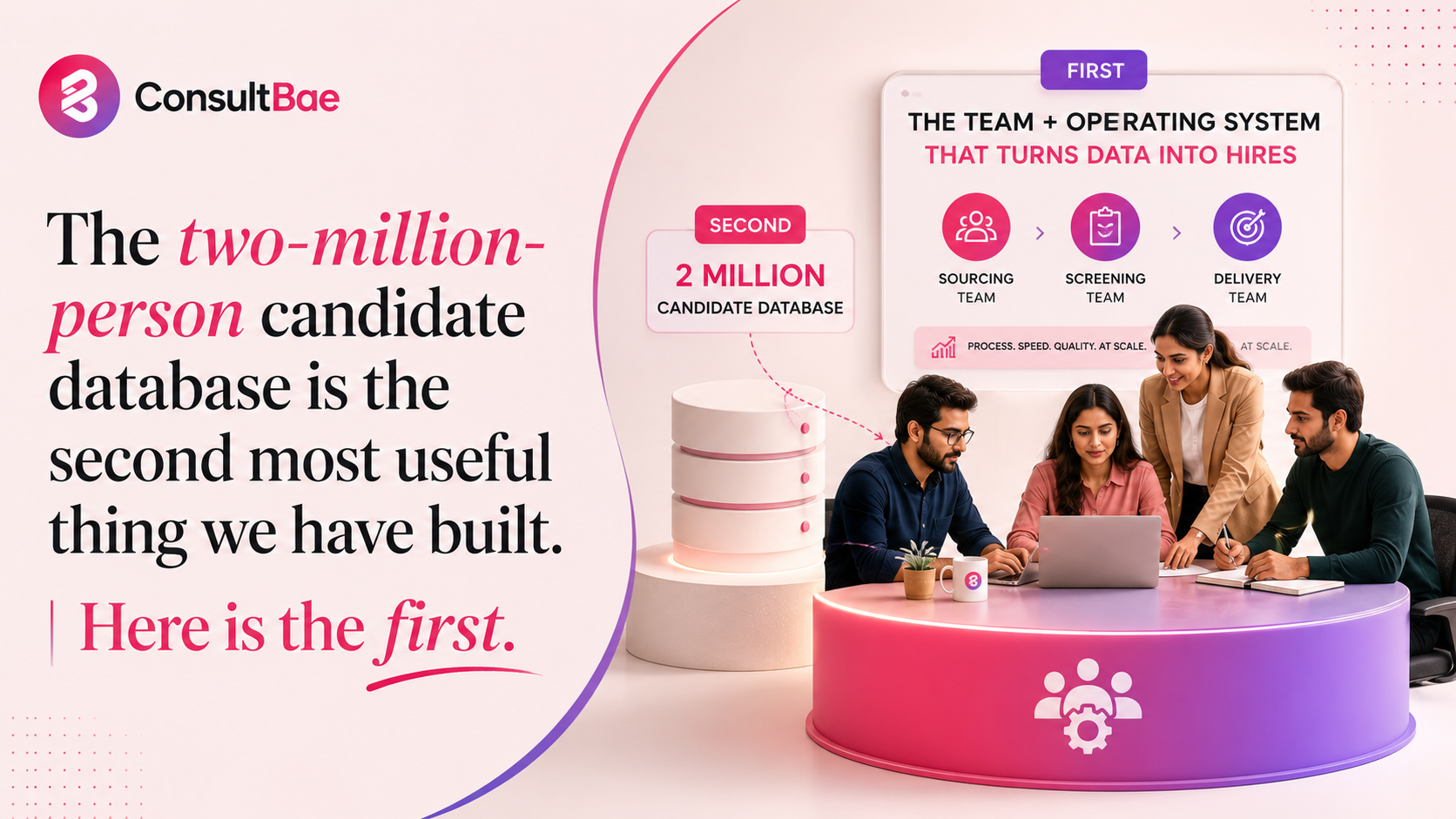
The two million candidates in our database are genuinely useful. They are the second most important thing we built. The first is the three-team operating structure that uses the database, and the difference between these two assets is the difference between having access to candidates and being able to consistently match them to roles fast.
Why a large database alone does not produce fast or quality hiring
A database of candidates is a set of names with associated information. On its own, it produces nothing. The value of the database is realised only when someone uses it to find the right people for a specific role, contact them in a way that earns engagement, evaluate them against role requirements, and bring qualified candidates forward to the client. Every step in that chain is operational work, and the structure of the team performing the work determines whether the database produces results or sits underutilised.
A generalist recruitment team, where one person handles sourcing, screening, and account management across multiple roles simultaneously, will use a database the way a generalist uses any complex tool: adequately. The same database in the hands of a team structured to do each part of the work well produces meaningfully different output, at meaningfully different pace, with meaningfully different quality.
The three-team structure that makes the database actually work
At ConsultBae, the recruitment work is divided across three teams, each focused on the part of the process they are best positioned to do well.
The sourcing team. These are people whose entire job is to find profiles that fit the brief, across paid and unpaid channels, supplemented by the internal database. They have built expertise in where specific kinds of candidates live online, how to surface profiles that are not obvious to a general search, and how to maintain the database itself as a living asset rather than a static list. Sourcing is what they do, full time, every day.
The recruiter team. These are the people doing first-level screening. Once sourcing has surfaced candidates and initial outreach has gone out, the recruiter team evaluates whether each candidate is a credible fit for the specific role. They look at experience, evaluate whether the candidate's profile matches the brief substantively, and qualify the candidates before they go further into the process. This is judgement work that requires both experience and the time to do it carefully, and giving it to people whose entire focus is screening produces consistency that a generalist team cannot match.
The account manager team. These are the people running second-level screening and the relationship with the client. They go deeper on the candidates the recruiters surfaced, evaluating project fit, values alignment, and the more nuanced questions that determine whether someone is genuinely right for the role. They are the ones who actually bring candidates forward to the hiring manager. An account manager at ConsultBae can share fifteen or more candidates a day across eight to ten open roles, which is a level of throughput that comes specifically from each part of the process being handled by the team built for it.
The database holds the candidates. The team structure determines what happens to them after they are surfaced. Without the structure, the database is a list. With it, the database is the foundation of a recruitment operation.
Why each team specialises in only what it is best at
The reason for splitting the work this way is not theoretical. It is what produces the throughput and quality we deliver. A sourcer interrupted to handle a client call loses the focused work that finding good profiles requires. A recruiter doing both screening and account management has less time for each, and the quality of screening drops. An account manager juggling sourcing as well does not have the bandwidth to manage the relationships that turn qualified candidates into closed roles.
The principle is straightforward: those who are good at something should do only that, and the structure should let them. Applied to recruitment, this principle is what makes the database produce the results it does. Without it, the same database would produce significantly less.
How this structure produces 15 profiles per day per account manager and 1-3 week close times
Throughput at this level is not the result of working harder. It is the result of each part of the process being handled by people whose entire focus is that part. An account manager who only does second-level screening and client engagement can move through fifteen profiles a day because the sourcing and first-level screening have already been done by the teams built to do them. The same person trying to also source candidates and run first-level screening would deliver a fraction of that throughput, and the quality would suffer at every stage.
The close times that result from this structure are equally a function of it. Roles close in one to three weeks at ConsultBae because the pipeline at each stage is being kept full and qualified by the team responsible for that stage. The handoffs between teams are designed to preserve context rather than lose it. The hiring manager sees a steady flow of qualified candidates rather than waiting for a recruiter to find time between competing priorities.
Sourcing throughput from a team whose entire focus is finding profiles. First-level screening quality from recruiters who only screen, building expertise across many briefs. Second-level screening and client relationship depth from account managers who only do that. The result: 15-plus profiles brought forward per account manager per day across 8-10 active roles, and roles closing in 1-3 weeks rather than the industry average of months.
How ConsultBae thinks about this
The database is real, and the database is useful. We have spent six years building it to two million candidates and the work to maintain it continues. But the database is not why we close roles in one to three weeks. The three-team structure that operates the database is why. Without it, the database would be a static asset that produced no more value than any other large list of names.
When clients evaluate hiring partners, the questions about database size are reasonable but incomplete. The harder question, and the more useful one, is how the partner's team is structured to actually use the database. A clear answer to that question reveals more about the partner's ability to deliver than any database size figure can.
Anubhav Sahay is part of the hiring team at ConsultBae, focused on mid-to-senior recruitment for funded startups across India.
Evaluating a hiring partner?
Ask about team structure, not just database size. ConsultBae's three-team operating model is why we close mid-to-senior roles in 1-3 weeks. Let us talk.
Talk to us