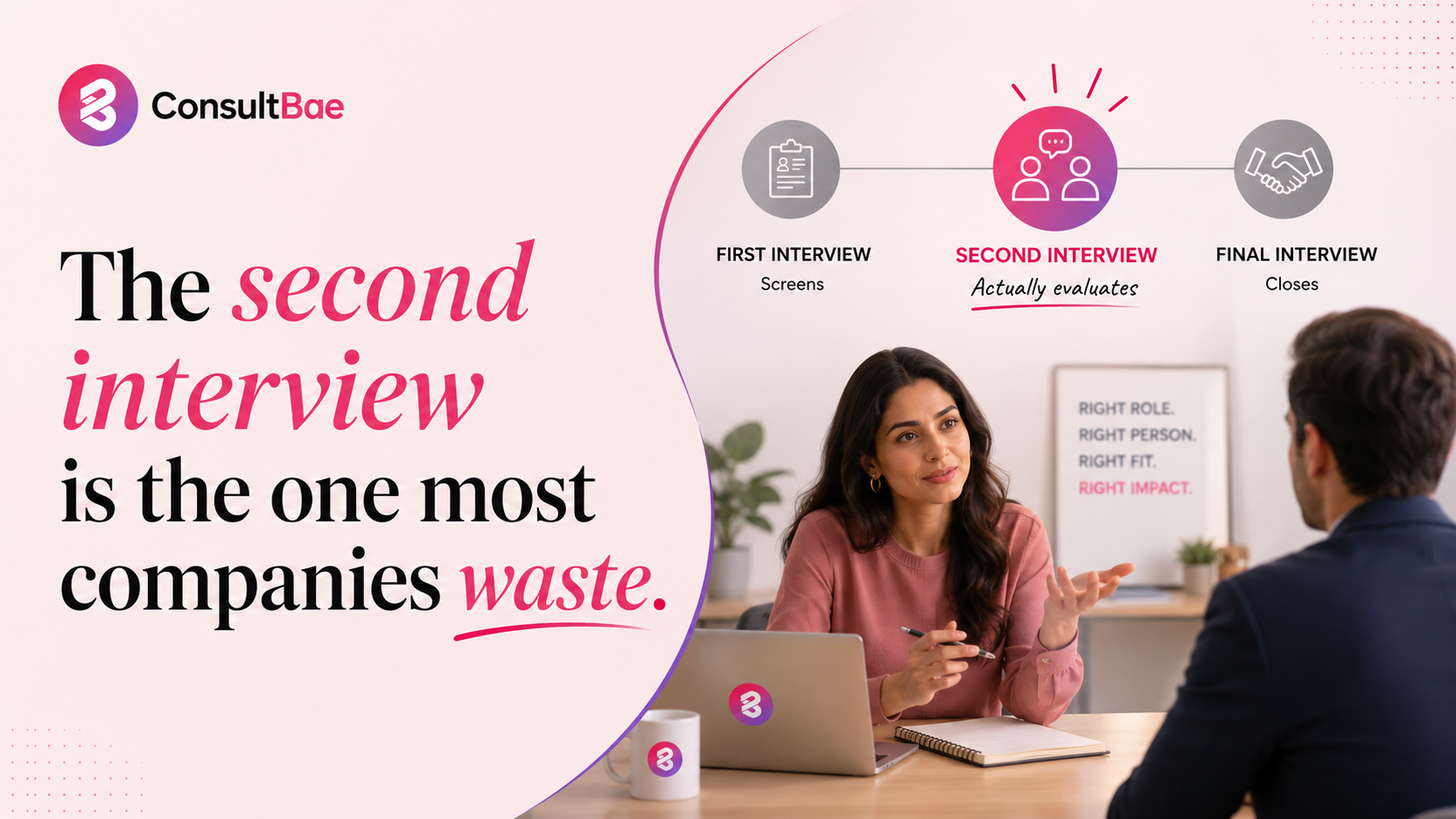
Most hiring conversations focus on the first interview and the final offer. The middle of the process — the second interview, sometimes the third — gets less attention and produces less value than it should. In practice, the second interview is where the actual evaluation of the candidate is supposed to happen, and in most hiring processes that is not what it does. It rehashes the first interview at a slightly more senior level, surfaces the same information again, and consumes time on both sides without meaningfully advancing the decision.
Done well, the second interview is the single highest-leverage stage in a hiring process. It is the moment when the company learns whether the candidate can actually do the work, not just whether they can talk about it convincingly. Done badly, it is a forty-five minute social ritual that everyone walks out of with the same understanding they had walking in.
What most second interviews actually do
The pattern repeats across companies. The first interview was with a recruiter or junior hiring manager. The second is with someone more senior, often the hiring manager or a peer of the role. The conversation covers the candidate's background, their reasons for considering the move, their understanding of the company, and a few questions about how they have handled situations in past roles.
This is not a useless conversation. It builds rapport, it confirms the impression from the first interview, and it lets the candidate ask questions of someone closer to the actual work. But it does not evaluate the candidate against the specific requirements of the role in any rigorous way. The interviewer leaves with a general sense of whether the candidate seems right, which is the same level of information they had before the conversation started.
What the second interview should actually do
A productive second interview surfaces specific capabilities the role requires through targeted evaluation. It tests how the candidate thinks in real situations rather than how they describe their past performance. It identifies deal-breakers before the company invests more team time in subsequent rounds. And it produces a written record that the rest of the interview process can build on rather than starting from scratch.
For an engineering role, this might mean a coding exercise or system design discussion that produces real evidence of how the candidate solves problems. For a product role, it might mean walking through a real product decision the candidate would face in the job and seeing how they approach it. For a sales role, it might mean a structured exercise around qualifying a real prospect or building an account plan. The specifics vary. The principle is the same: the second interview produces evidence, not just impressions.
An interview that ends with the interviewer saying "I had a good feeling about them" is an interview that did not actually evaluate anything. Feelings about candidates are notoriously unreliable predictors of performance. Evidence is what changes that.
The format that consistently works
The interview formats that consistently produce useful evaluation share a few features.
They are structured around a specific challenge or exercise that mirrors the actual work of the role. The interviewer is not just having a conversation, they are observing the candidate work through something that matters. The challenge has been designed in advance, calibrated against what the role actually requires, and used consistently across candidates so comparisons are meaningful.
The interviewer is someone who can actually evaluate the work, not just listen to it. A non-technical person cannot run a meaningful technical interview. A founder who has never sold cannot run a meaningful sales interview. The interviewer needs the credibility and capability to assess the candidate's approach, ask follow-up questions that surface real understanding, and distinguish between candidates who genuinely know what they are doing and candidates who can describe knowing it.
The interview produces a written debrief that captures what the candidate actually demonstrated, not just whether the interviewer liked them. This becomes input to the next stage of the process rather than a vague signal that everyone in the loop has to interpret.
Why this is hard to set up and worth the investment
Building a meaningful second-interview format is operationally heavier than running a generic conversation. The exercise needs to be designed, calibrated against role requirements, tested with internal team members, and refined based on what it surfaces. The interviewer needs to be briefed on how to run it consistently. The debrief format needs to be agreed in advance.
Most companies do not invest this upfront work because the default of a generic conversation feels acceptable and the cost of a poorly-evaluated hire is invisible until much later. The investment pays back across every subsequent hire the same exercise is used for. A second-interview format that works for a particular role can run effectively across dozens of candidates with minimal additional setup.
Specific evidence of how the candidate approaches the actual work of the role, gathered through a structured exercise calibrated to what the role requires. A clear go/no-go signal that the next stages of the process can build on. A written debrief that captures what the candidate demonstrated, available to subsequent interviewers. A consistent basis for comparing candidates across the role, not just impressions filtered through different interviewers' preferences.
How ConsultBae helps with this
When we work with clients on a role, we often help them design the middle of their process. The first interview is usually adequate as a screen. The final offer-stage conversations tend to handle themselves. The second interview is where the most leverage exists and where most companies have the least structure.
We help clients think through what the role actually needs to evaluate, design exercises or discussions that produce real signal, and structure the debrief so each interview adds value to the next rather than starting from scratch. The result is a process that identifies the right candidates faster, eliminates mismatches earlier, and produces hires whose actual capability matches what the process led the company to expect.
The second interview is the most valuable stage of a hiring process. Treating it that way is one of the more impactful operational improvements a hiring team can make, and the upside is visible in the quality of the people who eventually accept offers.
Anubhav Sahay is part of the hiring team at ConsultBae, focused on mid-to-senior recruitment for funded startups across India.
Losing time in the middle of your hiring process?
ConsultBae helps clients design the middle stages of hiring where most leverage exists. Let us look at yours.
Talk to us