I have worked inside enough funded startups to know the pattern. At Series B, the founder is describing a culture problem: misaligned teams, communication that breaks down between functions, senior hires who are technically strong and organizationally destructive, norms around accountability that nobody can quite pin down but everyone feels. The problem feels like a scaling problem. Something that emerged as the company grew.
It is almost never a scaling problem. Scale revealed it. The problem was hired in during seed, when the team was eight people and every hire felt like a small decision. The dysfunction that is now visible at fifty people was present at ten. It just did not have enough surface area to be visible yet.
I have seen this from the inside at multiple organisations, and I have watched it play out with founders we work with at ConsultBae. The culture problem most founders are trying to solve at Series B was created by decisions made in the months after their seed round closed, when speed was highest, process was thinnest, and the consequences of individual hiring decisions were not yet visible.
Why the first ten hires are structurally different
Every hire after the first ten enters an organisation that already has a culture, whether the founder intended to build one or not. That culture filters them. It shapes their behaviour through peer norms, through what gets rewarded and what gets tolerated, through the working styles and communication patterns of the people around them. A new hire who brings dysfunction into a team with strong existing norms will either adapt or leave. The norms absorb the individual.
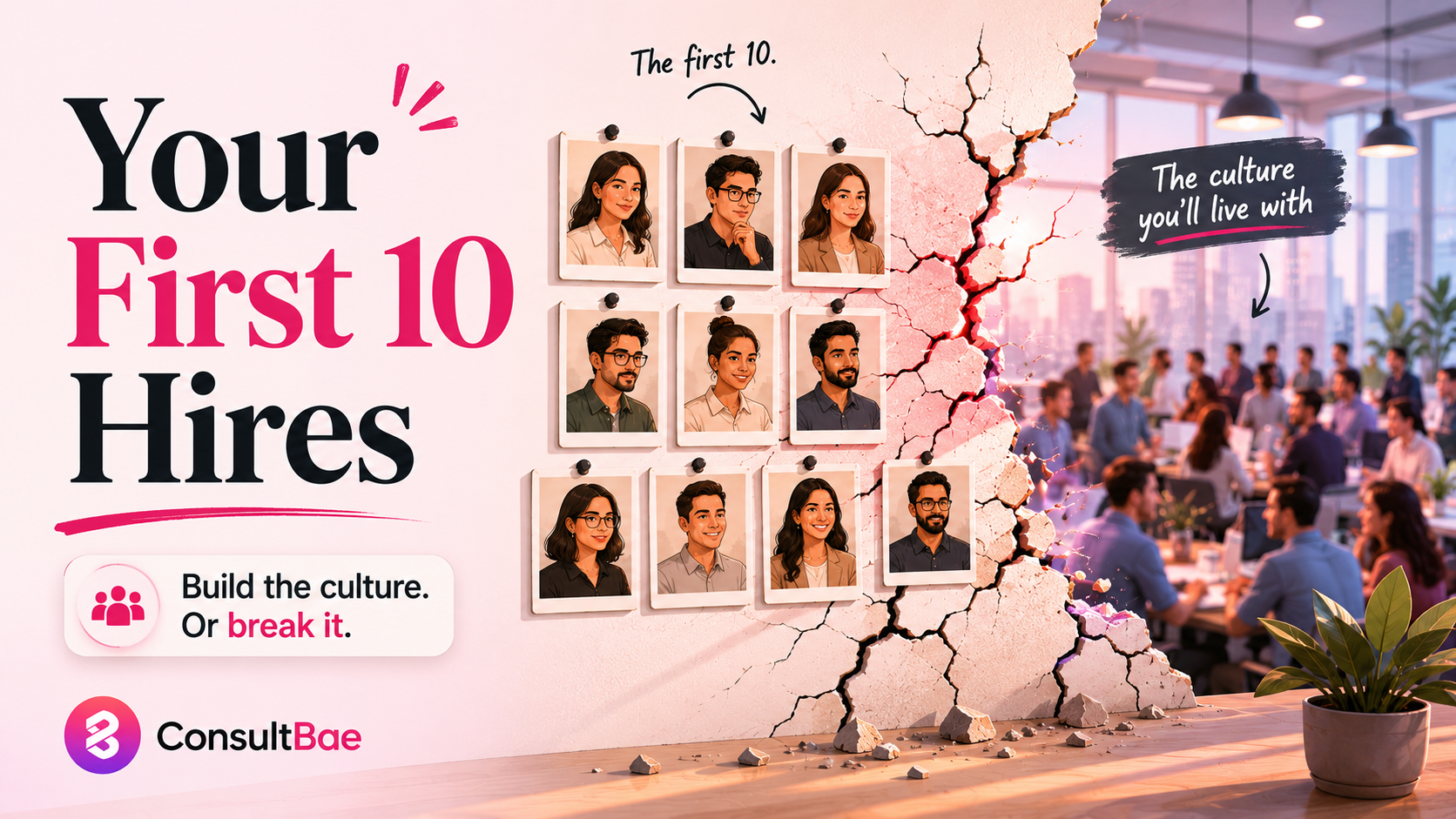
The first ten hires encounter none of that. There is no existing culture to absorb them. What they bring is what the culture becomes. Their communication style becomes normal. Their attitude toward accountability, toward ambiguity, toward each other becomes the baseline that every subsequent hire is measured against. They are not joining a culture. They are creating one, and they are doing it without anyone explicitly designing it, which means whatever emerges reflects their individual defaults rather than the founder's intentions.
This is compounded by the conditions of early-stage hiring. No formal process, the founder making every decision personally under time pressure, technical skills over-weighted because the immediate deliverable is a product, and the general urgency that follows a funding round makes patience feel like a luxury nobody has.
The first ten hires are not joining a culture. They are building one. The question is whether the founder is intentional about what gets built, or whether they find out two years later.
The four things early hires set that are hardest to change later
Not everything an early team establishes is equally difficult to change. Four patterns, once set, tend to persist through significant growth and require deliberate, sustained effort to shift.
Communication standards. How the early team communicates under pressure, how directly they give feedback, how they handle disagreement in meetings versus in corridors, how much gets said versus assumed: these patterns become the organisation's communication culture. A team that normalises passive conflict resolution in the first year builds an organisation where difficult conversations do not happen. Changing that at thirty people requires changing the behaviour of the people who defined it as normal.
Tolerance for ambiguity. Early-stage work is inherently ambiguous. The first ten hires either learn to operate productively in that ambiguity or they become anxious and political when things are unclear. The former builds an organisation that can navigate uncertainty. The latter builds one that becomes dysfunctional every time strategy is in flux, which at a startup is most of the time.
Attitude toward accountability. How the early team responds when something goes wrong tells the organisation what accountability means here. If missed deadlines are explained away and the norm is to manage perception rather than own outcomes, that becomes the standard. If the early team is direct about failure and treats it as information rather than threat, that becomes the standard instead. Both are contagious. Both are extremely difficult to change once established.
What counts as acceptable performance. The bar the first team sets is the bar the organisation inherits. If the early hires are exceptional and hold each other to a high standard, subsequent hires either rise to it or self-select out. If the early hires are adequate and the bar is set at adequate, the organisation defends that bar. Raising it later means telling people who have been performing acceptably that acceptable is no longer enough, which is one of the hardest management conversations a founder ever has to have.
Why funded startups hire wrong in the early stage
The funding round created urgency. The board wants to see the team built. The product needs to ship. The instinct is to hire fast, prioritise technical capability, and trust that culture can be sorted out once the immediate deliverable is done.
The problem is that culture is never sorted out later. It is established now, by default, by whoever is in the room. A founder who defers the culture question in the early months is not postponing it. They are answering it without realising it, through every hire they make under speed pressure with insufficient attention to the patterns that hire will establish.
The other mistake is treating cultural fit as a soft consideration that gets weighted below technical skill. At ten people, cultural fit is not soft. It is structural. A technically strong hire who normalises behaviours the founder does not want will cause more long-term damage than a slightly less technically strong hire who embodies what the team is supposed to be.
What it costs to fix a culture problem that was hired in
Culture problems that were hired in do not disappear as the company scales. They compound. The people who defined the dysfunctional norm are now senior, often respected, and defended by others who have adapted to the culture they created. Fixing the problem usually means addressing those individuals directly, which triggers a loyalty response in the team around them and a period of instability that the company has to absorb.
It also costs the people who leave because of it. Strong hires who join at Series A or B, encounter a culture that does not match what they were sold, and leave within a year are not a hiring problem. They are a culture problem that is expressing itself through attrition. Every one of those exits costs recruiting fees, onboarding time, and the opportunity cost of what that person would have built if they had stayed.
Founder time is the most direct cost. The months a founder spends managing culture problems at Series B are months not spent on product, customers, or the next round. The founder who made fast, inattentive hires at seed pays for it in management overhead at scale.
What hiring for culture actually means at seed stage
Hiring for culture at seed stage is not about finding people who match an existing culture. There is no existing culture. It is about being intentional about the culture you are trying to build and hiring people whose defaults align with it.
That requires the founder to have thought clearly about what they want the organisation to look like: how they want decisions made, how they want conflict handled, what standard of work they want normalised, how they want the team to behave when things go wrong. Not as a values document. As a set of specific, observable behaviours that the founder is willing to hire for and let go for.
The hiring process for early hires needs to surface those behaviours explicitly. Not through culture-fit questions that invite candidates to say what they think you want to hear, but through specific situations where the candidate's defaults become visible. How did you handle a situation where the direction was unclear. Tell me about a time you had to give feedback that was unwelcome. What did you do when a deadline was missed and the failure was partly yours.
The answers to those questions, across the first ten hires, determine more about the company's culture than any document the founder will ever write.
How ConsultBae approaches this
At ConsultBae, we work with founders at exactly the stage where these decisions are being made: the first hiring cycle after a round closes, when the team needs to grow quickly and the process is not yet mature enough to filter well on its own.
We push founders to be specific about what they are hiring for beyond the role. Not in the abstract language of culture fit, but in the concrete behavioural terms that allow us to assess candidates against what the founder actually wants the team to look like. That specificity is harder to articulate than a job description, and it is more important than anything in it.
The first ten hires are the most consequential hiring decisions a founder will make. They deserve more time, more deliberation, and more clarity about what is actually being decided than most founders give them in the months after a round closes and the pressure to build is at its highest.
Amitt Agrawaal is the Founder of ConsultBae. He has spent six years building ConsultBae's operations across recruitment, e-learning, and AI data collection, and has worked inside funded startups across multiple stages of growth.
Hiring your first team after a round?
ConsultBae works with funded founders on early-stage hiring where the decisions compound. Let us help you get them right.
Talk to us