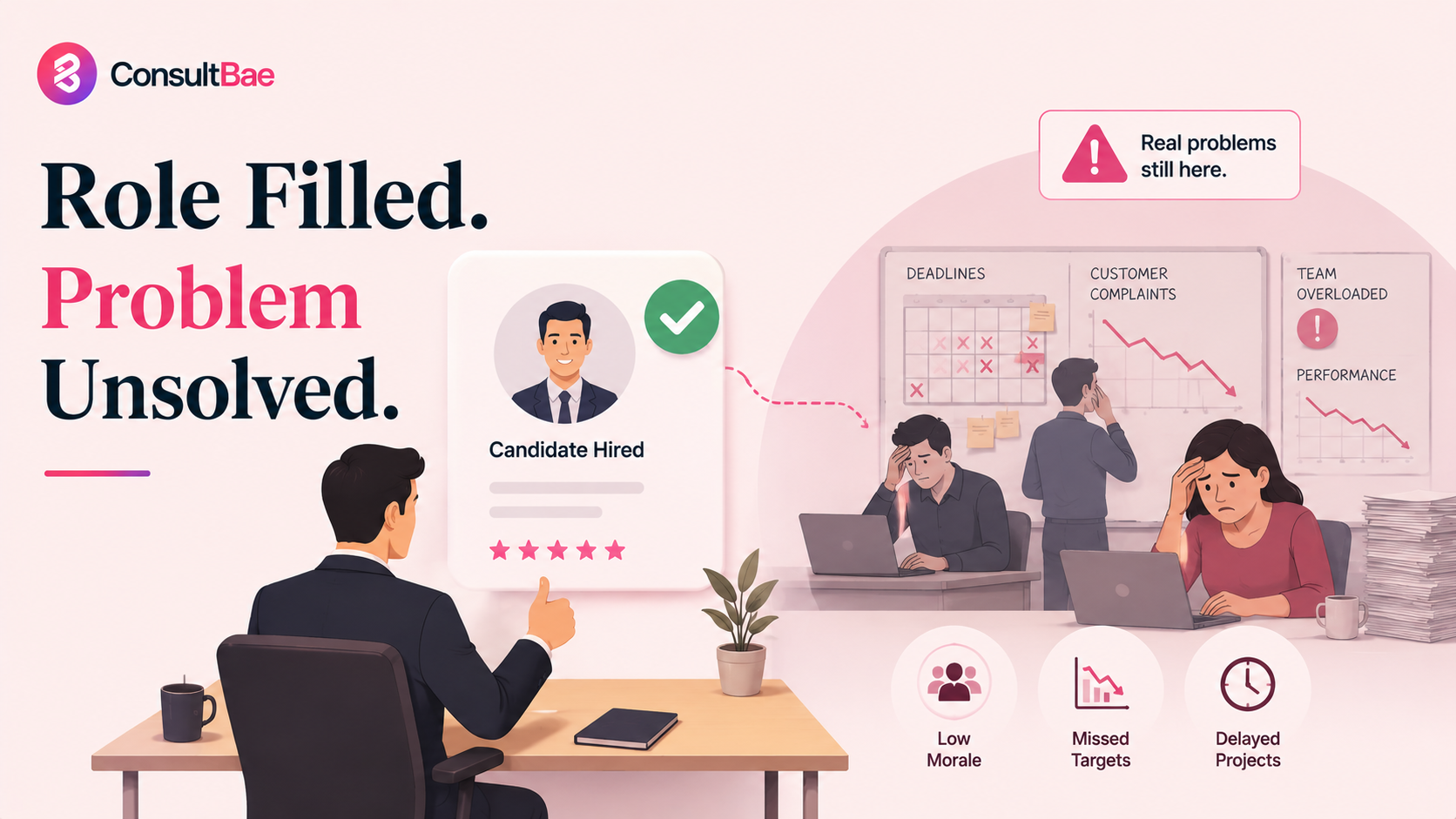
A company comes to a recruitment partner with a role to fill. The brief is clear: this title, this seniority, these skills, this compensation. The natural thing for the partner to do is take the brief and start sourcing. Sometimes that is exactly the right move, because the role is straightforward and filling it is genuinely what the company needs. Often, though, the role as stated is not the actual problem. It is a symptom of a hiring problem the company has not diagnosed, and filling it without addressing that problem just relocates the issue a few months into the future.
The difference between filling a role and solving the hiring problem behind it is the difference between a recruitment partner that processes requisitions and one that actually improves the company's hiring. The first is useful. The second is considerably more valuable, and it starts with being willing to ask whether the role as briefed is the right thing to be hiring for at all.
The difference between a vacancy and a hiring problem
A vacancy is a seat that needs filling. A hiring problem is the underlying situation that produced the vacancy or that will prevent the vacancy from being filled successfully. These are not the same thing, and treating every vacancy as simply a seat to fill misses the cases where the seat is the visible symptom of something deeper.
A company that has hired and lost three people in the same role over eighteen months does not have a vacancy. It has a hiring problem, and filling the seat a fourth time without understanding why the previous three did not work will most likely produce a fourth departure. A company asking for a role that is scoped to require an impossible combination of skills does not have a vacancy it can fill. It has a scoping problem that needs to be resolved before any candidate can succeed. Recognising the difference is the first step to actually helping.
Common cases where the requested role is a symptom
A few patterns recur where the role a company asks to fill is a symptom of a problem the role itself will not solve.
Repeated attrition in the same seat. When the same role keeps opening up because people keep leaving it, the problem is rarely the candidates. It is usually something about the role, the manager, the expectations, or the way the position sits in the organisation. Filling it again without addressing the cause repeats the cycle. The useful intervention is to understand why people leave this seat before sourcing the next person for it.
A role scoped wrong. Sometimes a role is defined in a way that no real person can satisfy: too many disparate responsibilities, a seniority level that does not match the compensation, a combination of skills that rarely coexist. The company experiences this as difficulty finding candidates. The actual problem is the scope, and the fix is rescoping the role, not searching harder for a candidate who does not exist.
A team structure issue mislabelled as a hiring need. Sometimes the request for a new hire is actually a response to a structural problem: work is falling through gaps between existing roles, or a team is struggling because of how responsibilities are divided rather than because it is understaffed. Adding a person may not fix this and can sometimes make it worse. The real issue is the structure, and a new hire dropped into a flawed structure inherits the flaw.
A company that has lost three people from the same seat in eighteen months does not have a vacancy. It has a hiring problem, and filling the seat a fourth time without understanding why will most likely produce a fourth departure.
Why good recruitment partners diagnose before they source
A recruitment partner that takes every brief at face value and starts sourcing immediately is optimising for activity rather than outcome. They will fill the role, collect the fee, and move on. If the role was a symptom of a deeper problem, the company will be back with the same role open again before long, and the partner will fill it again. This is good for the partner's transaction volume and bad for the company's actual situation.
A partner that diagnoses before sourcing asks the questions that surface whether the role is the real problem. Why is this role open. Has it been open before. What happened to the previous people in it. Is the scope realistic. Does the compensation match the level. Does this role fit cleanly into the team structure or is it patching a structural gap. These questions sometimes reveal that the best thing for the company is not to fill the role as briefed but to fix the underlying problem first. A partner willing to have that conversation is worth considerably more than one that simply processes the requisition.
Why is this role open right now? Has it been open before, and what happened to the people who held it? Is the scope something a real person can actually satisfy? Does the seniority match the compensation? Does this role fit cleanly into the existing team structure, or is it patching a gap between other roles? If the honest answers point to a deeper issue, filling the role without addressing it will not solve the problem.
How ConsultBae approaches this
We work on the hiring problem, not just the requisition. When a client brings us a role, part of the early conversation is understanding whether the role as briefed is the right thing to hire for, or whether there is a problem underneath it that filling the seat would not solve. Sometimes the answer is that the role is straightforward and we should simply get on with sourcing. Sometimes the answer is that the scope needs adjusting, the attrition pattern needs understanding, or the structural issue needs addressing before any hire will succeed.
This is not about making the engagement more complicated than it needs to be. It is about not setting a hire up to fail by ignoring the problem that produced the vacancy. A role filled well, into a situation that was diagnosed correctly, produces a hire that stays and succeeds. A role filled blindly into an undiagnosed problem produces the same vacancy again in six months. The diagnosis is what makes the difference, and it is part of what we think a recruitment partner should actually do.
Amitt Agrawaal is the Founder of ConsultBae, a recruitment and AI data services company operating across India, the US, and Europe. He has spent six years building ConsultBae across recruitment, staffing, and AI data.
Keep reopening the same role?
ConsultBae works on the hiring problem, not just the requisition. Let us help you diagnose what is actually going on.
Talk to us