When a company decides it needs help with hiring, the decision usually gets framed as a binary. Either build an internal recruitment function by hiring recruiters onto the payroll, or use an external agency that works role by role. Both are legitimate models with real trade-offs. But there is a third model that fits certain situations better than either, and most companies do not consider it simply because they do not understand how it works or when it applies.
That third model is recruitment process outsourcing, usually shortened to RPO. It sits between the internal and agency models, and for companies at a particular stage of hiring it solves problems that neither of the other two handles well. Understanding the difference between all three is the first step to choosing the model that actually fits.
The three models and what each one is
Internal hiring means building a recruitment team on your own payroll. Recruiters who are your employees, working only on your roles, embedded in your culture and processes. The advantage is deep alignment and dedicated focus. The cost is that you carry the headcount whether your hiring volume justifies it or not, and building a good internal recruitment function takes time and expertise that many companies do not have in-house.
Agency recruitment means engaging an external firm to fill specific roles, usually paid on success per placement. The advantage is flexibility and reach: you pay when a role is filled, and a good agency brings a network and a sourcing capability you do not have internally. The cost is that the agency is working across many clients, the relationship is transactional, and the agency does not develop the deep familiarity with your business that an embedded function would.
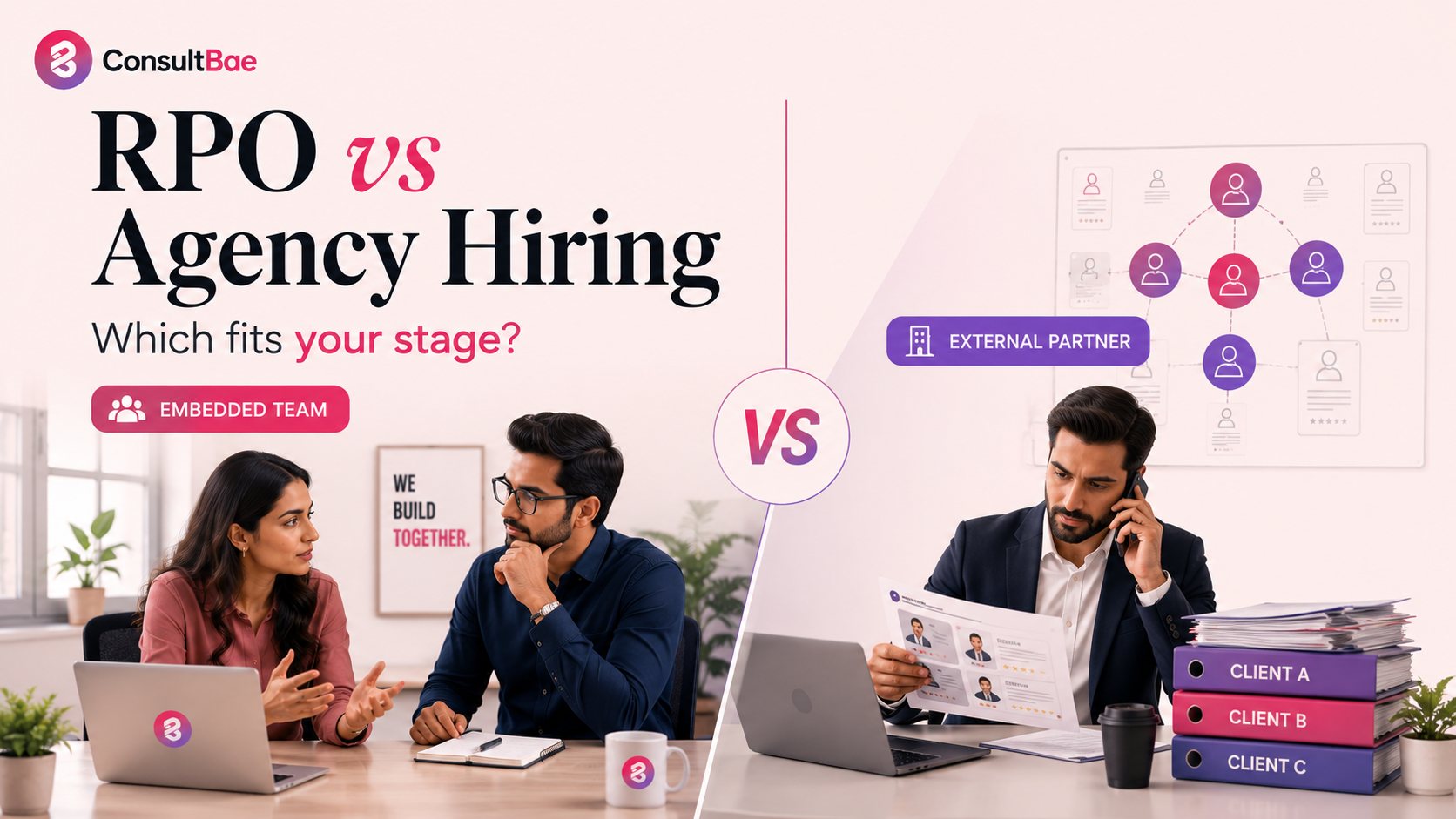
Recruitment process outsourcing means an external partner takes over some or all of your recruitment process and runs it as an extension of your team, usually over a sustained engagement rather than role by role. The partner embeds in your process, works to your standards, and operates with the continuity of an internal team without you carrying the permanent headcount. It is neither fully internal nor purely transactional.
Internal hiring gives you dedication at the cost of permanent headcount. Agency recruitment gives you flexibility at the cost of continuity. RPO is the model for companies that need the continuity without the headcount.
What each model is actually good for and at what stage
The right model depends on hiring volume, the sustainability of that volume, and how much process maturity the company already has.
Internal hiring makes sense when hiring volume is high and sustained enough to justify dedicated headcount, and when the company has the maturity to build and manage a recruitment function well. A company hiring steadily across many roles, year after year, is usually better served building this capability than renting it.
Agency recruitment makes sense for specific roles, intermittent needs, and situations where reach into a particular candidate market matters more than continuity. A company that needs to fill a handful of specialised roles, or that hires in unpredictable bursts, is well served by agencies that can be engaged as needed.
RPO makes sense in the middle: sustained hiring volume that justifies a dedicated process but not necessarily permanent internal headcount, a company that needs recruitment to run reliably without building the function from scratch, or a company scaling quickly that needs hiring capability faster than it can hire and train internal recruiters.
When RPO specifically makes sense
A few situations point clearly toward RPO over the alternatives. A company in a phase of rapid scaling, where hiring volume has jumped and the internal team cannot keep pace, but where building permanent recruitment headcount for a temporary spike does not make sense. A company that wants the continuity and process consistency of an internal function but lacks the in-house expertise to build one well. A company that has been using agencies role by role and is finding that the lack of continuity and the per-role costs are adding up in ways that a sustained embedded engagement would solve more efficiently.
In each of these, RPO provides what the situation needs: embedded, consistent recruitment capability, operating to the company's standards, without the company having to build and carry the function permanently.
The trade-offs of each
No model is free of trade-offs. Internal hiring carries fixed cost and requires management attention to build well. Agency recruitment can be expensive per placement and lacks continuity, with the agency's attention divided across many clients. RPO requires the company to genuinely integrate an external partner into its process, which works only when both sides commit to the embedded relationship rather than treating it as a more involved version of an agency engagement.
The mistake companies make is choosing a model based on what is familiar rather than what fits. Defaulting to agencies because that is what they have always used, when their hiring volume has grown to the point where RPO would serve them better. Or building an internal team prematurely, when their hiring is not yet sustained enough to justify the headcount and an embedded partner would bridge the gap more efficiently.
Internal: High, sustained volume. Maturity to build and manage a function. Long-term commitment to the headcount.
Agency: Specific or intermittent roles. Need for reach into particular markets. Flexibility over continuity.
RPO: Sustained volume that justifies process but not permanent headcount. Need for continuity without building in-house. Rapid scaling that outpaces internal hiring capacity.
How ConsultBae approaches this
We offer both agency recruitment and RPO, which means we are not trying to fit every client into a single model. When a company comes to us, one of the early conversations is which model actually fits their hiring stage, volume, and internal capability. Sometimes the answer is role-by-role agency engagement. Sometimes it is an embedded RPO relationship where we run their recruitment process as an extension of their team.
The decision matters because the wrong model produces friction regardless of how well it is executed. An agency relationship straining under volume that calls for RPO, or an RPO engagement on hiring that was really intermittent enough for agency work, both underdeliver. Getting the model right is a precondition for the hiring itself going well, and it is worth the conversation before any roles are opened.
Amitt Agrawaal is the Founder of ConsultBae, a recruitment and AI data services company operating across India, the US, and Europe. He has spent six years building ConsultBae across recruitment, staffing, and AI data.
Not sure which hiring model fits you?
ConsultBae offers both agency recruitment and RPO, and helps clients pick the right one for their stage. Let us talk it through.
Talk to us