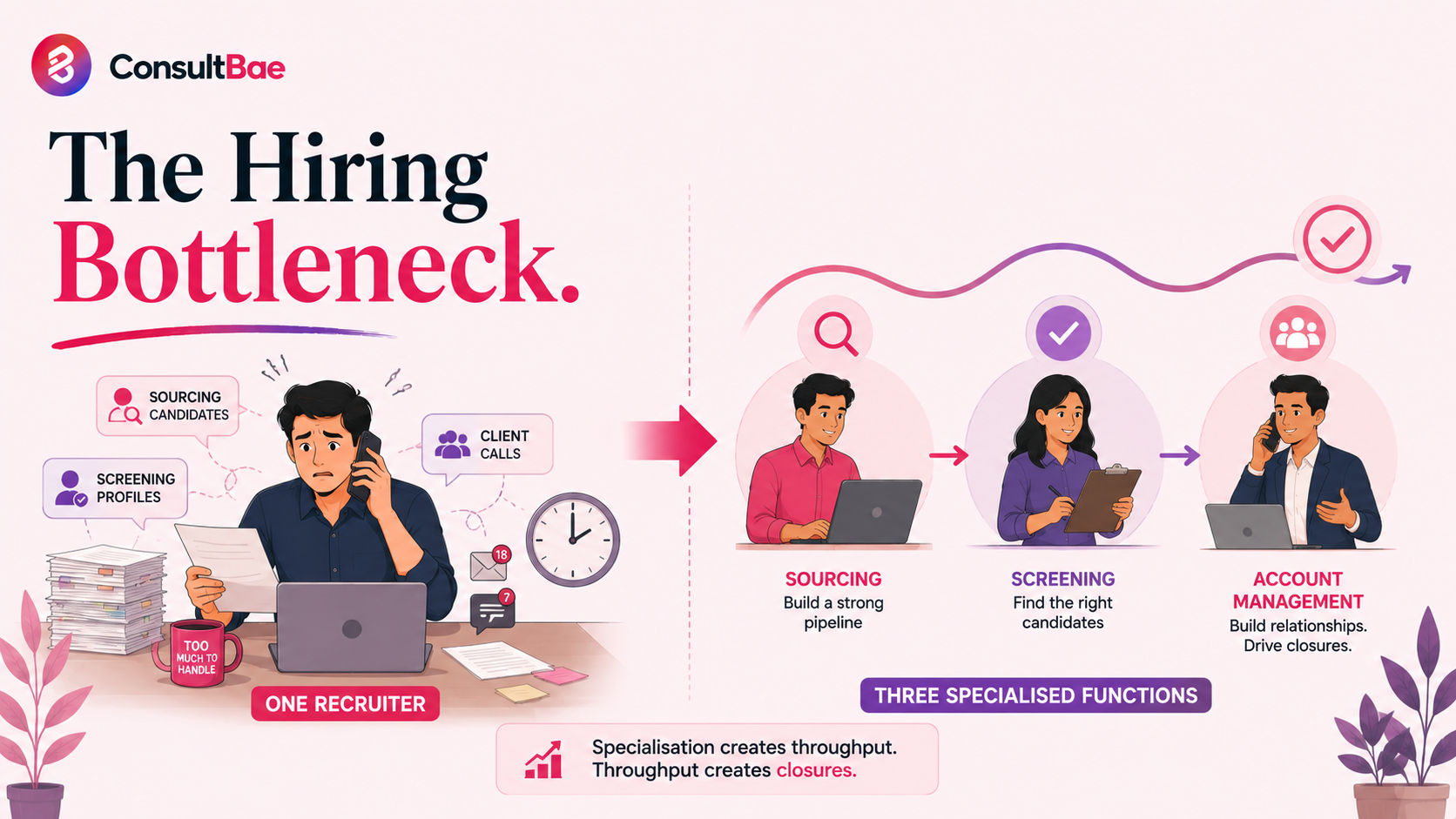
Most companies that are unhappy with their recruitment process describe the same symptoms: roles are taking too long to close, the shortlists that arrive are thin, candidates are going cold between first contact and interview, and the recruiter handling everything seems perpetually behind. The diagnosis is usually framed as a quality problem: wrong recruiter, wrong sourcing channels, wrong brief. The actual problem is more often structural.
A single recruiter managing a role from sourcing through to offer is doing at least three distinct jobs simultaneously. They are running searches and building a candidate pipeline. They are screening the candidates that come in and deciding who is worth presenting. They are managing the client relationship, briefing the hiring manager, coordinating interviews, and handling the negotiation at the offer stage. Each of these tasks requires a different mode of attention. Doing all of them at once means none of them are done at their maximum possible speed or quality.
The structural fix is not hiring more single-function recruiters. It is separating those three jobs into three specialised functions and letting each one run at the throughput it is capable of when it is the only thing someone is focused on.
How a Single-Recruiter Model Breaks Down Under Load
The failure mode of a single-recruiter model is predictable and almost universal across firms that run it: it works adequately when the role load is low, and it degrades rapidly as the number of simultaneous open roles increases. The recruiter who can handle two or three roles simultaneously without visible strain becomes visibly overwhelmed at five or six, and the degradation is not linear. Each additional role creates a compounding distraction from the others.
When a recruiter is simultaneously sourcing for three roles, they are making constant priority decisions about which role to focus on at any given moment. The role that gets attention is usually the most urgent one, not the one that would benefit most from sourcing investment. The roles that are less immediately urgent develop thin pipelines because they kept getting deprioritised. When those roles become urgent, the pipeline is not there.
Screening suffers similarly. A recruiter who is also managing sourcing does not have the undivided attention that rigorous screening requires. Profiles get reviewed too quickly. The nuanced judgment that separates a candidate who looks right on paper from one who is genuinely right for the role gets compressed into a faster decision with less supporting evidence. The shortlist that reaches the client has more variance in quality than a dedicated screening function would produce.
And account management suffers most of all, because it is the function that requires the most sustained attention and is the easiest to deprioritise when sourcing and screening are demanding time. The client who is not regularly updated on pipeline activity becomes anxious. The hiring manager who cannot get clear answers about timeline develops their own impression of the firm's capability, and that impression is usually more negative than the reality warrants.
The Three Functions That Need to Run Separately
The sourcing function's job is to find candidates. Not to evaluate them, not to manage the client relationship: to run searches, identify profiles, make initial contact, and build a pipeline of people who are aware of the role and have expressed some level of interest. This work is volume-oriented and repetitive. It runs best when the person doing it is freed from the distraction of anything else and can focus entirely on pipeline-building across multiple roles simultaneously.
The screening function's job is to evaluate the candidates in the pipeline and decide which ones are ready to present to the client. This requires genuine attention to each candidate, a thorough understanding of the role requirements, and the judgment to distinguish between candidates who meet the brief on paper and candidates who are actually likely to perform well in the role and stay. This work is assessment-oriented and requires uninterrupted focus. It runs best when the person doing it is not also trying to generate the pipeline they are screening.
The account management function's job is to manage the client relationship and drive the placement to completion. This means briefing the hiring manager, presenting shortlists with context, coordinating the interview process, managing candidate expectations during the offer stage, and handling the communication that keeps the process moving without losing candidates to competing opportunities. This work is relationship-oriented and requires consistent, responsive communication. It runs best when the person doing it is not distracted by sourcing or screening responsibilities that compete for the same hours.
"Distributing all three functions of sourcing, screening, and account management, running them separately, gives better throughput in the system and better closures. The pipeline is always healthy. That is the only fundamental thing that matters."
What Throughput Looks Like Before and After the Restructure
A single recruiter working across all three functions might present four to six profiles per role per week on a good week, fewer in a week where sourcing or account management is demanding more time. In a restructured model, an account manager who is exclusively focused on the relationship and presentation layer, drawing on a screening team that feeds them qualified candidates, can present ten to fifteen profiles in a single day across multiple roles.
That is not a marginal improvement. It is a fundamental change in the economics of the operation. A client who receives fifteen well-calibrated profiles in a day has a meaningfully better chance of finding the right candidate in the first round than a client who receives five profiles over a week. The pipeline is always populated because the sourcing function is continuously running regardless of what is happening in screening or account management. The screening quality is higher because it is the only thing the screener is doing. The account management quality is higher because the account manager is never distracted by tasks that pull them away from the client relationship.
The two-week average closure time that a three-function structure produces is the downstream result of all three of these improvements compounding together. It is not achievable by asking one person to work faster. It is achievable by removing the structural constraints that prevent each function from running at its natural speed.
How to Know If Your Recruitment Structure Is the Bottleneck
The clearest signal that the structure is the problem rather than the people is when performance is inconsistent in a pattern that correlates with role load rather than with recruiter tenure or seniority. If your experienced recruiters are producing excellent results when they have two open roles and deteriorating results when they have six, the structure is constraining them. If roles close quickly in quiet periods and slowly in busy ones, the structure is the variable, not the skill.
A second signal is when account management quality, the responsiveness, the pipeline updates, the quality of the briefing conversations, degrades precisely when the operational load peaks. This is the function that gets sacrificed first when a single recruiter is overloaded, because it is less immediately visible than an empty pipeline. By the time the client relationship has deteriorated enough to become a formal problem, the structural cause has usually been operating for weeks or months.
The third signal is pipeline depth. A single-recruiter operation maintains a shallow pipeline because the sourcing function is not continuously running. Every time the recruiter's attention shifts to screening or account management, sourcing stops. In a separated model, sourcing never stops. The pipeline is always being built regardless of where the screening and account management activities are in their respective cycles. The difference in pipeline depth, and therefore in the probability of closing a role within a defined timeline, is the most measurable output of the structural change.
What 15 Profiles Per Day Per Account Manager Actually Requires Upstream
Fifteen well-calibrated profiles reaching a client's desk in a single day requires a sourcing and screening operation that is running continuously in the background of that account manager's client-facing work. The sourcing team is running searches, engaging candidates, and feeding profiles into the pipeline around the clock. The screening team is reviewing those profiles, rejecting the ones that don't meet the brief, adding context to the ones that do, and passing the qualified shortlist to the account manager ready for presentation.
None of this is visible to the client. What the client sees is a responsive account manager who has good candidates, communicates clearly, and closes roles on time. What makes that possible is the separated structure running behind it, each function doing one job well rather than three jobs adequately.
Sourcing team: Runs candidate searches across paid and unpaid channels, maintains the internal database of active and passive candidates, makes initial contact, confirms basic interest and availability, and passes qualified profiles into the applicant tracking system for screening review. Handoff to screening happens when a candidate has confirmed interest and basic eligibility.
Screening team: Reviews profiles passed from sourcing, conducts first-level screening conversations to assess fit against the role brief, uses artificial intelligence prioritisation tools to focus attention on the strongest profiles, and passes shortlisted candidates to the account manager with a brief summary of why each is being recommended. Handoff to account management happens when the screened profile is ready for client presentation.
Account management team: Manages the client relationship, presents the shortlist with context, coordinates interviews, manages candidate expectations through the offer stage, and handles the feedback loop that keeps the brief calibrated as the search progresses. Feeds insights back to sourcing and screening to sharpen future pipeline quality. No active sourcing or screening responsibilities.
The restructure from single-recruiter to three-function model is not a complex transformation. It is a clear division of labour that allows three different types of work to be done at three different speeds simultaneously rather than sequentially by one person. The speed improvement at the output, the two-week closure instead of the six-week closure, is the product of three parallel functions each running faster than they could when they were competing for the same person's attention.
Looking for a Recruitment Partner Running This Structure?
ConsultBae's three-team model separates sourcing, screening, and account management so each function runs at maximum throughput. We close mid-senior roles in under two weeks with a healthy pipeline maintained across all active engagements.
Talk to Our Hiring Team