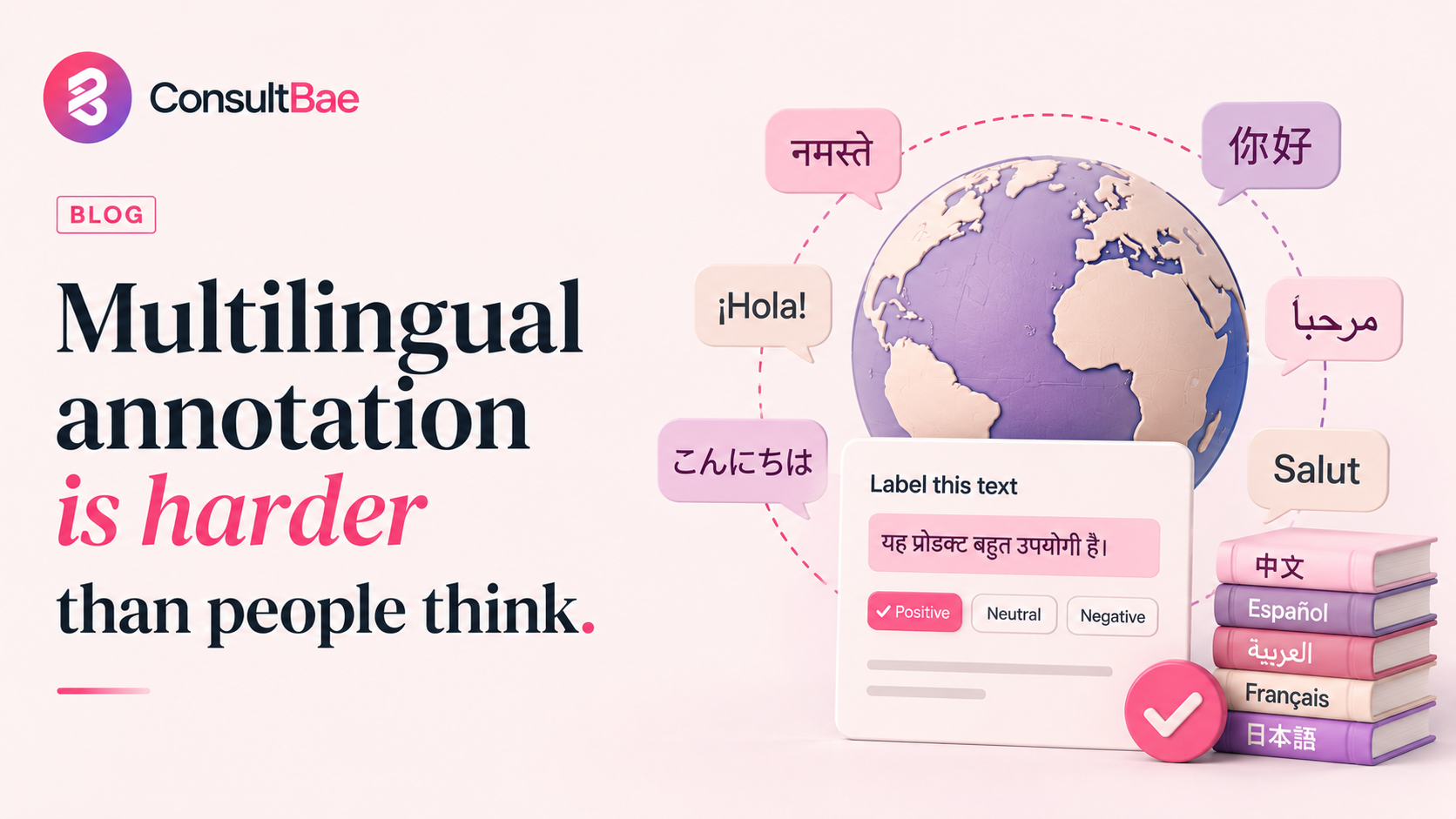
Annotating English text is a solved operational problem at this point. The contributor pools are deep, the tooling is mature, the quality processes are well-understood, and the cost structures are stable. Most annotation work in the industry happens in English and the assumptions baked into how that work runs are also English-centric, often invisibly so. Those assumptions begin to break down the moment a project expands to cover multiple languages, and the operational difficulties multiply faster than most teams expect.
A project that needs annotation across twenty languages is not twenty English projects in parallel. It is a different category of operational challenge, with quality dimensions that monolingual projects do not have to manage and contributor requirements that most annotation platforms cannot meet directly.
Why monolingual annotation assumptions do not transfer
The standard model for annotation operations relies on a few things that are present by default in monolingual work. A pool of qualified contributors who can be calibrated against guidelines in the same language those guidelines were written in. Review layers staffed by people fluent enough in the project's language to evaluate consistency and quality. Edge case decisions communicated quickly across the project team because everyone shares a working language.
Multilingual annotation breaks several of these defaults simultaneously. The contributor pool now has to be assembled across multiple languages, each with its own depth of available native speakers. Review can no longer be centralised because reviewers need to be fluent in the languages they are reviewing. Edge case decisions made in the project's working language now have to be translated and propagated across languages without losing nuance.
The four operational challenges of multilingual annotation
Four specific challenges show up consistently in multilingual annotation work and they need to be addressed in project design rather than improvised during execution.
Native-speaker quality bar. Annotation quality in a language depends heavily on the annotator being a genuine native speaker, not a second-language user. The difference between native and near-native shows up in edge cases, in subtle judgements about meaning and tone, and in the kind of contextual decisions that good annotation requires. Verifying native-speaker status across multiple languages and geographies is itself an operational challenge that monolingual projects do not have to think about.
Guideline translation that preserves intent. The annotation guidelines were written in one language by one team. When they are translated for use by annotators in other languages, the translation has to preserve not just the words but the underlying intent, the examples have to be re-grounded in the target language, and the edge case discussions need to make sense within that language's specific patterns. A literal translation that misses the spirit of a guideline will produce annotators who are following different instructions than the project intended.
Cross-language consistency checks. A multilingual dataset needs to be consistent across languages, not just within each language. If an annotation pattern is applied one way in Hindi and a different way in Spanish, the dataset has a structural inconsistency that will surface in the model. Detecting this requires review processes that can compare annotation patterns across languages, which is operationally harder than comparing within a single language.
Edge case decisions that vary by language. Some annotation decisions that look identical at the surface level actually require different handling in different languages because the underlying linguistic structure is different. Sentiment categorisation, named entity recognition, intent classification — all of these can have language-specific edge cases that need decisions made by people who understand the language deeply. Centralising these decisions in the project's working language often produces wrong calls for the languages where the situation is structurally different.
A multilingual annotation project is not a translation problem. It is a coordination problem across languages, each with its own quality dimensions and its own edge cases.
Why machine translation cannot solve the underlying problem
A natural instinct when facing multilingual annotation complexity is to ask whether translation tools can collapse the problem back into a monolingual one. Translate the data into one working language, annotate it there, translate the results back. This works for some narrow tasks. For most meaningful annotation work, it does not.
Machine translation introduces errors and shifts in meaning that compound through the annotation step. The annotator is no longer working with the original data, they are working with an approximation of it. Any subtleties that were present in the original language are at risk of being lost or distorted in translation, and the resulting annotation reflects the translated approximation rather than the original.
For tasks where the model needs to handle the original language in production, this is a structural problem. The model trained on annotations derived from translations will perform on the translated distribution, not the original one. The mismatch shows up in production performance.
What a well-run multilingual annotation operation actually looks like
A multilingual annotation operation that produces consistent quality has a few features that distinguish it from a monolingual one extended carelessly.
The contributor network has direct relationships with native speakers in each target language, with verification processes that confirm native fluency rather than relying on self-reporting. Guidelines are developed in the source language and then localised by people who can preserve intent rather than just translate words. Review layers are staffed per language, with cross-language coordination through a central team that can compare patterns across the dataset.
Edge case decisions are documented in a way that travels: the underlying reasoning is captured, not just the resolution, so that decisions made in one language can be applied appropriately in another or explicitly adapted where the language requires it. Quality monitoring tracks consistency both within languages and across them, with feedback loops to annotators when patterns drift.
Verified native speakers in every target language, not approximations. Guidelines localised with intent preserved, not literal translations. Per-language review layers with cross-language coordination. Edge case reasoning documented, not just resolutions. Quality monitoring that tracks consistency within and across languages. Communication infrastructure that lets language-specific decisions surface and get resolved properly.
How ConsultBae approaches this
Our contributor network covers languages that most annotation platforms cannot reach directly, including low-resource Indian languages and a range of languages across Asia, Europe, and other geographies. The network gives us the contributor side. The annotation operation built around it is what makes it actually useful for multilingual projects.
We approach multilingual annotation as a distinct operational discipline. Project design accounts for the cross-language coordination requirements from the start. Guidelines are localised properly, not translated literally. Review structures are built per language with central oversight. Edge case handling is documented in ways that travel across languages.
Multilingual annotation will be a larger part of AI data work as models move into markets where they need to perform across the actual linguistic diversity of the populations they serve. The operations that can do this work well are different from the operations that do single-language work at scale, and the difference is worth understanding when evaluating partners for projects that need this kind of coverage.
Vanshika Jain works in AI Data Collection and Annotation at ConsultBae, focused on annotation operations and data quality across projects in multiple modalities and domains.
Need annotation across multiple languages?
ConsultBae's network covers languages most platforms cannot reach, with the operational discipline multilingual work actually requires. Let us talk.
Talk to us