For a long time, nobody in the startup world talked about failure the way it actually happened. The success stories were everywhere. The thousand companies that tried the same thing and didn't make it back, those stories stayed quiet, which meant every founder walking into year one was working with an incomplete picture of the odds.
One of the things that picture missed was the retention problem. Not the hiring problem, which gets discussed endlessly, but the quieter, more expensive problem that comes 18 months later, when the person you built the early company with leaves for somewhere that can offer them what you cannot yet. The departure doesn't usually happen because of money alone. It happens because the environment that made the role exciting at the beginning, the low structure, the shared improvisation, the sense that everyone was figuring it out together, stopped being exciting and started feeling like instability.
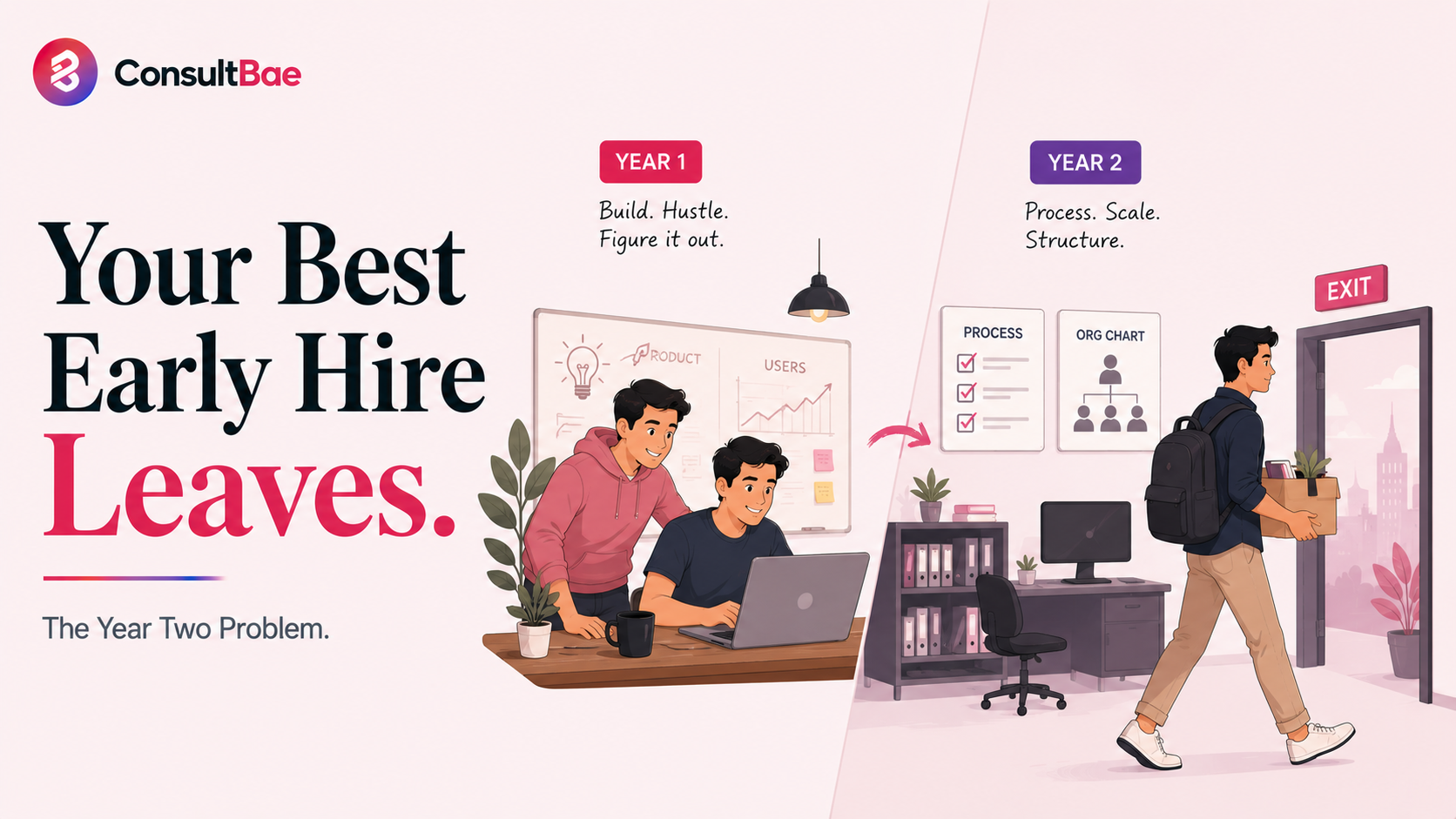
Hiring for appetite gets you through year one. Systems and documented processes get you through year two and beyond. Most bootstrapped founders invest heavily in the first and almost nothing in the second until someone walks out the door.
Why Early-Stage Hiring Logic Breaks Down at Scale
When you are building from zero with no external funding, the hiring calculus is different from a well-capitalised startup. You cannot compete on salary. You cannot offer the brand recognition that attracts people who are optimising for a resume line. What you can offer is ownership: the chance to build something from the beginning, to have your fingerprints on decisions that matter, and to grow at the speed the company grows rather than waiting for a promotion cycle that may never come.
This works extremely well for a specific type of person: someone with genuine appetite for building, high learning speed, and enough comfort with ambiguity to function productively when the playbook hasn't been written yet. Aptitude is the proxy indicator for this. Someone who can figure things out quickly, who asks the right questions, who connects dots without being told to look for them: this person is worth more at the zero-to-one stage than someone with more experience who needs more structure to perform.
The problem begins when the company grows past the stage where improvisation is a feature. At some point, a team of 20 or 30 people cannot function on institutional memory and informal coordination. Processes need to be documented. Roles need to be defined more precisely. The way things get done needs to be written down so that new people can learn it without requiring the founder or a senior team member to personally transmit it each time. This is not a failure of culture. It is the natural maturation of any organisation that is actually growing.
But the person who thrived in the improvisation phase may not thrive in the structure phase. And the founder who is good at improvisation may not be good at building the structure. Both of these gaps, if unaddressed, produce turnover at exactly the moment when stability matters most.
The Aptitude-First Approach and Where It Reaches Its Limits
Hiring for aptitude over experience is the right call at the early stage. It is not wrong. The risk is in treating it as a permanent philosophy rather than a phase-specific one.
A high-aptitude early hire learns quickly, takes ownership broadly, and often ends up carrying responsibilities well beyond their initial role because the company needs it and they are capable of handling it. This is genuinely valuable. It is also, if left unmanaged, a setup for burnout and eventual departure. The person who is doing six different things because the company needed six different things done is not getting the professional development that would come from doing one of those things deeply. Their career is growing horizontally while they may have wanted it to grow vertically. At year two, when the startup they joined is no longer early-stage in the exciting sense but is still early-stage in the resource-constrained sense, they begin to wonder whether their interests are aligned.
The answer is not to stop hiring for aptitude. It is to build the role architecture and the development infrastructure that gives high-aptitude early hires a path forward within the company, rather than leaving them to conclude that forward means elsewhere.
"Initially the hiring was focused on someone who has the appetite to grow, who is a quick learner, who wants to build a career in the same direction. Once you have covered the zero to one journey, you look for people who come with prior experience, so the learning curve is smaller and you also learn from them."
What Documented Systems Actually Do for Retention
The connection between documentation and retention is not obvious until you watch what happens in its absence. When the way things work lives only in the heads of a few senior people, or in informal coordination between team members who have been there long enough to know, the organisation becomes fragile in proportion to how few people hold that knowledge. When any one of those people leaves, the knowledge goes with them. But more importantly, while they are still there, those people become the bottleneck for everything. Every new hire has to learn from them directly. Every process change has to go through them implicitly. They cannot take time off without things slowing down. This is exhausting, and it is one of the reasons early team members leave: not because they wanted to, but because the organisation never built the infrastructure that would have let them step back slightly without everything falling apart.
A documented playbook does something more than preserve knowledge. It signals to the person who holds that knowledge that the organisation values what they know enough to make it institutional, not personal. It creates a path for other people to develop in the same area. And it frees the person who built the process from being permanently on call as the living documentation of how it works.
The Transition from Figuring It Out Together to Here Is the Process
There is a specific moment in a bootstrapped company's growth where the culture of improvisation, which was the company's genuine strength in the early phase, begins to work against it. Team members who joined when everything was being invented look around and see that things are being formalised. Decisions that used to be made in a five-minute conversation now go through a process. Roles that used to be fluid are being defined. Some people experience this as the company losing what made it special. Others experience it as the company finally becoming serious.
Both perceptions are partly right. The challenge for the founder is to make the transition legible: to communicate that the shift from improvisation to process is not a retreat from the early culture but a maturation of it. That the people who built the improvisation phase are being asked to help build the process phase, not replace it. That the skills that made them valuable at zero to one, the learning speed, the ownership, the ability to operate without a manual, are still valued but are now being applied to the work of making the company work at a larger scale.
This communication is not automatic. It requires the founder to name the transition explicitly, to involve early team members in building the systems rather than simply presenting those systems as something that has been decided, and to create a clear picture of what the company looks like at the next stage and what role the early team members play in it.
What Our Own Early Team Taught Us About This
At ConsultBae, the first two hires were interns. They stayed for a few months, contributed what they could at that stage, and moved on. The person who has been with us the longest joined as an early generalist and now leads the recruitment vertical. Four years in, she is not doing what she was hired to do. She is doing something more specific, more senior, and more directly tied to the company's core output. That evolution was not accidental. It happened because the role was allowed to develop as the company developed, and because the systems built around the vertical gave her a clear structure within which to grow rather than a permanent state of improvisation to manage.
The founders who build teams that stay are not the ones who hire the best people and hope for the best. They are the ones who build the infrastructure that gives good people somewhere to go, within the company, as the company changes. The hiring is the beginning. The systems, the documentation, the role architecture, the explicit communication about where things are going: that is what determines whether year one becomes year four.
A hire who grows with you has a clear path inside the company that matches their professional ambitions, not just their current output. They see how the company's growth creates opportunity for them specifically.
A hire who grows past you has outgrown the role, the clarity, or the environment the company can offer. This is not always preventable, but it is often delayed or avoided by investing in role development, documented systems, and explicit conversations about the future before the person starts having those conversations with someone else.
The difference is usually not salary. It is visibility: whether the person can see their next two years inside the company as clearly as they can see them elsewhere.
This is, in the end, a version of the same problem ConsultBae was built to help other companies solve. Hiring well is the beginning. Keeping the people you hire, by building the context that makes staying the right choice, is the work that never ends, and never stops mattering.
Building a Team That Stays?
ConsultBae works with startups and growth-stage companies on mid-senior permanent hiring, staffing, and the sourcing infrastructure that keeps your pipeline healthy through every stage of growth.
Talk to Our Hiring Team