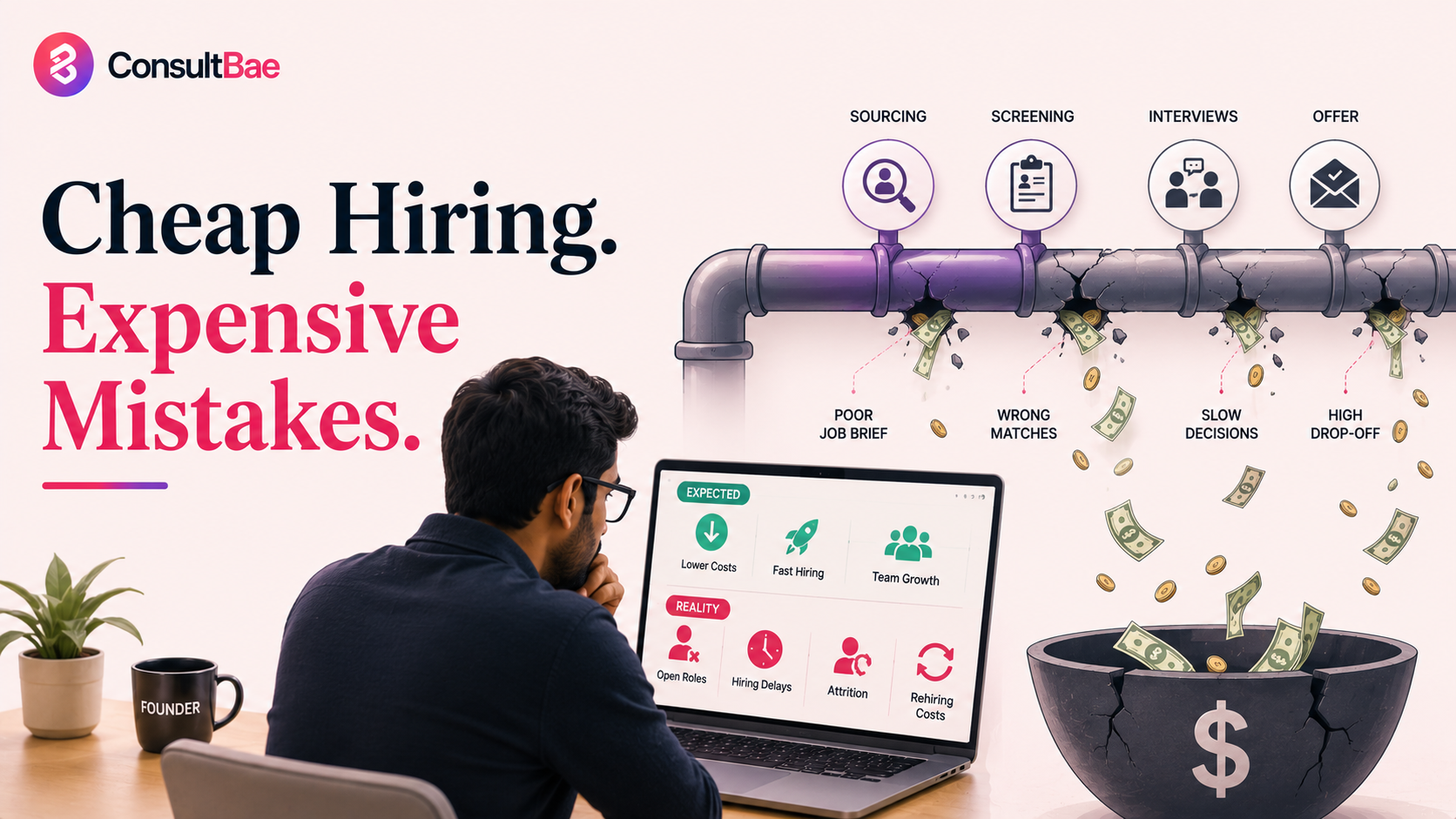
It usually starts with a spreadsheet. A founder based in the US, running a funded technology company, opens a cost comparison between hiring a senior engineer locally and hiring the same profile out of India. The numbers are stark. The conclusion seems obvious. They reach out to a staffing firm, describe what they need, and wait.
What happens next is where the cost advantage quietly disappears. The profiles arrive slowly. The screening is generic. The candidate they eventually hire doesn't stay past the first year. The founder goes back to the spreadsheet and wonders why this didn't work the way it was supposed to.
The problem isn't India as a talent market. The problem is what they hired for it.
Why US Companies Are Looking at India Right Now
The logic behind building a delivery team in India has existed for decades, but the current wave is different in character. It isn't just about cost reduction, though that remains significant. It is about access to a talent pool that, in several technology verticals, is genuinely deep. It is also about time zone overlap: a team in India, working adjusted hours, can collaborate in real time with a US-based leadership team in a way that teams in further time zones cannot.
Indian founders who have moved to the US carry an additional advantage: they understand both markets. They know how to hire in India, what the compensation expectations look like, what career growth means to a candidate who is building a long-term relationship with an overseas company. This makes them well-positioned to build India-based delivery functions, but it doesn't mean they always do it efficiently.
The most common mistake is treating the India team as a cost centre to be filled with available resources rather than a delivery capability to be built with precision. Those are two fundamentally different approaches, and they produce fundamentally different results over a two-year horizon.
The Vendor Trap: Resource Supply Versus Delivery Partnership
A staffing vendor provides people. A delivery partner provides a functioning team. The distinction sounds semantic until you are six months into a relationship and realise that what you have is a collection of individuals who have been placed but never quite integrated, and that the partner who placed them considers their job complete.
The vendor model is transactional by design. A role opens, a profile is sourced, a placement is made, an invoice is sent. There is no structural incentive for the vendor to think about whether this person will still be there in 18 months, whether they are the right composition for the team being built, or whether the engagement model makes sense for the client's actual delivery needs.
A delivery partnership operates differently. It starts with the question of what the client is trying to build, not what role they are trying to fill. Sometimes those are the same question. Often they are not. A company that thinks it needs three individual developers may actually need a pod: a developer, a quality assurance engineer, and a DevOps professional who can function as a unit, share context, and produce output that holds together. That is a different conversation, and it requires a partner who is willing to have it.
"The goal is not just to be a resource provider. It is to be a digital transformation partner, someone who helps the client think about how they want to drive their technology function, not just who they want to put in it."
What a Pod Model Actually Looks Like in Practice
The pod model is not complicated in theory. You identify the smallest complete unit of delivery capability required for a client's specific project, staff it as a team rather than as a set of individual roles, and manage it as an ongoing engagement rather than a series of one-off placements. The complexity is in the execution.
Building a pod means thinking in terms of composition before thinking in terms of individuals. What combination of skills does this project actually require? What level of seniority? What communication style, given the need to collaborate across time zones with a US-based team? What working hours? What accountability structure? These questions have to be answered before the first profile is sourced, not after the first hire has already started.
It also means the partner holds the pod together over time. If one member of the pod leaves, the partner finds the replacement and manages the transition so the client's delivery isn't interrupted. The pod is the unit of value, not the individual placement. That framing changes everything about how the relationship operates.
Speed as the Real Metric: Closing Roles in Under Two Weeks
Speed is often treated as a secondary concern in recruitment, something that matters but not as much as getting the right person. In a staffing context for a US client building a delivery team in India, this hierarchy is wrong. Speed is the primary metric because every week a role stays open is a week of delivery capacity the client doesn't have, and delivery capacity is the reason the engagement exists.
Closing roles consistently in under two weeks is not about moving faster through the same process. It is about restructuring the process so that each stage runs at maximum throughput. Sourcing, screening, and account management are separate functions, run by separate teams, each optimised for the specific work it is doing. Sourcing does not screen. Screening does not manage accounts. Account management does not source. Each function operates in parallel, feeding the next stage, and the result is a pipeline that can sustain multiple roles simultaneously without any single bottleneck slowing everything down.
A pipeline built this way also has a healthy reserve of pre-engaged candidates who have been contacted, qualified at a basic level, and are ready to move into formal screening when a role opens. This is the difference between a pipeline that starts from scratch with every new role and one that is already partially filled before the role is formally defined.
How to Evaluate a Staffing Partner Before You Sign
The questions worth asking before committing to a staffing relationship for an India-based delivery team are more operational than many companies realise. References matter, but what you ask about in those references matters more. Not whether placements were made, but how long they stayed. Not whether roles were filled on time, but what happened when a placement didn't work out and how quickly the partner responded.
It is also worth asking how the partner thinks about the difference between sourcing and strategy. A vendor will describe their process: sourcing channels, screening steps, timeline commitments. A delivery partner will ask about your product roadmap, your engineering culture, your working style, and your growth plan before they describe their process. The sequence of questions tells you a great deal about the kind of relationship you are entering.
What is the average tenure of placements you have made for US clients in India over the past two years?
How do you handle a placement that doesn't work out within the first three months?
Do you manage pod-based engagements, or only individual role placements?
What does your pipeline look like for the specific tech stack we are hiring for, and how current is it?
What does the first conversation look like: do you start by asking what roles are open, or by asking what we are building?
The India talent opportunity is real. The companies that extract the most value from it are not the ones who found the cheapest vendor. They are the ones who found a partner who understood the difference between filling a role and building a team, and who stayed invested in the outcome long after the placement was made.
Building a Delivery Team in India?
ConsultBae works with US-based companies to build and manage India-based technology and delivery teams, from individual placements to full pod-based engagements.
Talk to Our Staffing Team