Contract staffing at the mid-to-senior level has a reputation problem on both sides of the market. Senior candidates often see contract work as a downgrade from permanent employment: less stable, less invested in by the company, a less compelling career story. Companies often use contract staffing as a cost-saving measure or a hedge against headcount commitment, which produces engagements that work for neither side. The result is that contract staffing gets dismissed by people who should be considering it and used badly by people who do.
The cases where contract staffing genuinely works at senior level exist, and they look different from how the format is usually framed. Understanding when contract makes sense and how to structure it is the difference between a tool that solves real hiring problems and a tool that produces predictable disappointment for both the company and the candidate.
Why senior candidates are skeptical of contract roles
Strong senior candidates have options. When they evaluate a contract role, they are usually weighing it against permanent opportunities, and the comparison is not neutral. Permanent roles tend to come with longer-term commitment from the company, stronger equity participation, deeper integration into the team, and a clearer story to tell future employers about what they did.
Contract roles, depending on how they are structured, can lack some or all of these. The candidate worries about being treated as peripheral to the organisation, about working hard on something that will not be visible in their next role conversation, about being the first cost cut when the company tightens its budget. These concerns are not unreasonable. They are based on how contract staffing has frequently been used at this level, and they shape the candidate's openness to the format before any specific conversation begins.
When contract staffing genuinely works for both sides
A few specific situations produce engagements where contract staffing serves the company and the candidate equally well.
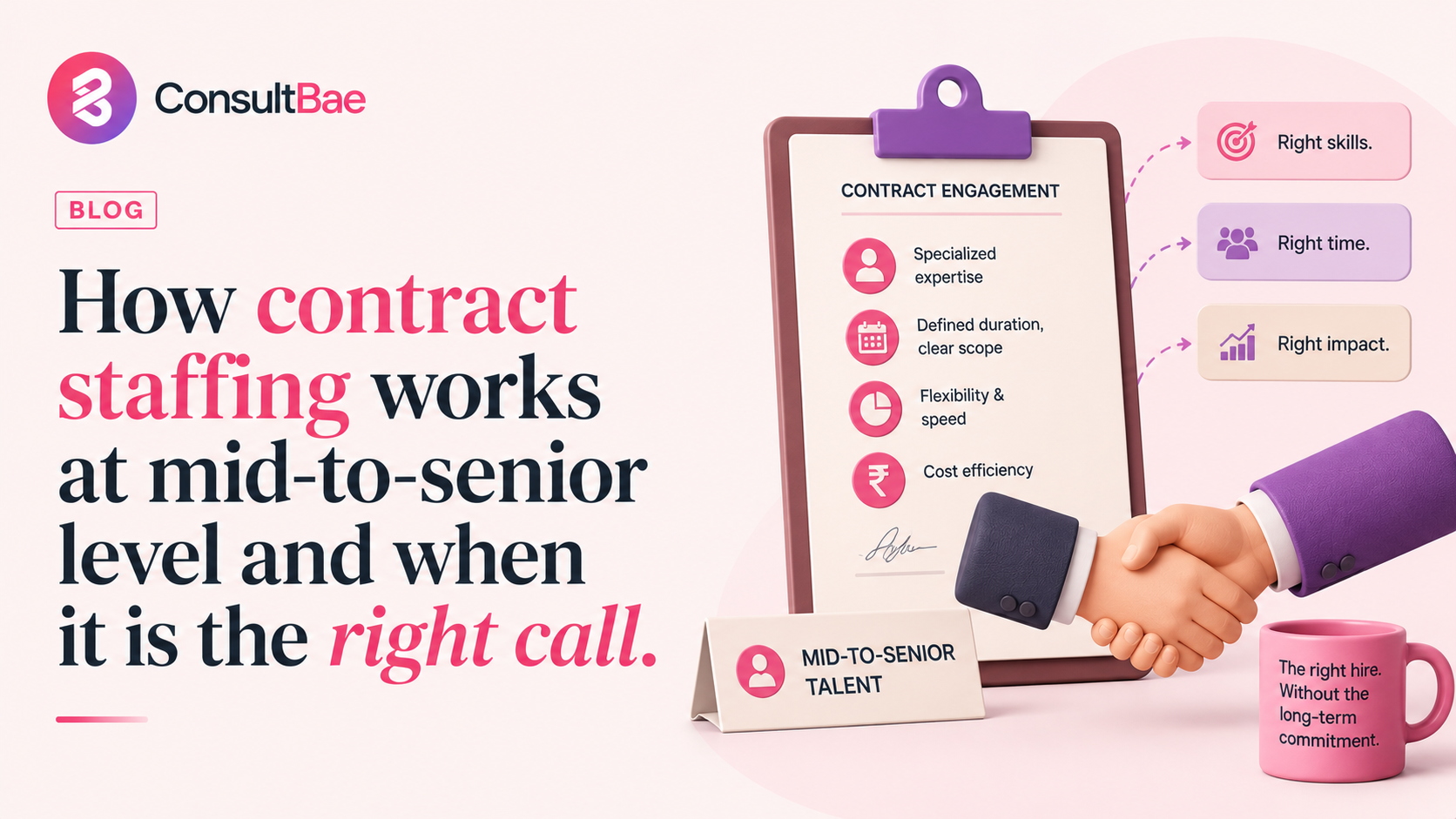
Time-bounded needs with clear deliverables. A company that needs a specific senior capability for a defined project, with a clear scope and timeline, is using contract staffing for what it is actually good for. The candidate knows what they are signing up for, the company knows what it is paying for, and the engagement ends cleanly when the work is complete. This works well for transformation projects, launches, system implementations, or any situation where the need is real and the duration is genuinely bounded.
Specialised expertise the company cannot justify retaining permanently. Some senior capabilities are needed intensively for a period and not at the same intensity afterwards. A company moving from one technology stack to another, or building a function it does not currently have, may need senior expertise for twelve to eighteen months that would be over-resourced for the role's long-term needs. Contract staffing lets the company access that capability without committing to a permanent headcount that does not fit the steady state.
Bridge hires before permanent roles. A company in the middle of a leadership search may need senior interim capability while the permanent search continues. A contract engagement with a strong interim leader keeps the function moving rather than creating a vacuum that affects the team and the work. This serves the company by maintaining momentum, and serves the contractor by providing a meaningful engagement that often produces strong referrals into their next opportunity.
Contract staffing fails when it is used as a substitute for permanent hiring the company should have committed to. It works when it serves a need that genuinely does not require permanent commitment from either side.
How to structure contract engagements that retain senior talent
The structural choices around a contract engagement determine whether strong senior candidates are willing to take it and whether they perform well in it once they do.
The scope should be specific and substantial. Senior contractors want to do work that matters and ends with a clear outcome they can point to. Engagements scoped as "general support" or "ongoing assistance" attract weaker candidates and produce weaker work, regardless of the rate offered.
Compensation should reflect the senior nature of the engagement. Underpaying senior contractors is a common mistake that filters the pool toward candidates who could not get equivalent permanent roles. Paying at the level the work actually requires opens the pool to the candidates who can deliver it.
Integration with the team should be genuine. A contractor treated as a temporary extra produces temporary extra work. A contractor integrated into the team with clear authority over their scope produces work indistinguishable in quality from a permanent senior hire. The behaviours that produce this integration are not subtle: include them in relevant meetings, give them ownership of decisions within their scope, treat them as full participants for the duration of the engagement.
The exit should be clean. A clear conversation at the start about how the engagement ends, what knowledge transfer is expected, and what reference and recommendation the company will provide afterwards makes the engagement easier to take on. Senior contractors are building a portfolio of engagements, and clean exits with good references are part of how their next opportunity gets built.
What companies get wrong when they default to contract staffing
The most common mistake is using contract staffing for needs that are actually permanent, because the company is not ready to commit to the headcount or wants to defer the comp decision. This produces engagements that frustrate everyone involved. The contractor is doing permanent work without permanent investment from the company. The company is paying contract rates for ongoing work that would be more efficiently staffed permanently. The contractor leaves when something better comes along, often before the company has the permanent replacement lined up.
The second mistake is underpaying for the seniority of the work. Companies sometimes assume that contract rates should be below permanent compensation when adjusted for benefits. For senior contract work, this assumption produces weaker candidate pools and worse outcomes. Strong senior contractors price their engagements at rates that reflect the risk and irregularity of the work, which is often higher than the equivalent permanent role's total compensation, not lower.
Contract makes sense: The need is genuinely time-bounded. The work requires specialised expertise that would be over-resourced permanently. The role is a bridge while a permanent search continues. The deliverable is specific and can be scoped concretely.
Contract does not make sense: The work is ongoing and the company simply has not decided to commit to permanent headcount. The role is general support without specific deliverables. The company is using contract as a way to underpay for what should be a permanent senior role.
How ConsultBae approaches this
We do both contract and permanent hiring at mid-to-senior level. When clients come to us with a role, one of the first conversations is whether the work is genuinely suited to contract staffing or whether it is a permanent role being framed as contract for other reasons. The answer determines what kind of candidates we surface and how we position the engagement to them.
Contract staffing is currently a growing part of our work, including for clients in the US who are using our network for senior tech engagements. The placements that work well are the ones where the scope, the compensation, and the integration are all aligned with what the format is actually good for. The ones that struggle are the ones where contract was the wrong choice from the start. Getting that decision right is one of the more useful conversations we have with clients early in the process.
Anubhav Sahay is part of the hiring team at ConsultBae, focused on mid-to-senior recruitment for funded startups across India.
Deciding between contract and permanent staffing?
ConsultBae handles both, and helps clients decide which one the role actually needs. Let us talk through your situation.
Talk to us