The AI data industry has a vocabulary problem. The language used to describe what happens in data collection and annotation projects borrows heavily from machine learning and model development: training sets, modalities, ground truth, labelling pipelines. This vocabulary is accurate in a narrow technical sense, but it consistently misleads the people who need to commission this work, because it implies that the critical competence is technological. It isn't.
The critical competence in AI data services is operational. It is the ability to take an underspecified brief from a model builder, translate it into a structured project with defined scope and measurable deliverables, find and onboard the right contributors in the right demographics at the right volume, manage the collection process so that quality is embedded throughout rather than checked at the end, and deliver a clean, annotated dataset on the committed timeline. That is a project management problem. It always has been.
This distinction matters for anyone building or evaluating a data partnership, because the vendors who understand it are positioned very differently from the vendors who don't.
What an AI Data Project Actually Involves Day to Day
On a live data collection project, the day-to-day work looks nothing like what the technical vocabulary suggests. There are no algorithms running. There are no model weights being adjusted. What is happening is this: a project manager is tracking contributor completion rates and identifying the ones who have gone quiet. A sourcing coordinator is replacing drop-offs with vetted backups from the reserve pool. A quality reviewer is sampling collected files and flagging batches that don't meet the annotation brief. A client relationship manager is translating a mid-project scope change from the client into revised instructions for the contributor team without losing the work already completed.
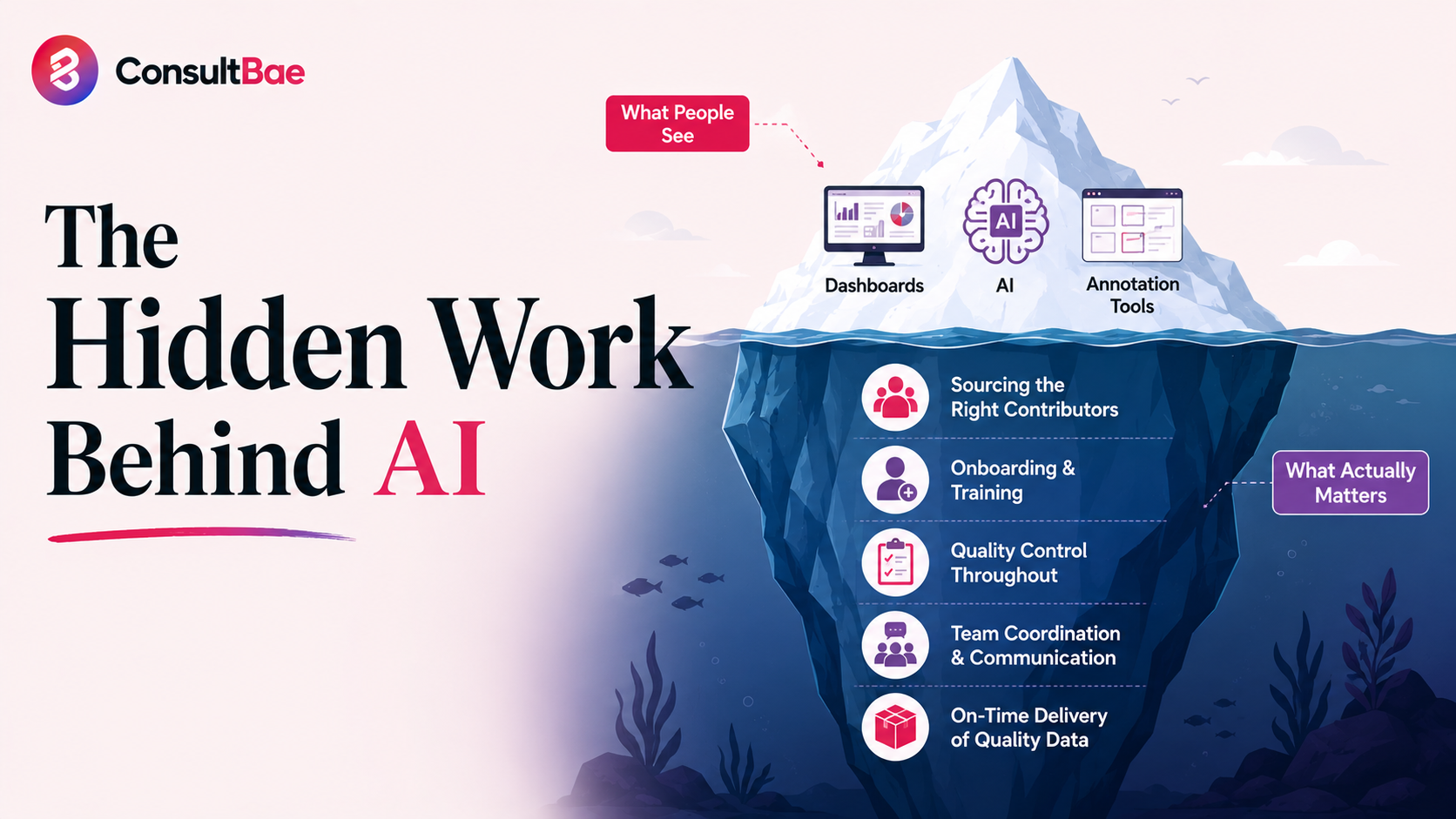
This is coordination work, communication work, and process management work. It requires people who are good at running projects, not people who are good at running models. The technical layer, the annotation tools, the file management systems, the automated quality checks, matters, but it matters as infrastructure. The infrastructure does not make the project succeed. The people running the project make it succeed or fail, and they do it through the quality of their operational decisions, not their technical expertise.
Where Most Vendors Fail: Treating It as a Technology Problem
Vendors who position themselves primarily as technology providers in the AI data space tend to over-invest in tooling and under-invest in contributor management. They build sophisticated platforms for task assignment, quality scoring, and dataset delivery. What they often lack is a reliable pipeline of contributors who can actually produce the data to specification, in the volume required, within the timeline committed.
This matters because the hardest part of any data collection project is not designing the annotation interface. It is finding 200 native speakers of a specific language variant, in a specific age and gender distribution, who are available, willing, technically capable of following the recording instructions, and reliable enough to complete the task without requiring repeated follow-up. That problem is a human sourcing problem. It is not solved by better software.
The clients who discover this mismatch usually do so mid-project. The vendor's platform is functioning correctly. The quality of the data that has been collected is acceptable. But the volume is 40 percent of what was committed, because the contributor pipeline was shallower than it looked at the proposal stage and there is no reserve to draw on. The project is now late, and the fix, recruiting and onboarding new contributors mid-stream while maintaining quality, is expensive and slow.
"The AI data vertical is non-technical at its core. It is project management. We take the project, we execute it, and we deliver it to the client. The automation helps, but the decisions that determine whether it works are operational ones."
The Four Operational Stages of a Well-Run Data Project
A data collection and annotation project that delivers reliably moves through four distinct operational stages, each of which requires different skills and different attention from the team running it.
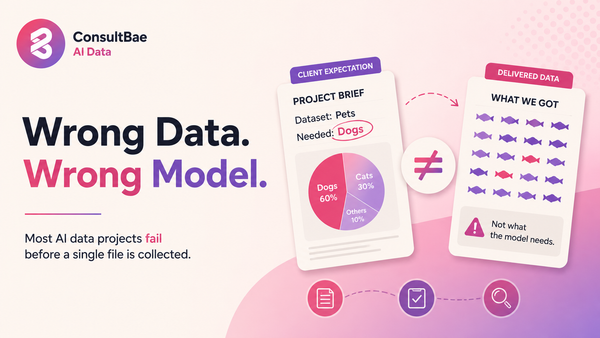
The first is scoping. A brief that arrives from a model builder is rarely complete. It describes what the client wants the model to be able to do, not what the data needs to look like in order to train that capability. Translating one into the other requires asking the right questions: what demographic distribution matters for this use case, what languages and dialects need to be represented, what recording conditions are acceptable, what annotation schema will the model training pipeline consume, what file formats are required, and what quality threshold separates usable data from data that will degrade the model. Getting scope wrong at this stage is the most expensive mistake in any data project, because every subsequent stage will execute against the wrong specification.
The second stage is contributor sourcing and onboarding. This is where the theoretical project meets the actual population of available humans. The sourcing work is done against the demographic specifications established in scoping. Onboarding is the process of getting contributors to the point where they can produce data that meets the brief: understanding the instructions, having the right equipment, knowing what acceptable and unacceptable output looks like, and being clear on the timeline and payment structure. Onboarding quality directly predicts data quality. Contributors who were poorly onboarded produce inconsistent output regardless of how good the annotation tool is.
The third stage is collection and annotation management. This is the ongoing operational work of the project: monitoring completion rates, reviewing sample batches, replacing contributors who are not delivering, communicating scope updates to the active contributor pool, and maintaining the quality of the dataset as it grows. The temptation at this stage is to reduce human oversight in favour of automated quality checks. Automation helps. It does not replace the judgment of someone who reads a flagged audio file and understands why it failed in a way that automated acoustic analysis cannot fully capture.
The fourth stage is delivery and validation. The dataset is assembled, final quality checks are run, the client receives the deliverable in the agreed format with the agreed documentation. This stage matters more than it looks like it does, because a dataset that arrives in the wrong format, without adequate documentation of the collection methodology, or without the demographic breakdown the client needs for their model evaluation, fails the client's use case even if the underlying data is excellent.
Why Automation Helps but Does Not Replace Coordination
There is a version of the AI data industry's future in which most of the coordination work described above is automated. Contributor matching, quality scoring, pipeline management: in principle, all of this can be systematised further than it currently is. In practice, the projects that run most smoothly today are not the most automated ones. They are the ones with the most experienced project managers making the decisions that automation cannot make reliably yet.
Automation is useful for reducing the administrative burden of high-volume, repetitive tasks: sending onboarding instructions to 300 contributors, tracking completion percentages against a timeline, flagging files that fall outside defined acoustic parameters. These are tasks where automation genuinely helps and where the cost of occasional errors is recoverable. The decisions that determine project success, whether the scope was interpreted correctly, whether the contributor pool is representative enough, whether a mid-project quality issue reflects a systemic problem or an individual outlier, require human judgment, context, and the kind of pattern recognition that comes from having run enough projects to know which signals matter.
What Clients Should Actually Evaluate When Choosing a Data Partner
A client evaluating AI data vendors for the first time typically focuses on the platform: the annotation tool, the quality dashboard, the dataset management interface. These things matter, but they are not what determines delivery. The right questions are operational. How many contributors do you have active in the demographic profile my project requires, right now, not in total? What is your attrition rate mid-project and what is your process for replacing drop-offs? How do you handle a scope change that arrives after collection has begun? What does your quality review process look like at the file level, not just the aggregate metric level?
Demographic specification: language, dialect, regional variant, age range, gender distribution, and any other contributor characteristics that affect the model's intended use case. Vague specifications produce vague data.
Recording or annotation conditions: what equipment is acceptable, what background noise is tolerable, what lighting conditions apply for video or image tasks. Leaving this unspecified produces a dataset with inconsistent collection conditions that complicate training.
Quality criteria defined upfront: what constitutes a passing file versus a reject, defined in terms that a contributor can understand and apply before they submit, not terms that only become visible during post-collection review.
Volume with buffer: the required volume plus the expected drop-off and attrition rate. A brief that asks for exactly 500 hours with no stated buffer will receive 500 hours on paper and fewer than 500 hours of usable data in practice.
The partners who answer operational questions with specificity, rather than deflecting to platform features or aggregate capability claims, are the ones who have actually run projects at scale and know where things break. The platform is the container. The operations are what fills it. Evaluating a data partner on the container alone is the reason so many first data projects end with a gap between what was promised and what arrived.
Planning a Data Collection or Annotation Project?
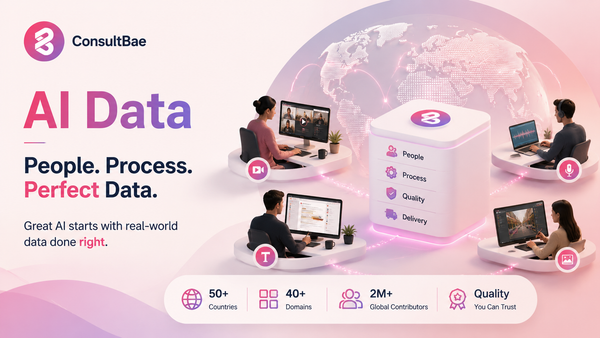
ConsultBae manages AI data projects across all four modalities in 100 plus countries, from scoping through delivery. We handle contributor sourcing, onboarding, quality management, and final dataset delivery as a complete operational service.
Talk to Our AI Data Team