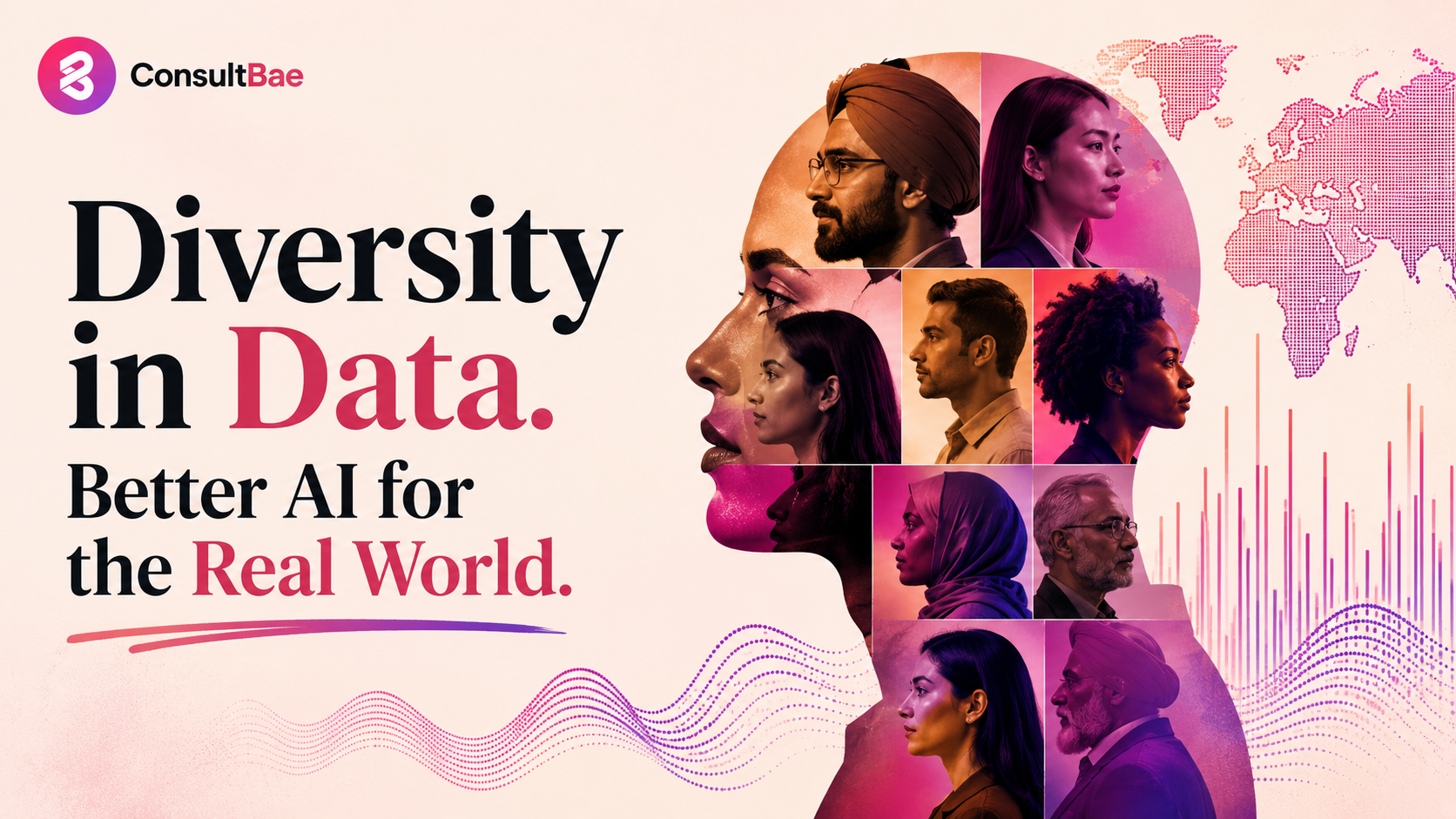
A facial recognition system that works accurately for one demographic and fails for another is not a bug in the algorithm. It is a predictable consequence of what the algorithm was trained on. A voice assistant that understands one accent clearly and struggles with others is not a technical limitation waiting for a better model architecture. It is a data limitation that will persist until the training data reflects the population the model is supposed to serve.
These failures are well documented at this point. What is less well understood is the mechanism behind them and, more practically, what it actually takes to prevent them at the data collection stage rather than patch them after the model is already in production.
I have spent two years running data collection projects across 100-plus countries, across multiple languages, accents, age groups, and geographies. The demographic diversity problem is not abstract from where we sit. It is operational. It shows up in every project brief that specifies demographics, and it shows up in the gaps left by every brief that does not.
What demographic diversity in training data actually means
Demographic diversity in training data is not a single variable. The dimensions that matter depend entirely on what the model is being trained to do.
For a speech model, the relevant dimensions include language, dialect and accent variation within a language, age, gender, and recording environment. A speech model trained on studio-quality recordings of young adult male voices from one region of one country will perform well on that input profile and degrade on everything else: older speakers, female speakers, speakers with regional accents, speakers in noisy environments, speakers from other countries who speak the same language differently.
For a computer vision model, the dimensions include skin tone, age, body type, lighting conditions, and the visual context surrounding the subject. A model trained primarily on images from one geographic region, one lighting environment, or one demographic group builds its understanding of visual patterns from that narrow sample and generalises poorly beyond it.
For a text model, the relevant diversity is subtler but equally consequential: the socioeconomic background, cultural context, and educational level of the people who produced the text the model learned from shapes the assumptions the model makes about what is normal, correct, and relevant.
Homogeneous training data does not produce a neutral model. It produces a model optimised for the demographic that produced the data, which performs as a biased system for everyone else.
How homogeneous data produces biased models
The mechanism is straightforward even if the consequences are not always obvious during development. A model learns patterns from training data. If the training data over-represents a specific demographic, the model becomes highly accurate at recognising and responding to the patterns that demographic produces, and proportionally less accurate at everything that deviates from those patterns.
This is not a flaw in the learning process. It is the learning process working exactly as designed. The model is optimising for accuracy on the data it has. If the data is skewed, accuracy on that data produces a model that performs unequally across the real-world population it will eventually serve.
The problem compounds because testing often does not catch it. If the test set was drawn from the same distribution as the training set, performance on the test set will look strong. The failures surface in production, when the model encounters the demographic groups that were underrepresented in both training and testing, and the evaluation metrics that looked solid in development turn out not to reflect real-world performance at all.
Three real-world failure patterns
Three failure patterns appear most consistently in production systems that have a demographic diversity problem in their training data.
Speech models that degrade on accented and dialectal speech. A model trained predominantly on standard accent speech from a narrow geographic range will lose accuracy significantly when confronted with regional accents, non-native speaker patterns, or dialectal variation. For a voice interface deployed at scale across a linguistically diverse country, this means a large portion of the user base receives a materially worse experience than the rest, and that portion tends to correlate with the populations that were underrepresented in training.
Image and video models that underperform across skin tone variation. This is the most widely reported demographic diversity failure in computer vision. Models trained on image datasets that skew toward lighter skin tones build their understanding of faces, expressions, and identities on a narrow visual range. Performance drops measurably and consistently on darker skin tones. The failure is not subtle at the extremes of the training distribution and it has real consequences in every application from identity verification to healthcare imaging.
Text and language models that reflect the assumptions of a narrow cultural context. Large language models trained predominantly on English-language internet content inherit the cultural assumptions, reference points, and implicit value frameworks of the demographic that produced most of that content. For users from different cultural contexts, the model's outputs can feel misaligned in ways that are difficult to articulate but consistent in their effect: the model works better for some people than for others in ways that track demographic lines.
Speech: Language, regional dialect and accent variation, age range, gender distribution, recording environment, native versus non-native speaker split.
Image and video: Skin tone range using a standardised scale, age range, gender, lighting conditions, geographic setting, body type where relevant to the use case.
Text: Geographic origin of contributors, first language, educational background, cultural context, register and formality level.
If a brief does not specify these dimensions, the collection will default to whatever is easiest to source, which is rarely the most diverse option.
Why this keeps happening
Collecting demographically diverse data is operationally harder than collecting homogeneous data. It requires intentional sampling design before collection starts. It requires contributor networks that reach demographic groups that are not well-served by standard crowd platforms. It requires quality processes that do not inadvertently filter out the diversity you went to the effort of collecting — a quality check that over-indexes on standard accent patterns, for example, will systematically reject the accented speech that diversified your dataset.
Under timeline pressure and budget constraints, teams collect what is accessible. What is accessible through standard crowd platforms tends to be concentrated in specific geographies, specific age groups, and specific language backgrounds. The path of least resistance produces homogeneous data, and homogeneous data produces models with predictable failure patterns that will surface in production.
The other factor is that diversity gaps are invisible during development in a way that other quality problems are not. A dataset with inconsistent labelling will usually show up in training metrics. A dataset with demographic gaps will show strong metrics across the board and fail on the underrepresented groups in production, where those groups are finally present in sufficient numbers to make the failure visible.
What diverse data collection actually requires
Diverse data collection starts with a sampling design that specifies the demographic dimensions relevant to the use case before collection begins, not as an afterthought once the data is in. It requires contributor networks that extend beyond the populations standard platforms can reach: rural communities, elderly speakers, speakers of low-resource languages and dialects, geographic regions underrepresented in the global digital workforce.
It requires quality processes calibrated to preserve diversity rather than filter it out. And it requires a client brief that treats demographic specification as a core requirement rather than a nice-to-have, because a vendor cannot collect diverse data on a brief that does not ask for it.
How ConsultBae approaches this
When we built the AI data network at ConsultBae, we built it specifically to reach contributor populations that standard platforms cannot access. The 20-country expansion that turned the vertical from a domestic operation into a global one was driven by exactly this requirement: a client needed demographic coverage that did not exist in any existing pool, and we built the network to provide it.
Today, our contributor network spans 100-plus countries and includes crowd workers, language specialists, domain experts, and local coordinators across geographies that are consistently underrepresented in global AI training datasets. We have collected speech data across Indian languages and dialects specifically because that coverage was absent from what the major platforms could provide. We have run image and video collection projects with explicit demographic specifications because our clients understood that homogeneous data would produce models that failed in the markets they were building for.
Demographic diversity in training data is not a compliance requirement to satisfy before shipping. It is the variable that determines whether a model performs consistently across the population it will serve or performs well for some and poorly for others in ways that were entirely predictable from the data it was trained on. The time to solve it is at collection. By the time the model is in production, the cost of fixing it is significantly higher than the cost of getting the data right from the start.
Amitt Agrawaal is the Founder of ConsultBae. He has spent six years building ConsultBae's operations across recruitment, e-learning, and AI data collection across 100+ countries.
Need demographically diverse training data?
ConsultBae collects across 100+ countries with explicit demographic sampling. Let us talk about what your model needs to perform across the population it will serve.
Talk to us