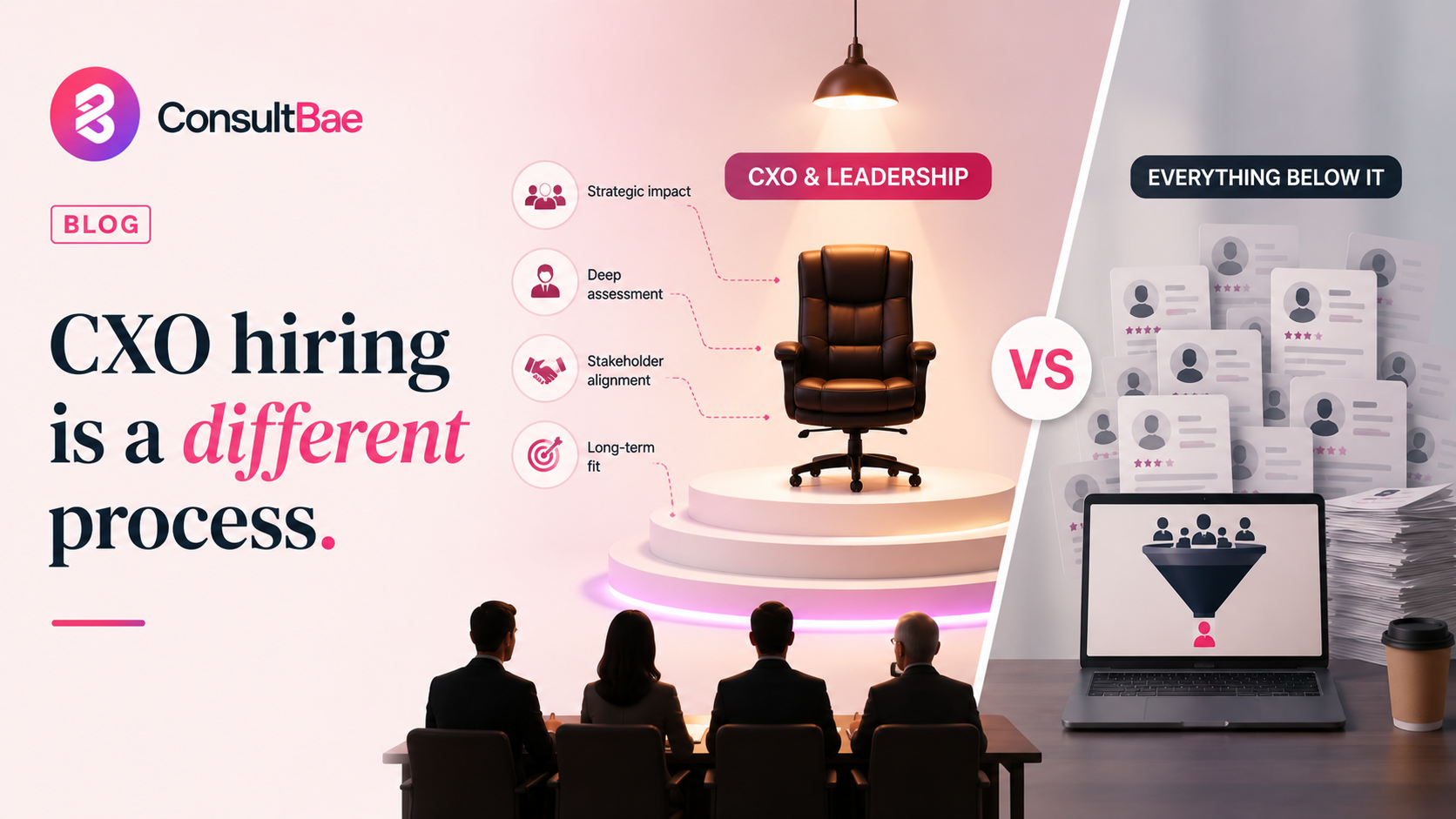
The hiring process most companies use was built for filling roles below the executive level. It works reasonably well there. Job description goes out, candidates apply or are sourced, interviews are conducted, an offer is made. When companies apply that same process to executive hiring, to bringing in a chief executive, a chief technology officer, a chief financial officer, or any role at that tier, it tends to either fail to attract the right people or produce expensive mistakes. The reasons are structural, not a matter of running the standard process better.
Executive hiring is a different kind of problem from everything below it. The candidate pool is smaller, the candidates are mostly not looking, the stakes of a wrong decision are far higher, and the evaluation requires assessing things that standard interviews are not designed to surface. Treating it as a more senior version of regular hiring is the mistake that produces poor executive hires.
Why executive hiring is structurally different
Several things change at the executive level, and they change together in ways that compound.
The candidate pool is small. There are not many people qualified to be the chief technology officer of a company at a particular stage in a particular domain, and the ones who exist are mostly already employed in good roles. The pool of active applicants for an executive role is not the pool you want to hire from, because the strongest candidates are not applying to anything.
The stakes are high. A wrong hire at the manager level is a setback. A wrong hire at the executive level can set a company back by quarters or years, because executives shape strategy, culture, and the teams beneath them. The cost of the mistake is large enough that the process needs to be built around avoiding it, not around efficiency.
The evaluation is different. What makes someone a strong executive is not primarily a set of testable skills. It is judgement, track record, the ability to operate under ambiguity, the capacity to build and lead teams, and alignment with where the company is trying to go. These are not things a standard interview surfaces well, and assessing them requires a different approach.
The strongest executive candidates are not applying to anything. The process that works below the executive level assumes candidates come to you. At the top, you have to go to them.
What changes in sourcing: headhunting, not posting
Because the strongest executive candidates are not active applicants, sourcing for executive roles cannot rely on posting a job and waiting. It requires identifying the specific people who would be right for the role, often a small and definable set, and approaching them directly. This is headhunting in the genuine sense: research to identify the right targets, then a careful, credible approach that gives a satisfied executive a reason to consider a move they were not looking for.
This is a different skill from the high-volume sourcing that works for other roles. It is closer to a targeted, relationship-driven process, where the quality of the approach matters enormously because the candidate has no reason to engage unless the opportunity and the way it is presented genuinely warrant their attention.
What changes in evaluation: track record and judgement over skills testing
Evaluating an executive is about understanding what they have actually done, how they think, and how they operate, not about testing discrete skills. The evaluation leans heavily on a deep examination of track record: not just what roles they held but what they actually accomplished, what decisions they made, how those decisions played out, and what the people who worked with them say about how they operate.
It also requires assessing judgement and fit through extended conversation rather than structured testing. How does this person think about the problems the company is facing. How do they handle ambiguity. How do they approach building a team. Do their values and working style align with where the company is going. These are surfaced through depth of conversation and thorough reference work, not through the kind of evaluation that works for more junior roles.
What changes in the close: relationship, vision, and comp complexity
Closing an executive hire is its own distinct phase. The candidate is usually leaving something good, the decision is significant for them personally and professionally, and the compensation is more complex than at other levels, often involving equity, performance components, and terms that require genuine negotiation.
The close at this level is built on relationship and alignment of vision as much as on the offer itself. An executive joining a company is making a bet on the company's direction and their place in shaping it. The close has to address that, not just the compensation package. This is a different kind of closing conversation from the ones that work at other levels, and it requires the people running it to operate with the candidate as a peer making a major decision, not as an applicant being extended an offer.
Sourcing: Targeted headhunting of passive candidates, not job postings. The right people are not applying.
Evaluation: Deep track record analysis, judgement assessment, and thorough reference work, not skills testing.
The close: Built on relationship and vision alignment, with genuinely complex compensation that requires real negotiation.
Timeline: Longer and more deliberate, because the stakes justify the care and the candidates require it.
How ConsultBae approaches this
We handle CXO and leadership hiring as a distinct service, separate from our mid-to-senior recruitment, because the process genuinely requires a different approach. The sourcing is headhunting rather than the high-throughput model we use for other roles. The evaluation goes deep on track record and fit. The close is managed as the significant, relationship-driven decision it actually is for the candidate.
Applying a standard hiring process to an executive search is one of the more common and more expensive mistakes a company can make. The roles are too consequential and the candidates too different for the regular process to serve them well. Treating executive hiring as its own discipline, with its own approach at every stage, is what produces executive hires that actually work out.
Amitt Agrawaal is the Founder of ConsultBae, a recruitment and AI data services company operating across India, the US, and Europe. He has spent six years building ConsultBae across recruitment, staffing, and AI data.
Hiring at the executive level?
ConsultBae handles CXO and leadership hiring as a distinct service with the approach the tier actually requires. Let us talk.
Talk to us