The first project was straightforward, at least by the standards of what came next. Hundreds of native speakers across five or six Indian languages, each recording one hour of spoken prompts on their phone. The task was simple, the population was accessible, and an existing recruitment database made the sourcing manageable. Within ten days, roughly 250 recording sessions were complete.
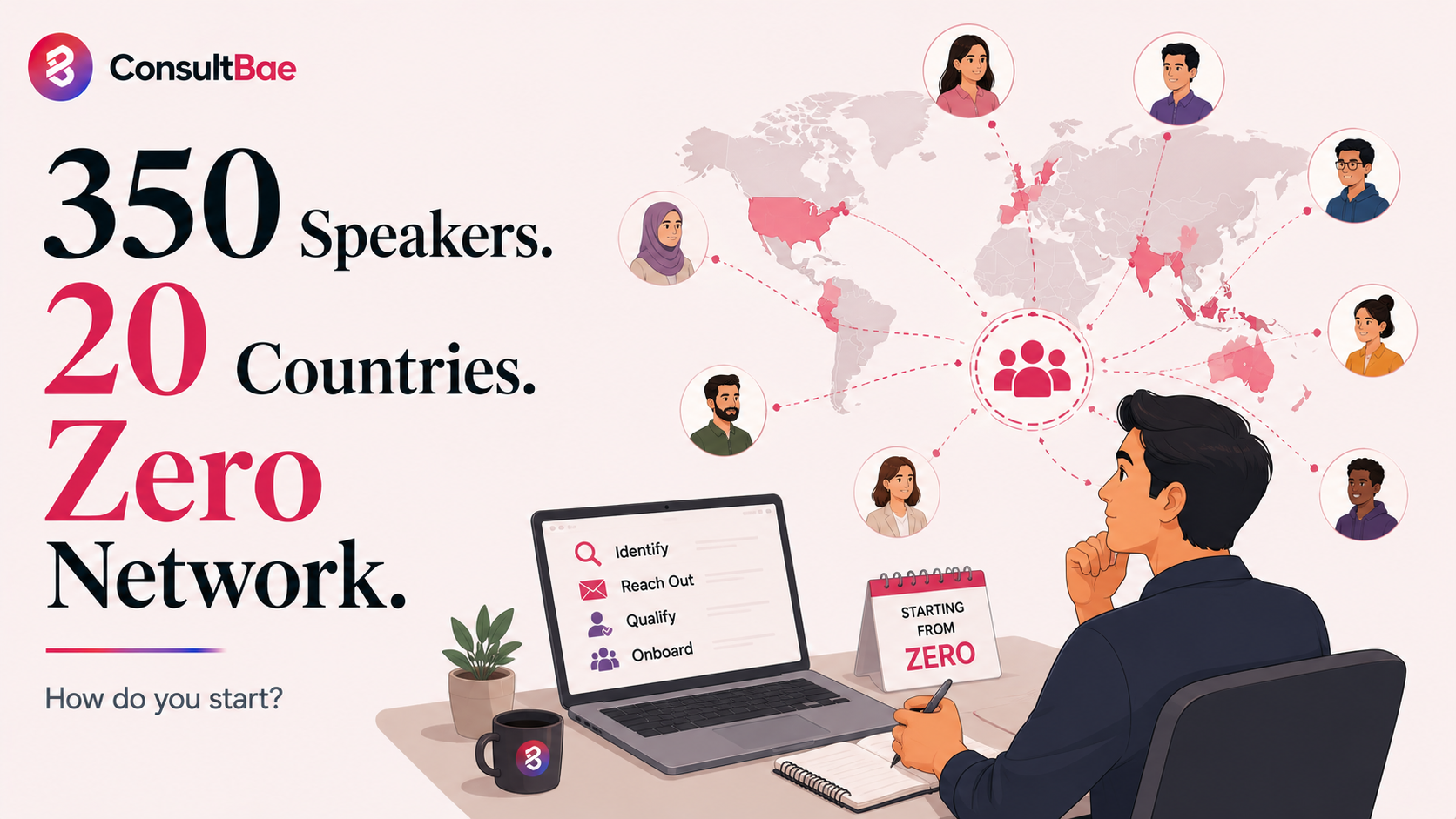
Then the client called again. The same type of project. The same basic brief. Except this time: 350 contributors, spread across 20 countries, including markets in Southeast Asia, Europe, and parts of the world where there was no existing infrastructure, no existing contacts, and no existing playbook.
The question of how you start is not rhetorical. It has a real answer, and the answer is more operational than most people expect.
What the Client Actually Asked For
AI model builders that are training speech-based systems need large volumes of recorded audio in specific languages, accents, and dialects. The reason for this is straightforward: a speech model trained primarily on one demographic group will perform poorly for speakers who don't match that group. Regional accents matter. Age distribution matters. Gender balance matters. The way a person from rural Bavaria pronounces a sentence is meaningfully different from how someone from Munich says the same words, and both are different from how a second-generation German speaker of Turkish heritage says it. A model that cannot handle this variation will fail in the real world, and the failure will be noticed immediately.
This is why data collection projects of this kind are not simply about volume. They are about demographic representation, geographic spread, and linguistic authenticity. Getting 350 speakers across 20 countries is not the same as getting 350 speakers from any 20 countries. The composition has to be intentional, and that means the sourcing has to be intentional.
Why an Existing Recruitment Network Isn't Enough
The instinct, when you receive a brief like this with an existing database of several million candidates, is to search the database first. For a project requiring Indian candidates, this works well. For a project requiring speakers of a specific regional language in Eastern Europe or West Africa, it does not.
A recruitment database is built around employment: professional profiles, career histories, skills that employers pay for. It is not built around linguistic demographics. The fact that someone is in the database does not tell you which languages they speak natively, what their regional accent is, or whether they are willing to participate in a paid data collection task that has nothing to do with their professional work.
What you need for a multilingual data collection project is a different kind of network entirely: one built around communities rather than careers. That means approaching the problem differently from the ground up in each new market.
"We started engaging with professors at universities, with small local organisations, with community groups that could reach the right people. In every country, the first contact was someone who knew the community, not someone in a database."
Universities, Small Organisations, and Local Partners as Contributor Pipelines
In practice, building a contributor pipeline in a new country starts with identifying who already has access to the population you need. For linguistic diversity, this often means linguistics departments at universities, whose faculty work directly with native speaker communities for their own research. It means language schools, particularly those serving immigrant and diaspora communities. It means local non-governmental organisations whose members represent the demographic profile required. It means community radio stations, regional media outlets, and cultural associations that maintain active relationships with the populations in question.
These are not the obvious first calls for a company that came out of recruitment. But they are the right calls for a company that needs to find 350 people with specific linguistic profiles, in specific geographic distributions, within a timeline that doesn't allow for a slow build.
Each of these relationships requires its own investment. A university linguistics professor needs to understand the research value of the project and the ethical standards being applied to data collection. A local community organisation needs assurance that its members will be treated fairly and paid on time. A small regional partner needs a clear brief and a point of contact who speaks their language, sometimes literally. The network is not plug-and-play. It is built conversation by conversation, in each new market, from the beginning.
What Took 10 Days for One Country Took Much Longer in 20
The speed of the original India-based project created an impression that this model could scale quickly anywhere. That impression was corrected in practice. India was fast because the infrastructure existed: a database, an operational team, a set of regional contacts, and years of experience working in the specific talent markets involved. None of that existed in the 20 countries on the new list.
In each new market, the first task is mapping the landscape: who are the relevant intermediaries, what platforms do locals use for paid task work, what payment methods are accessible, what compliance considerations apply to data collection in that jurisdiction, and what communication channels are actually used by the target population. This intelligence-gathering phase takes time, and it cannot be skipped without paying for it later in the form of poor-quality data, high drop-off rates, or contributors who are technically enrolled but practically unreachable.
The 3.5-month project duration reflects the reality of this work. The data collection itself was not the slow part. Building the contributor infrastructure in each new market, verifying the quality of recordings, managing the ongoing relationship with contributors, and ensuring the final dataset met the client's specifications: that was where the time went, and it was time well spent.
Generic contributors are task-oriented participants who can record audio, annotate images, or complete other structured tasks without domain expertise. They are sourced through crowdsourcing platforms and community networks and work well for high-volume, lower-complexity collection.
Language and dialect specialists are native speakers of specific languages or regional variants, often sourced through academic, cultural, or community channels. Their value is authenticity: they produce data that generic contributors from adjacent linguistic communities cannot replicate.
Domain experts are professionals whose subject-matter knowledge is embedded in the data itself, medical practitioners, legal professionals, engineers, whose voice data or annotation carries the implicit structure of their field. This category is the fastest-growing requirement as model builders move from generic to specialised intelligence.
What a Project Like This Teaches About Workforce Resilience
The companies that succeed in large-scale AI data collection are not necessarily the ones with the largest existing networks. They are the ones that have learned how to build new networks quickly, in unfamiliar markets, using approaches that don't require starting from a warm database every time.
This capacity, the ability to stand up a contributor pipeline in a new country within weeks rather than months, is not a technology problem. It is a relationship problem. It requires knowing which organisations to approach, how to approach them, what they need to say yes, and how to maintain the relationship through a project that may run for months with contributors who are doing this work part-time, in parallel with the rest of their lives.
The 20-country project was also an early signal of where the industry was going. The need for linguistic diversity and demographic representation in training data was then an emerging requirement. It is now a standard expectation. The companies that built the infrastructure to deliver it early have a meaningful advantage over those that are only now beginning to understand what it involves.
Building that infrastructure starts with a single honest answer to the question of how you start. Not with a database. With a conversation, in each new market, with whoever already has access to the people you need.
Scaling a Data Collection Project Across Borders?
ConsultBae operates contributor networks in 100+ countries across all four data modalities: voice, image, video, and text. We handle sourcing, collection, annotation, and quality validation end to end.
Talk to Our AI Data Team