
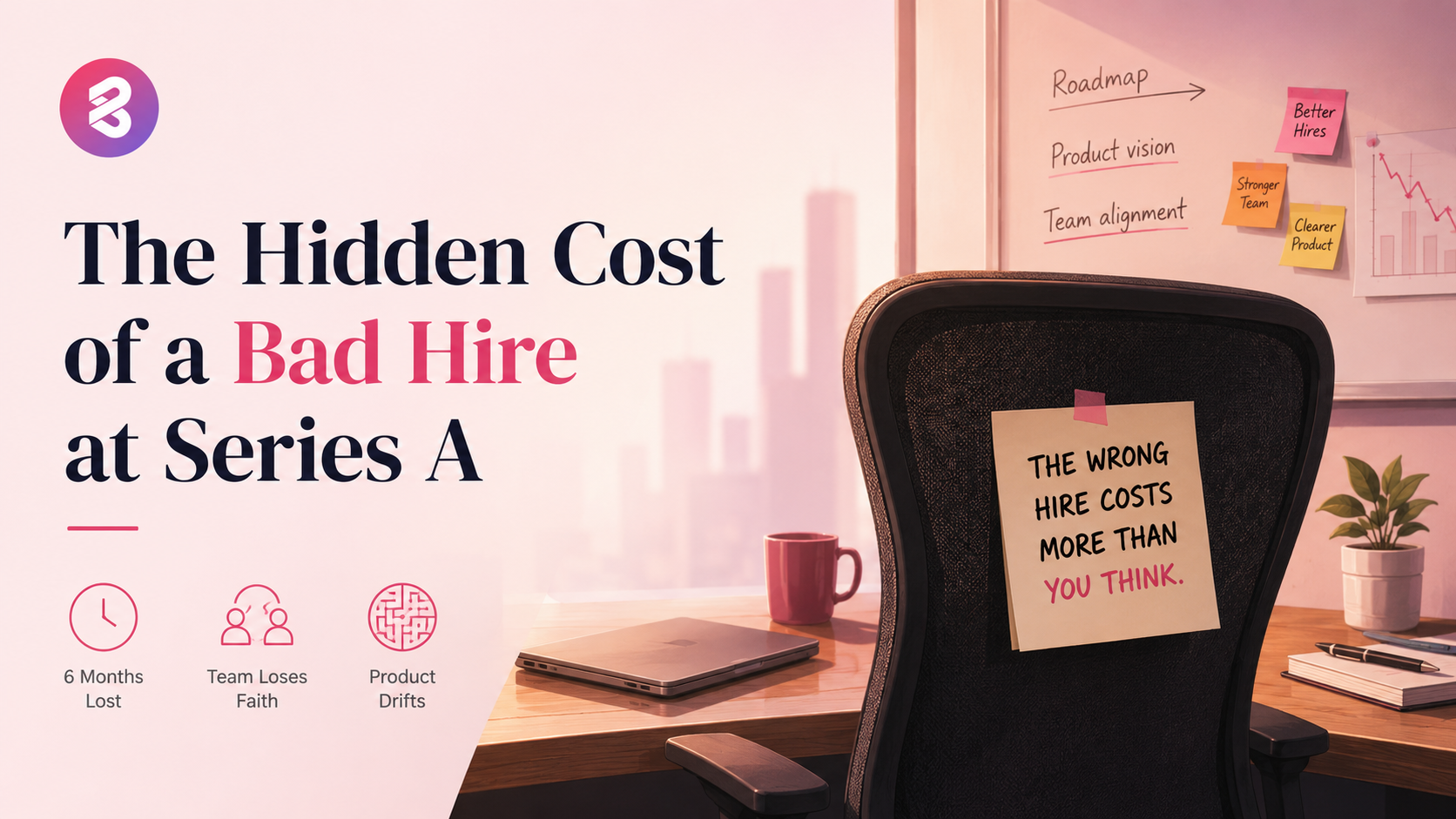
A Series A startup hired a VP of Product. Strong resume. Good interviews. The founder felt confident. Within three months, the roadmap had shifted twice. Engineers were building features nobody had asked for. The sales team was pitching a product that did not match what was being built. And the VP, by most visible measures, was still performing fine.
By the time the founder made the call to let them go, six months had passed. The salary cost was real but manageable. What was not manageable was the six months of organizational drift that came with it. Features that had to be unwound. Trust that had to be rebuilt. A board conversation that was harder than it needed to be.
This is the cost that does not show up in any bad hire calculation. And at Series A, it is the cost that actually matters.
At Series A, you are not just hiring for a role. You are hiring for a direction. The wrong person in a senior seat does not just underperform. They pull the company toward a version of itself that was never the plan.
Series A is the highest-stakes hiring window
Pre-seed and seed hires matter, but the team is small enough that misalignment surfaces quickly and corrections are cheap. Post-Series B, the org is large enough to absorb a bad hire at most levels without catastrophic damage. Series A is the window where neither of those things is true.
At Series A, you are typically 15 to 40 people. Every senior hire owns a meaningful slice of the company's direction. A head of engineering who prioritizes the wrong technical bets slows the entire product. A head of sales who misreads the ICP wastes runway on the wrong customers. A head of people who hires for culture fit over capability builds a team that feels good and executes poorly.
The other thing that makes Series A hiring uniquely dangerous is speed pressure. You have just raised a round. Investors want to see the team built out. There is real pressure to fill seats quickly, and that pressure is exactly when hiring mistakes happen.
The 4 ways a bad Series A hire actually costs you
1. Roadmap drift. A misaligned senior hire does not usually blow up the roadmap in one meeting. It happens gradually. Their priorities subtly reshape what gets built. Decisions accumulate. Three months in, the product is solving a slightly different problem than it was supposed to, and nobody can point to the moment it changed.
2. Downstream hiring damage. Senior hires at Series A recruit the layer below them. A VP who is wrong for the company builds a team in their image. When you eventually part ways with the VP, you often inherit a team that does not fit either. One bad hire can generate three to five downstream hiring problems.
3. Founder time tax. A misaligned hire rarely fails cleanly. They generate management overhead, miscommunications, and decisions that need to be revisited. At a stage where founder time is the scarcest resource in the company, the cost of managing a struggling senior hire is disproportionately high.
4. Team confidence erosion. Early employees at a Series A startup are watching how leadership decisions get made. When a senior hire visibly struggles or gets let go after six months, it raises questions that nobody asks out loud. Is the founder making good decisions? Is this company going somewhere? That erosion is quiet, hard to measure, and genuinely damaging to the retention of people you cannot afford to lose.
The commonly cited cost of a bad hire is one to three times annual salary. That figure covers recruiting costs, onboarding time, and productivity loss during the vacancy and ramp period.
It does not cover roadmap corrections, downstream hiring mistakes, founder time, or team confidence. At a Series A startup, those uncounted costs are typically larger than the counted ones. The salary figure is what makes CFOs wince. The organizational cost is what actually sets companies back.
HR leaders at Series A are actually responsible for
The framing that HR exists to fill roles is a pre-Series A framing. At Series A, the HR leader is one of the most strategically important people in the company because they are the person most responsible for whether the right people are in the right seats before the org gets too large to course-correct cheaply.
That means the job is not just sourcing candidates and running interviews. It is designing a hiring process that surfaces alignment, not just competence. It is building structured evaluation frameworks that reduce the influence of interview performance and increase the signal on how someone actually thinks and decides. It is knowing when to slow down a hire that feels right but has not been tested well enough, even when there is pressure from the top to move fast.
Most Series A startups do not have that capability built yet. The HR function is either a single generalist, a founder doing it alongside everything else, or an outsourced recruiter who is incentivized to close positions rather than interrogate fit. None of those setups reliably catch misalignment before it becomes expensive.
What better Series A hiring actually looks like
The companies that navigate Series A hiring well tend to share a few specific practices that most startups skip because they slow the process down in the short term.
They define what alignment means before they start interviewing, not after. Not just skills and experience, but how the person makes decisions, what they optimize for when resources are constrained, and what they think the company should be in two years. Those answers need to be stress-tested against the founder's actual answers, not just assumed to match because the candidate interviewed well.
They run structured work samples rather than relying on interviews alone. A candidate who performs brilliantly in a one-hour conversation and struggles with a real problem in the actual context of your company is telling you something important. Most hiring processes are not designed to surface that information before an offer is made.
They check references with real questions. Not "would you work with this person again" but "describe a time they disagreed with a decision from above them and what they did about it." The difference between those questions is the difference between a reference call that confirms your existing view and one that genuinely updates it.
Speed and quality in hiring are not always in conflict. But when they are, Series A is the stage where choosing speed is most likely to cost you something you cannot easily buy back.
Where ConsultBae fits
ConsultBae works with startups and growth-stage companies on talent strategy and hiring execution. For Series A companies specifically, that means helping HR leaders build the processes, frameworks, and candidate pipelines that reduce the risk of the kind of misalignment that is expensive to fix later.
The work is practical. It is not about adding more interviews or slowing hiring down arbitrarily. It is about making the process more signal-rich so that the decisions you make quickly are also decisions you are confident in. At a stage where every senior hire shapes the company's next twelve months, that confidence is worth investing in.
If your team is heading into a Series A hiring push and the process feels less structured than the stakes deserve, that instinct is probably right.
Building your Series A team and want to get it right?
Talk to ConsultBae about hiring strategy, candidate pipelines, and process design for growth-stage startups.
Get in touch