- What can go wrong when agreements are vague
- The bilateral agreement structure: mirroring obligations across the chain
- What needs to be in writing before a subject matter expert starts work
- How scope changes mid-project get handled without losing momentum
- What documentation does for trust, not just risk
The conversations in e-learning that tend to go wrong in ways that are hard to recover from rarely begin with a disagreement about content quality. They begin with a misalignment that was present from the start of the engagement but was never documented clearly enough to catch before it became a problem. A subject matter expert who understood the timeline differently from the platform. A deliverable that the platform considered standard but the expert had never agreed to. A usage rights question that nobody thought to raise until the course was already being edited for launch.
These are not exotic edge cases. They are the normal failure modes of a production process that involves multiple parties, moving timelines, and deliverables that are inherently difficult to define until the work is already in progress. The platforms and capacity partners who run the smoothest engagements are not necessarily the ones with the best content or the most talented contributors. They are the ones who build clear agreements before work begins and maintain them honestly when things shift.
The agreement infrastructure of an e-learning project is unglamorous. It is also the thing that determines whether a 247-course project finishes on time or collapses into a dispute about what was actually promised.
What Can Go Wrong When Agreements Are Vague
Vague agreements in e-learning production fail in predictable ways, and they almost always fail at the point where someone's expectation collides with someone else's assumption.
A subject matter expert is engaged without a written timeline. The platform assumes the first draft will arrive in ten days. The expert, who has a full-time job and agreed to contribute in their spare time, assumed they had three weeks. Neither party stated their expectation explicitly. Ten days pass. The platform chases. The expert feels pressured and defensive. The platform feels let down. The relationship is damaged before a single piece of content has been reviewed.
A voiceover artist records several hours of narration. The platform edits and launches the course. Six months later the platform wants to update the course content and re-record sections. The original agreement said nothing about revisions or re-recording rates. Now there is a negotiation that nobody budgeted for, over terms that nobody thought to establish when they had leverage and goodwill on both sides.
In each case, the failure is not malicious. Nobody acted in bad faith. The problem is that the agreement did not do the job of making expectations explicit, and explicit expectations are the only kind that can actually be managed.
The Bilateral Agreement Structure: Mirroring Obligations Across the Chain
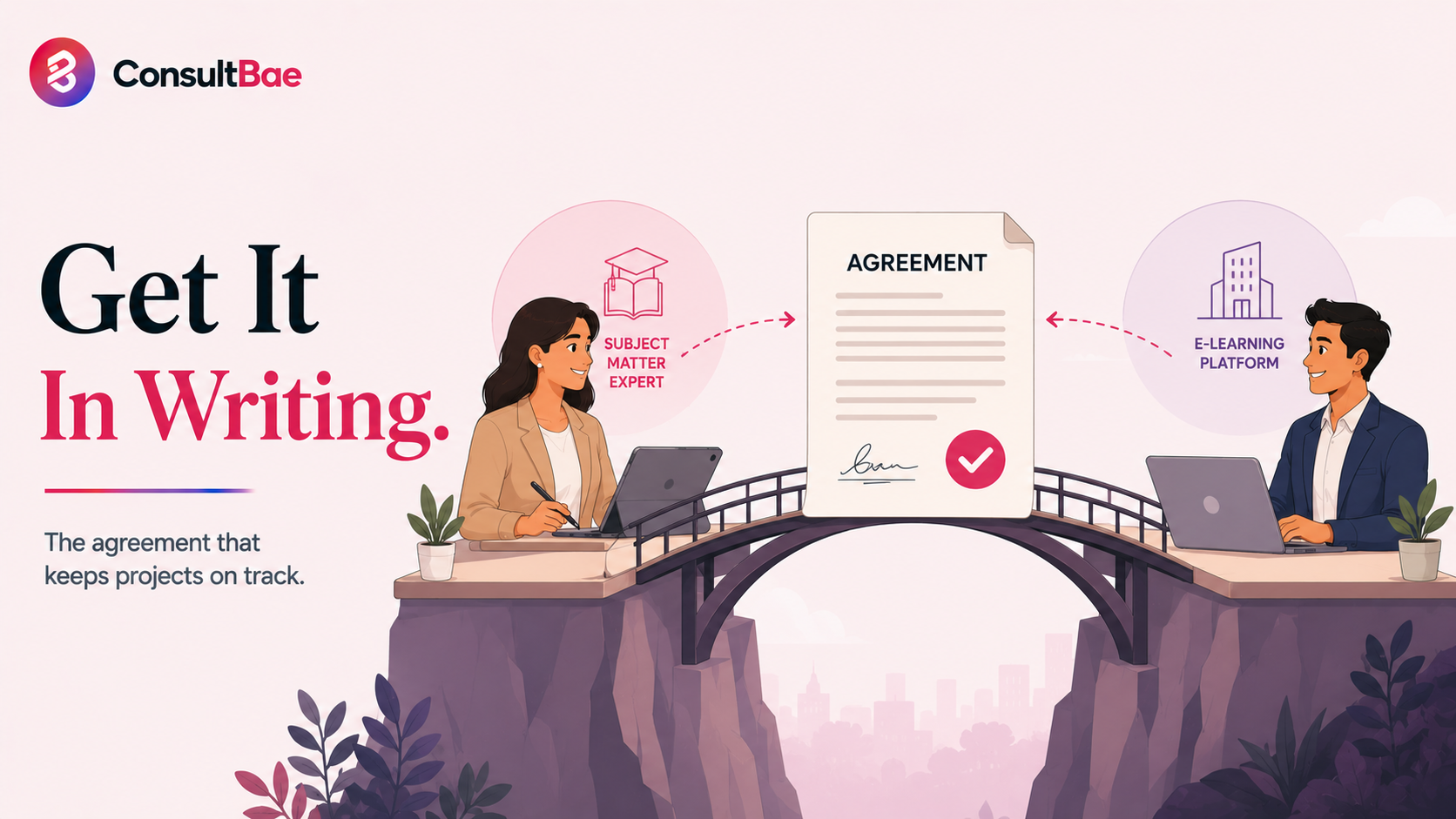
In an e-learning production engagement, there are typically at least three parties: the platform that owns the course and sets the quality standards, the capacity partner that sources and manages the contributors, and the contributors themselves. The platform holds the capacity partner accountable for delivery. But if the capacity partner does not hold the contributors to equivalent standards through a parallel agreement, the accountability chain has a gap precisely where most of the risk sits.
The bilateral agreement structure addresses this directly. The agreement between the platform and the capacity partner establishes what will be delivered, by when, to what standard, and with what consequences for shortfall. The agreement between the capacity partner and each contributor mirrors the relevant terms: the same deliverable definition, the same timeline, equivalent quality standards, and equivalent payment terms that create a direct incentive for the contributor to meet the brief.
This mirroring is not bureaucratic formality. It is the mechanism by which the platform's expectations become the contributor's working reality, rather than remaining aspirations at the vendor level that never fully translate to the people actually doing the work. When a subject matter expert signs an agreement that specifies exactly what they are providing, when they are providing it, how it will be reviewed, and what they will be paid upon completion, the ambiguity that causes most mid-project problems has been removed at source.
"We have an agreement with the client. We make a similarly structured separate agreement with the subject matter experts. That way, whatever the client holds us to, we hold the contributor to. The chain of accountability has to run all the way through."
What Needs to Be in Writing Before a Subject Matter Expert Starts Work
The minimum viable agreement with a freelance subject matter expert for an e-learning project covers more ground than most platforms realise when they are moving quickly to fill a gap in a production timeline. The rush to get someone started is one of the most reliable predictors of a documentation shortfall, because the urgency creates pressure to begin work before the paperwork is complete.
What the agreement needs to establish, before a single deliverable is produced, is the scope in concrete terms: not "review the course content" but the specific number of modules, the expected format of feedback, and the estimated time commitment. It needs the timeline with specific dates, not approximate windows. It needs the payment structure, including the rate, the payment trigger, and the invoicing process, because contributors whose payment process is unclear become unreliable contributors. It needs the usage rights, covering how the deliverable will be used, whether the contributor's name and likeness will appear on the finished course, and whether the capacity partner has the right to make editorial changes to the recorded content. And it needs the revision policy: what counts as a deliverable that meets the brief, how many revision rounds are included, and what the process is for disputing a quality decision.
None of this is complicated. All of it, when left unaddressed, produces the kinds of conversations that stall projects and damage relationships.
How Scope Changes Mid-Project Get Handled Without Losing Momentum
Scope changes in e-learning production are not exceptional. They are a regular feature of working with clients who are building courses at volume and whose requirements evolve as the production process reveals things the initial brief did not anticipate. A platform that requests a ten-minute tool demonstration may realise mid-review that the demonstration needs to be seven minutes to fit the course structure. A course that was planned in English may get approved for a Spanish-language version after the original recording has already been completed.
The way scope changes get handled without losing momentum depends on whether the original agreement was specific enough to make the change legible. If the agreement simply says "provide a tool demonstration," there is no baseline against which to measure the change, no clear basis for renegotiating the rate, and no mechanism for updating the contributor's expectations without reopening the entire relationship from scratch. If the agreement says "provide one tool demonstration of seven to ten minutes in length, recorded in English, with voiceover narration," then a change to Spanish is clearly a new deliverable with a new rate, and both parties have a shared reference point for the conversation.
Specificity in the original agreement is what makes scope change conversations efficient rather than contentious. It creates the shared language that both sides need to identify what has changed, agree on what the change is worth, and update the working arrangement without the friction that comes from arguing about what was originally intended.
What Documentation Does for Trust, Not Just Risk
The intuition that drives most resistance to thorough documentation in creative and freelance production is that it signals distrust. It feels legalistic. It seems to imply that the person you are asking to sign the agreement might not behave well, which creates an awkward relational dynamic before any work has begun.
This intuition gets it backwards. A clear agreement does not signal distrust. It signals professionalism. It tells the contributor that the capacity partner takes the engagement seriously enough to define it precisely. It tells the platform that the capacity partner has thought carefully enough about the delivery process to document every material aspect of it. It gives everyone involved a shared reference point that reduces the cognitive load of the relationship because the important questions have already been answered in writing.
Scope in concrete terms: the specific deliverable, the format, the estimated time commitment, and the quality standard against which it will be reviewed.
Timeline with specific dates: submission deadlines, review turnaround windows, and revision round timelines.
Payment structure: rate, payment trigger, invoicing process, and timeline for payment after invoice submission.
Usage rights: how the deliverable will be used, whether the contributor will receive credit, and whether the capacity partner may make editorial changes to recorded content.
Revision policy: how many revision rounds are included in the original rate, what constitutes a pass or a fail on quality review, and what the dispute process looks like.
The e-learning projects that run smoothly, that deliver on time and stay within budget and leave contributors willing to come back for the next one, are not the ones where everyone happened to be compatible and professional. They are the ones where the agreement did the work of aligning expectations early, so that the human relationships involved in the production could focus on the content rather than on managing ambiguity.
Building an E-Learning Production Partnership?
ConsultBae manages the full contributor engagement cycle for e-learning platforms, from sourcing and vetting through agreements, onboarding, delivery management, and payment. We handle the infrastructure so your production team can focus on the course.
Talk to Our E-Learning Team